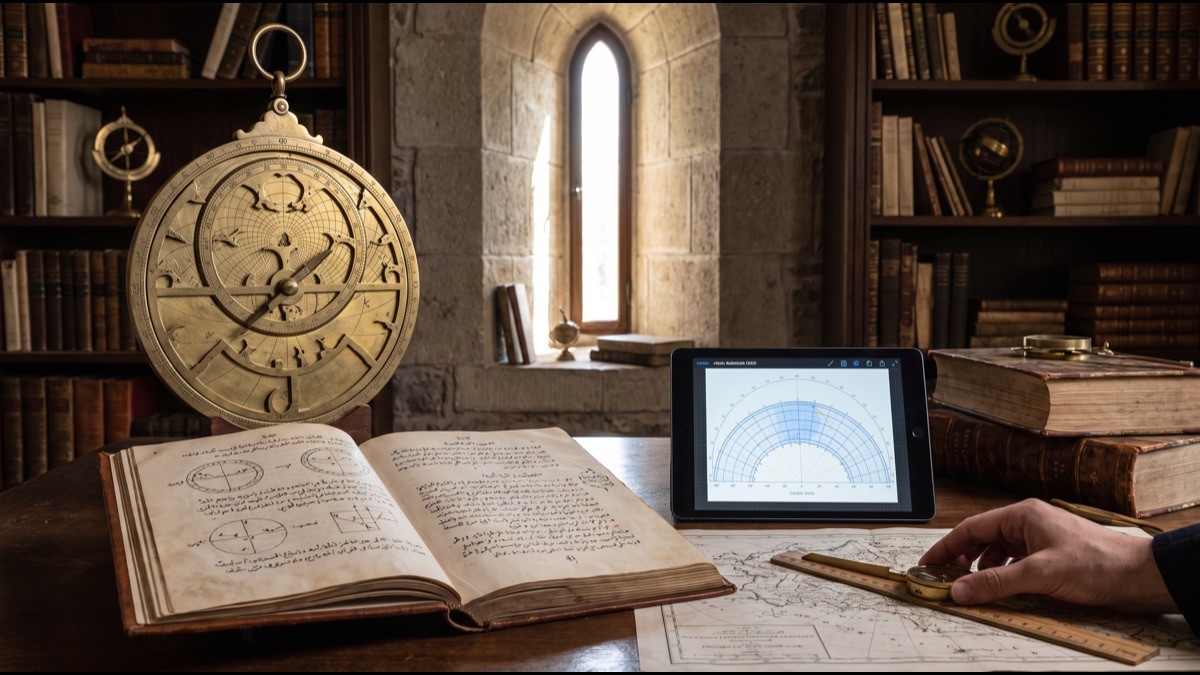
Why Maghrib Time Trends Every Evening
Prayer times are one of the most-searched pieces of information in the Muslim world, and Maghrib tops the list: every evening, millions of people look up the exact minute of sunset — for the daily prayer, and in Ramadan for iftar. The number on that timetable feels precise and almost bureaucratic, yet it is pure astronomy. Every prayer time on your phone is calculated from the position of the sun relative to your exact location on Earth.
The reassuring part is that the underlying science is settled and well documented. The variation you see between apps, cities, and countries comes from something simpler than disagreement: different scholarly conventions for defining "dawn" and "nightfall" in degrees, plus ordinary geography. This guide explains how each prayer maps to the sun, what the famous calculation methods (Muslim World League, Umm al-Qura, ISNA, and others) actually specify, and why your city and your neighbour's city can legitimately differ by a few minutes. For the timetable you pray by, follow your local religious authority — in the UAE, that is the General Authority of Islamic Affairs and Endowments (Awqaf).
How the Sun Defines Each Prayer
Each of the five daily prayers is anchored to a solar event. The formula behind every timetable starts from your latitude and longitude and the date, applies the Earth's tilt and orbit (through quantities astronomers call solar declination and the equation of time), and outputs the moment each solar condition is met.
Fajr begins at true dawn: the first appearance of horizontal light on the eastern horizon, when the sun is still a defined number of degrees below it. Sunrise follows when the sun's upper edge breaks the horizon — it is not a prayer time itself, but it closes Fajr's window, which is why timetables list it. Dhuhr begins just after the sun crosses the local meridian, its highest point of the day (the moment called zawal; prayer is deferred a few minutes past it).
Asr is the one prayer defined by shadows rather than horizon angles. In the Shafi'i, Maliki, and Hanbali schools it begins when an object's shadow equals its height plus the shadow it already had at noon; the Hanafi school waits until the shadow reaches twice the object's height. That single difference is why Asr can be 30–75 minutes later on a Hanafi timetable. Maghrib arrives at sunset, when the sun's disk drops fully below the horizon. Isha begins when evening twilight fades — again defined as the sun being a set number of degrees below the horizon — or, in some methods, as a fixed interval after Maghrib.
The Main Calculation Methods
Because "dawn" and "nightfall" are gradual, scholarly bodies standardized them as twilight angles — how far the sun sits below the horizon. The major conventions:
| Method | Fajr | Isha | Common in |
|---|---|---|---|
| Muslim World League (MWL) | 18° | 17° | Europe, Far East, parts of the Americas |
| ISNA (North America) | 15° | 15° | USA, Canada |
| Egyptian General Authority | 19.5° | 17.5° | Egypt and parts of Africa and the Levant |
| Umm al-Qura (Makkah) | 18.5° | 90 min after Maghrib (120 in Ramadan) | Saudi Arabia |
| Univ. of Islamic Sciences, Karachi | 18° | 18° | Pakistan, India, Bangladesh |
| Gulf Region | 19.5° | 90 min after Maghrib | Gulf states |
| Dubai (UAE-based research) | 18.2° | 18.2° | Close to UAE official timings |
The pattern to notice: a larger angle means the sun is further below the horizon, so Fajr comes earlier and Isha comes later. Moving from ISNA's 15° to the Egyptian 19.5° can shift Fajr by 20–30 minutes. Umm al-Qura is the outlier that skips an Isha angle entirely and simply fixes the wait after Maghrib — 90 minutes most of the year, 120 minutes during Ramadan.
Even after choosing a method, official timetables are tuned locally. Religious authorities may add a minute here or there for safety margins or observation checks, which is why a generic calculator and your mosque's printed timetable can differ by one to five minutes while both being "correct" under the same convention. In the UAE, Awqaf publishes the authoritative national timetable.
Why Times Differ Between Cities and Apps
Geography does most of the work. Solar noon moves roughly four minutes for every degree of longitude, so Dhuhr in Abu Dhabi is noticeably later than in Fujairah on the same day. Latitude changes how long twilight lasts: nearer the equator, dawn and dusk are brisk; far from it, twilight stretches, which is why Fajr and Isha gaps between methods matter far more in London than in Dubai.
Time zones add a human layer: they pin the clock to a standard meridian, so two cities at similar longitudes but different time zones can share the same solar geometry yet show different clock times. Apps then add their own choices — which method, which madhhab for Asr, and whether to apply local authority adjustments — which is why two apps sitting side by side can disagree by several minutes.
Extreme latitudes get special rules. In summer far north or south, the sun may never dip far enough below the horizon for true twilight to end, making angle-based Fajr and Isha impossible to compute. Timetables then fall back on documented conventions: Middle of the Night (splitting the period from sunset to sunrise in half), One-Seventh of the Night (Isha after the first seventh, Fajr at the start of the last), or the Angle-Based method (assigning the same fraction of the night that the twilight angle implies). Most worshippers in such places follow the ruling of their local council.
The practical takeaway: pick the method your country's religious authority uses, keep it consistent, and treat differences of a few minutes between apps as convention, not error. If you are curious how Islam organizes time on a larger scale, our guides to the Hijri calendar and the five pillars of Islam are good next reads, and our Ramadan health guide covers the practical side of fasting days that these timetables frame.
Sources
- AlAdhan — Prayer Time Calculation Methods — Explains the recognized methods, their angles and regions, and how official timings are tuned.
- PrayTimes — Calculation Documentation — The published formulas for solar positions and the high-latitude adjustment rules.
- AlAdhan API — Methods List — Machine-readable parameters (Fajr and Isha angles or intervals) for every supported method.
- UAE General Authority of Islamic Affairs and Endowments — Prayer Times — The UAE's official prayer timetable service.
Frequently Asked Questions
Why does Fajr time differ between two prayer apps?
Apps use different calculation methods with different twilight angles — from 15 to 19.5 degrees — which can shift Fajr or Isha by 10 to 30 minutes. Set your app to the method your local religious authority follows.
What angle does the Muslim World League method use?
The Muslim World League method places Fajr when the sun is 18 degrees below the horizon and Isha when it is 17 degrees below the horizon.
Why is Isha 90 minutes after Maghrib in Saudi Arabia?
The Umm al-Qura method used in Saudi Arabia fixes Isha at 90 minutes after Maghrib — 120 minutes in Ramadan — instead of using a twilight angle.
How is Asr time calculated?
Asr begins when an object's shadow reaches a set ratio of its height: one times the height (plus the noon shadow) in the Shafi'i, Maliki, and Hanbali schools, and two times in the Hanafi school.
How are prayer times calculated in high-latitude cities?
Where twilight lasts all night in summer, calculators apply special rules such as dividing the night in half, taking one-seventh of the night, or using a fraction of the night based on the twilight angle.
About the Author
The doyouknow.app Editorial Team writes accessible explainers on Islamic knowledge and culture, built on documented methodology and official sources — verified against the references listed above before publication.
Loved This Article?
Share it on WhatsApp → Share on WhatsApp
Get more explainers in your inbox — Subscribe to our newsletter.