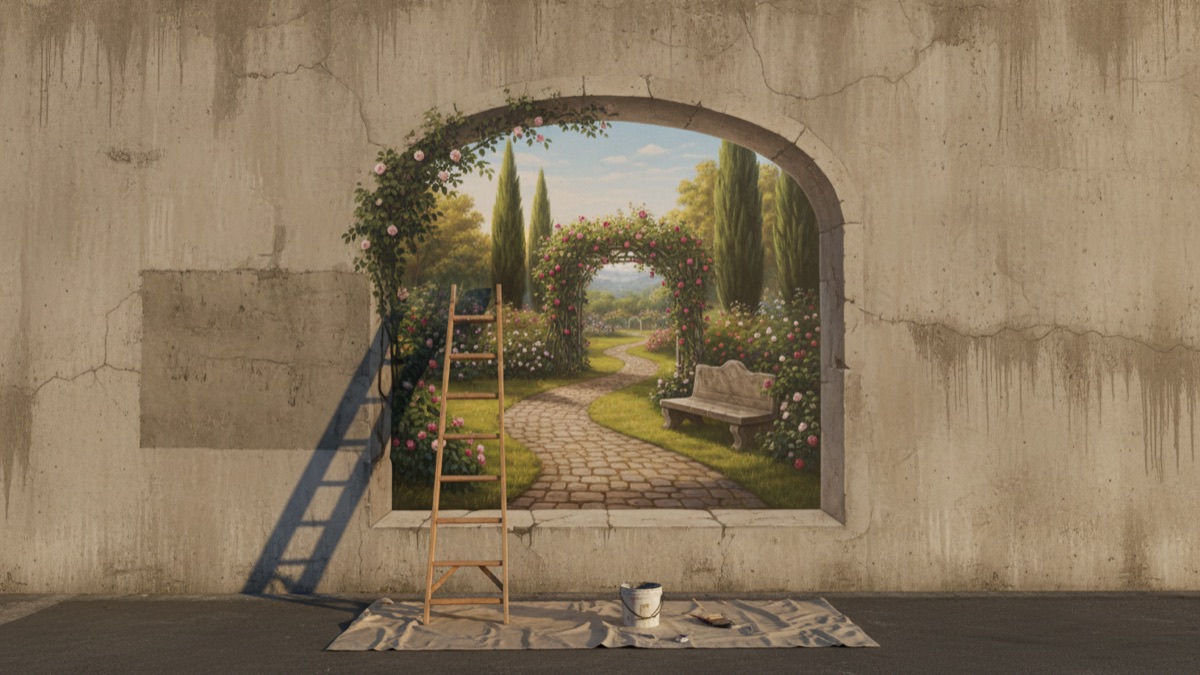
Trompe l'oeil, French for 'deceive the eye,' is a painting technique that uses extremely realistic detail, shading, and perspective to make a flat, two-dimensional surface appear three-dimensional to the viewer.
The technique relies on precise control of light, shadow, and vanishing points so that painted objects, like a doorway, a bookshelf, or a window, appear to physically exist rather than being painted onto a wall or canvas.
French for 'Deceive the Eye'
From Ancient Frescoes to Modern Street Art
Ancient Greek and Roman artists were already experimenting with illusionistic painting, and later European artists refined trompe l'oeil during the Renaissance and Baroque periods, often using it in ceiling frescoes to make rooms appear to open onto the sky.
The technique remains popular today in murals and street art, where artists paint scenes like fake cracks, sinkholes, or extending staircases onto flat pavement or walls to create photo-friendly optical illusions.
Sources
- Wikipedia — overview of trompe l'oeil technique and history
- The Metropolitan Museum of Art — background on illusionistic painting in art history
- Encyclopaedia Britannica — definition and historical development of trompe l'oeil
FAQ
What does 'trompe l'oeil' mean?
It's French for 'deceive the eye,' referring to the technique's goal of tricking viewers into perceiving a flat painted surface as three-dimensional.
When was trompe l'oeil first used?
Illusionistic painting techniques date back to ancient Greek and Roman art, though the technique was significantly refined during the European Renaissance and Baroque periods.
Is trompe l'oeil still used in modern art?
Yes — it's commonly seen in contemporary murals and street art, where artists create realistic illusions like fake holes or extending pathways on flat surfaces.
About the Author
We reference Wikipedia, The Metropolitan Museum of Art, and Encyclopaedia Britannica to explain the background and current understanding of this topic.
Loved This Article?
Share it on WhatsApp → Share it on WhatsApp
Get more guides in your inbox — Subscribe to our newsletter for weekly surprising stories from Egypt, Saudi Arabia, Dubai, and beyond.