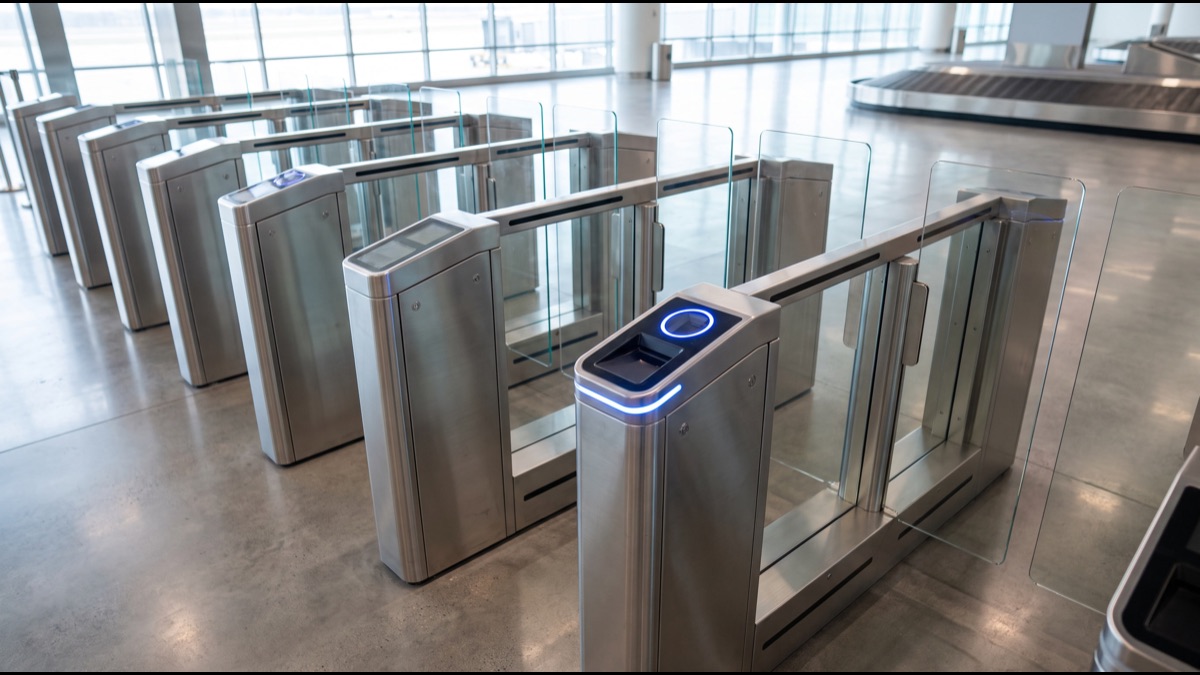
A trip through immigration that once took twenty minutes of queuing can now take under fifteen seconds at a growing number of major airports, including several of the busiest hubs in the Gulf. That speed is not a shortcut around border security; it is a tightly sequenced automated process doing, in seconds, several checks a human officer would otherwise perform more slowly by hand.
Automated border control gates, universally called e-gates, look deceptively simple: a booth, a passport reader, a camera, and two sliding doors. Behind that simplicity sits a chain of cryptographic verification, biometric comparison, and real-time database checks that together decide, almost instantly, whether the document and the face in front of the camera genuinely belong to the same person and whether that person is clear to enter.
Understanding what actually happens inside that brief pause at the gate explains both why e-gates have spread so quickly across major international airports and why, even with all this automation, a meaningful share of travelers still get quietly redirected to a human officer instead.
From a Long Queue to a Few Seconds
Traditional immigration processing relies on a human officer visually comparing a traveler's face to their passport photo, manually checking the document's security features, and querying watchlist databases by hand, a process that is thorough but inherently slow once dozens of flights land within the same hour at a major hub.
E-gates were introduced specifically to handle the predictable, lower-risk majority of that traffic, travelers holding a valid biometric passport whose documents and faces present no immediate red flags, freeing human officers to focus their attention on the harder cases, irregular documents, unclear matches, and travelers flagged by security systems.
What Is Actually Stored on a Passport Chip
Modern biometric passports contain a small embedded chip, readable by a short-range wireless signal, that stores a digital copy of the passport's printed information along with a stored facial image and, in many countries, additional biometric data such as fingerprints, all digitally signed by the issuing government to prove the data has not been altered since the passport was produced.
This chip is what an e-gate actually reads first, rather than optically scanning the printed page the way older systems did, since the digital data on the chip is both richer and far harder to forge convincingly than a printed photo and printed text alone, especially once the accompanying digital signature is checked.
How the Gate Confirms the Chip Is Genuine
Before trusting anything read from the chip, the e-gate verifies the digital signature attached to that data against a certificate belonging to the passport's issuing country, part of an international public key infrastructure that participating governments maintain specifically so that other countries' border systems can confirm a passport chip's contents have not been tampered with.
If that cryptographic check fails, whether because the chip has been damaged, cloned, or was never signed by a legitimate authority in the first place, the gate will refuse to proceed with the biometric comparison at all and instead route the traveler directly to a staffed counter, since a compromised chip removes the entire basis the automated process relies on.
The Live Face Scan and What It Is Comparing
Once the chip data is confirmed genuine, a camera inside the gate captures a fresh, live image of the traveler standing at the booth and runs a facial recognition algorithm that compares specific measured facial geometry, relative distances between features rather than a simple pixel-by-pixel photo overlay, against the facial image stored on the passport chip.
This comparison produces a similarity score, and the gate opens only if that score clears a threshold set by the relevant border authority, a threshold calibrated to balance letting genuine travelers through quickly against the risk of accepting someone using a stolen or borrowed passport that happens to show superficial resemblance.
Why Lighting and Posture Still Trip Up the Camera
Despite steady algorithmic improvements, facial recognition accuracy still degrades under poor lighting, unusual head angles, glasses reflecting glare, or facial coverings, which is why e-gate booths are deliberately designed with controlled overhead lighting and clear instructions to remove hats, sunglasses, and face coverings before the scan begins.
Frequent travelers quickly learn the small habits that make the process smoother, standing directly centered in front of the camera at the marked position, looking straight ahead rather than down at a phone, and waiting for the visual prompt before stepping forward, all of which noticeably reduce the odds of a failed match on the first attempt.
What Happens in the Milliseconds Behind the Green Light
Between the chip read and the doors opening, the system is simultaneously running several checks in parallel rather than in a single slow sequence: validating the chip's digital signature, running the facial comparison, and querying border and security watchlist databases, all coordinated so the entire process typically completes within a few seconds even though multiple independent systems are involved.
This parallel processing architecture is precisely why e-gates can clear a steady stream of travelers so quickly during peak arrival periods, since the system does not wait for one check to finish before starting the next, but instead treats the chip verification, facial match, and database query as three largely independent processes that only need to be reconciled at the very end before the gate opens or holds.
The Watchlist Checks Nobody Sees
Behind the visible chip read and face scan, the traveler's passport number and biographic details are checked in real time against national and international watchlists covering security concerns, outstanding legal matters, immigration violations, and in some countries, health or customs flags, a process that happens automatically and invisibly regardless of whether anything is actually found.
A watchlist match does not necessarily mean anything serious, since names and dates of birth can coincidentally overlap with an unrelated record, but any match at all is enough to have the system automatically hold the gate closed and route the traveler to a human officer for manual review rather than making an automated pass-or-fail determination on a security matter.
Why Some Travelers Are Sent to a Human Officer Anyway
A meaningful share of travelers who attempt an e-gate never actually get through it, not because anything is wrong with their documents, but because of routine failure conditions built deliberately conservative: a facial match score just below threshold, a chip read error caused by a worn or damaged passport, or simply standing slightly off-center during the scan.
Border authorities generally accept this trade-off deliberately, since a system tuned to reject borderline cases toward human review, rather than approving them automatically, keeps the overall error rate for wrongly admitting someone extremely low, treating the occasional inconvenienced genuine traveler as a far more acceptable outcome than a security gap in the automated layer.
How E-Gates Handle Children and Older Passports
Most e-gate systems set a minimum age requirement, commonly somewhere between seven and twelve years old depending on the country, both because facial recognition accuracy is measurably less reliable on rapidly changing young faces and because young children generally still need to be processed alongside an accompanying adult rather than independently.
Older passports issued before biometric chips became standard, or passports whose chip has been physically damaged, simply cannot be read by an e-gate at all, so travelers holding them are directed to a traditional staffed counter automatically, which is part of why national governments have pushed hard in recent years to encourage citizens to renew to current biometric passport formats well before expiry.
Why the Gulf Adopted E-Gates So Aggressively
The UAE and Saudi Arabia in particular have invested heavily in e-gate infrastructure at their major airports, driven by extraordinarily high passenger transit volumes at hubs like Dubai and Abu Dhabi, where a large share of arriving travelers are transit or short-stay visitors whose documents and travel patterns fit cleanly into the categories e-gates handle best.
UAE residency and Emirates ID holders in particular benefit from expanded biometric enrollment programs that let them clear immigration through the same automated infrastructure repeatedly with very high reliability, part of a broader regional push to keep processing times low even as passenger numbers at Gulf airports have grown substantially faster than at many comparable global hubs.
What Data Actually Gets Kept After You Walk Through
Border authorities generally retain a record of the crossing itself, the passport number, timestamp, and gate result, as part of standard immigration recordkeeping required for any entry or exit regardless of whether it happened through an e-gate or a staffed counter, since that record is what actually constitutes the official immigration history tied to the traveler's document.
The live facial image captured at the gate is typically used only for that single comparison and is not permanently stored as a separate biometric database entry in most jurisdictions, though policies vary by country and by whether the traveler is also enrolled in a separate trusted-traveler or residency biometric program that does retain biometric data for repeated future use.
How Fraud Attempts Against E-Gates Actually Get Caught
Attempts to defeat e-gates with printed photos, masks, or other spoofing methods are countered by liveness detection built into modern facial recognition systems, which analyze subtle cues like micro-movements, reflections, and depth information from specialized cameras to distinguish a live human face from a flat photograph or a static mask held up to the lens.
Attempts to use someone else's genuine passport rely on the fraudster resembling the passport holder closely enough to pass the facial threshold, which is precisely the scenario the calibrated similarity threshold is designed to catch, and border agencies continuously tune that threshold based on real-world fraud attempt data gathered across their entire e-gate network.
Comparing E-Gates to Full Biometric Corridors
Some of the newest airport terminals have begun deploying walk-through biometric corridors that skip the stop-and-scan booth entirely, capturing facial images continuously as travelers walk at a normal pace through a monitored passage, representing the next evolution beyond the discrete, single-stop e-gate model most travelers encounter today.
These corridors promise even shorter processing times and higher throughput during peak periods, but they also raise additional privacy and accuracy questions since continuous capture in a moving crowd is technically harder to get right than a single controlled scan of one stationary traveler standing at a fixed booth position.
What Airlines and Airports Gain From Faster Processing
Faster immigration clearing has direct commercial value for airports and airlines beyond passenger convenience, since shorter queues reduce the risk of connecting passengers missing tight transfer windows, free up terminal floor space that would otherwise be consumed by long queuing lanes, and generally improve the passenger satisfaction scores that factor into international airport rankings and airline route-planning decisions.
Airports competing for status as regional or global transit hubs, a category Gulf airports compete in especially aggressively, treat immigration processing speed as a genuine strategic differentiator, since a transit passenger choosing between two competing hub airports for a layover will often factor in how quickly and predictably they can clear security and immigration if a stopover involves leaving the airside area.
Why Privacy Regulators Keep a Close Eye on This System
Because e-gates process facial biometric data, a category of personal information privacy regulators in many jurisdictions treat with particular sensitivity, border authorities deploying this technology generally have to publish data retention policies, limit how long facial images are kept, and in some regions face legal requirements to allow travelers to request details of what data has been collected about them.
This regulatory attention has pushed several governments to be notably more transparent about e-gate data handling than about other border security systems, publishing explicit retention periods and the specific legal basis for biometric processing, a level of disclosure that reflects how seriously privacy regulators treat facial recognition technology compared to older, non-biometric border processing methods.
What Frequent Travelers Actually Notice Over Time
Travelers who use the same e-gate system regularly, business travelers and residents in particular, often report noticing their own success rate improve slightly over repeated crossings, an effect some attribute to simply learning the correct posture and positioning rather than any actual change in how the system itself evaluates them each time.
Frequent-traveler and residency biometric enrollment programs, common across the Gulf, take this further by pre-registering a traveler's biometric profile in advance, which some border authorities use to streamline the matching process further, since the system already holds a recent, high-quality reference image rather than relying solely on the passport chip's original photo, which may be several years old by the time of travel.
How a Failed Attempt Differs From a Security Flag
It is worth distinguishing clearly between a routine failed e-gate attempt, caused by lighting, positioning, or a marginal facial match score, and an actual security or watchlist flag, since the two produce a similar outward result, being redirected to a staffed counter, but represent very different underlying situations for the traveler and for the processing officer handling the case.
A routine failure is typically resolved within moments once a human officer manually verifies the document and face, while a genuine watchlist match triggers a more thorough review process that can take considerably longer, which is one reason immigration halls sometimes appear to have travelers waiting at the staffed counter for noticeably different lengths of time even though from the outside their situations might look identical.
What Happens if the System Goes Down Entirely
Every airport running e-gates maintains staffed immigration counters as a permanent fallback, not merely for travelers whose documents cannot be processed automatically, but for the entire terminal in the event of a technical outage affecting the gates, the underlying database connections, or the network link to national and international watchlist systems the gates depend on.
These fallback procedures are tested regularly precisely because a border crossing point can never be allowed to simply stop functioning, so even airports that route the overwhelming majority of eligible travelers through automated gates on a normal day retain enough staffed capacity and standard operating procedures to process every arriving flight manually if the automated layer becomes unavailable for any reason.
The Trade-Off Between Speed and Scrutiny
Every design choice behind an e-gate ultimately balances the same tension: process the predictable majority of low-risk travelers as fast as possible while keeping the threshold for automated approval conservative enough that genuinely risky cases reliably fall through to human review rather than slipping past unnoticed.
That balance is why e-gates have spread so widely without eliminating human immigration officers altogether, and why the technology continues to evolve toward faster, less intrusive verification methods without loosening the underlying security standard that determines whether the gate actually opens.
Sources
- Wikipedia — overview of automated border control and e-gate technology
- International Civil Aviation Organization — global standards for biometric passports and border interoperability
- UAE General Directorate of Residency and Foreigners Affairs — regional e-gate and Emirates ID enrollment information
- U.S. Department of Homeland Security — background on biometric border screening and liveness detection
FAQ
What information does an e-gate actually read from my passport?
It reads the digital chip embedded in the passport, which contains a digitally signed copy of your printed details and a stored facial image, rather than scanning the printed page optically the way older systems used to.
Why did the gate reject me even though my passport is valid?
Common causes include a facial match score falling just below the required threshold due to lighting or angle, a worn or damaged chip that read incorrectly, or standing off-center during the scan, none of which necessarily mean anything is wrong with your document.
Can someone use a stolen passport to pass through an e-gate?
Only if their face closely matches the photo stored on the chip well enough to clear the calibrated similarity threshold, which is precisely the scenario the facial comparison step is designed to catch and route to a human officer instead.
Is my facial scan stored permanently after I walk through an e-gate?
In most jurisdictions the live image is used only for that single comparison rather than stored as a permanent biometric database record, though policies differ by country and by enrollment in separate trusted-traveler biometric programs.
Why do young children usually have to use a staffed counter instead?
Most e-gate systems set a minimum age, commonly around seven to twelve, because facial recognition is measurably less reliable on rapidly changing young faces and because young children typically need to be processed alongside an accompanying adult.
About the Author
We reference Wikipedia and other authoritative sources to explain the background and current understanding of this topic.
Loved This Article?
Share it on WhatsApp → Share it on WhatsApp
Get more guides in your inbox — Subscribe to our newsletter for weekly surprising stories from Egypt, Saudi Arabia, Dubai, and beyond.