Ancient Egyptian embalmers removed four specific internal organs from a body during mummification and preserved each one separately in its own dedicated container, while leaving one organ, the heart, deliberately untouched inside the body because they believed it, not the brain, was where a person's intelligence and identity actually lived. This selective approach to organ removal reveals a genuinely sophisticated, if scientifically incomplete, understanding of anatomy paired with specific religious beliefs about what each organ meant for a person's journey into the afterlife.
Canopic jars, the containers used to hold these preserved organs, were not simply storage vessels but an integral part of the mummification process itself, since Egyptian religious belief held that a body needed to remain as complete as possible, organs included, for a person to successfully exist in the afterlife.
Understanding how these organs were actually preserved means looking at the same fundamental preservation chemistry used on the body itself, removing water to prevent bacterial decay, applied at a smaller scale to four specific pieces of tissue, each one then assigned its own protective deity and its own symbolically decorated jar.
It also explains why canopic jar design changed meaningfully over three thousand years of ancient Egyptian history, and why, surprisingly, later periods sometimes returned the preserved organs to inside the body itself, using jars that no longer contained anything at all.
Why Organs Had to Be Removed at All
Egyptian embalmers understood, through centuries of accumulated practical experience rather than formal medical theory, that the body's soft internal organs decompose considerably faster than muscle, skin, and bone, since these organs carry a much higher moisture content and, in several cases, house bacteria that accelerate decay from the inside out.
Leaving these organs in place during mummification would have doomed the entire preservation effort to failure relatively quickly, since even a meticulously dried and treated exterior could not prevent internal decomposition from destroying the body from within if the organs driving that decay were simply left untouched inside the torso.
This practical understanding, arrived at empirically rather than through any formal anatomical science, is precisely why organ removal became a standard, essentially non-negotiable step in Egyptian mummification practice for the vast majority of its long history, applied consistently across an enormous span of time despite the absence of any written theory explaining exactly why it worked.
Which Four Organs Were Actually Removed and Preserved
The four organs consistently removed and preserved separately were the liver, the lungs, the stomach, and the intestines, each one extracted through a small incision typically made in the left side of the abdomen using a sharp obsidian or metal blade specifically designed for this precise, delicate task.
Each of these four organs was then treated using the same fundamental dehydration process applied to the body as a whole, packed in and around natron, a naturally occurring salt mixture, for a period of weeks specifically to draw out moisture and inhibit the bacterial activity that would otherwise cause rapid decomposition.
Once sufficiently dried, each organ was typically wrapped in linen, sometimes with protective amulets tucked into the wrapping, before being placed into its own dedicated jar, a treatment closely mirroring, at a smaller physical scale, the wrapping process applied to the mummified body itself.
Why the Heart Was Deliberately Left Inside the Body
Unlike the four organs removed and preserved separately, the heart was specifically left in place within the body, reflecting the ancient Egyptian belief that the heart, not the brain, served as the actual seat of intelligence, emotion, and moral character, the essential core of a person's identity that needed to remain intact and correctly positioned for the afterlife.
Egyptian religious texts describe the heart being weighed against the feather of Ma'at, the goddess representing truth and cosmic order, during final judgment in the afterlife, a ritual that made physical possession of one's own correct, undisturbed heart genuinely essential to successfully passing that judgment and continuing into eternal life.
This selective preservation choice, four organs carefully removed while one specific organ was deliberately protected in place, reveals that organ handling during mummification was driven by specific, coherent religious logic about each organ's particular spiritual significance, not simply a uniform, purely practical anti-decay procedure applied identically to everything inside the body.
What Happened to the Brain, and Why It Was Treated So Differently
The brain, unlike the four organs preserved in canopic jars, was typically removed and discarded entirely rather than preserved, extracted through the nostril using a long hooked tool specifically designed to break through the ethmoid bone and draw brain tissue out piece by piece.
This strikingly different treatment directly reflects the ancient Egyptian belief that the brain held little genuine spiritual or intellectual significance compared to the heart, a belief system in which discarding brain tissue caused no meaningful religious concern, unlike the careful, deliberate preservation given to organs considered genuinely significant for the afterlife.
Modern anatomical understanding, of course, reverses this ancient assessment of which organ actually houses cognition, but the Egyptian approach was internally consistent within its own belief system: an organ's treatment during mummification tracked its perceived spiritual importance directly, entirely independent of its actual biological function as modern science would later come to understand it.
The Four Sons of Horus and Why Each Jar Had a Different Guardian
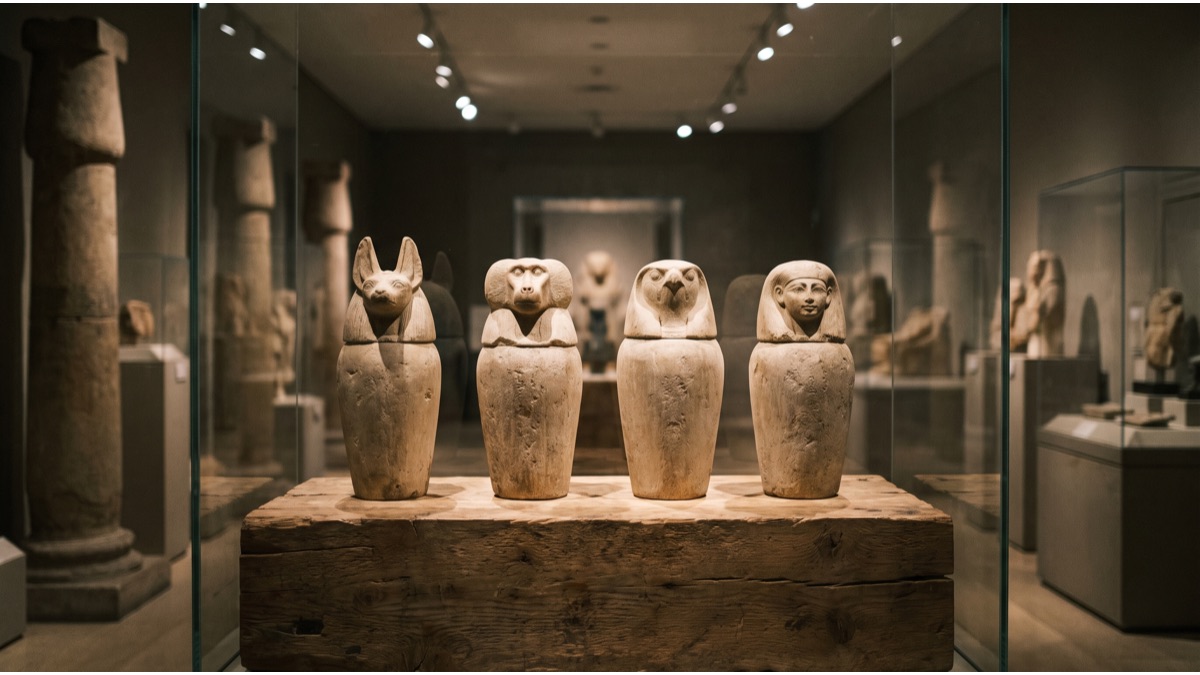
Each of the four canopic jars was specifically associated with one of the four Sons of Horus, minor protective deities, each depicted with a distinct head, human, baboon, jackal, and falcon, and each one assigned responsibility for guarding one specific organ throughout its journey into the afterlife.
Imsety, depicted with a human head, protected the liver; Hapi, with a baboon head, protected the lungs; Duamutef, with a jackal head, protected the stomach; and Qebehsenuef, with a falcon head, protected the intestines, a fixed pairing system maintained with genuine consistency across Egyptian religious practice for centuries.
Each of these four guardian deities was in turn protected by one of four goddesses, creating a genuinely elaborate, doubly layered protective structure around each individual organ, reflecting how seriously Egyptian religious belief treated the ongoing spiritual protection of these preserved body parts even long after the physical embalming process itself had been completed.
How Canopic Jar Design Actually Changed Over Time
During the earliest periods canopic jars were used, their lids were typically plain or shaped simply like a human head, representing the deceased generically rather than depicting any specific one of the four protective deities individually associated with a given organ.
By the New Kingdom period, canopic jar lids had evolved to specifically depict each of the four Sons of Horus with their distinct animal or human heads, making the specific jar-to-organ-to-deity pairing immediately visually identifiable to anyone familiar with the religious iconography, rather than requiring inscribed text alone to convey that same information.
This stylistic evolution reflects broader changes in Egyptian religious art and funerary practice across roughly three thousand years of continuous use, with canopic jar design serving as one genuinely useful, physically dateable marker archaeologists use to help estimate the approximate period a given set of jars, and often the burial they belonged to, actually originates from.
What Canopic Jars Were Actually Made From
Canopic jars were crafted from a range of materials depending on the era and the wealth of the person being buried, including limestone, calcite (Egyptian alabaster), pottery, and, for particularly wealthy or high-status burials, materials like faience or even precious metals for the most elaborate examples.
Wealthier burials generally featured more elaborately carved and decorated jars, a pattern consistent with the broader ancient Egyptian practice of scaling the elaborateness of essentially every element of funerary preparation according to the deceased's social status and the resources their family could actually commit to the burial.
The specific stone or material used also carried practical preservation implications, since denser, less porous materials like calcite offered better long-term protection for the contents against moisture intrusion and gradual material degradation over centuries compared to more porous, cheaper materials like ordinary pottery.
Why Later Periods Sometimes Stopped Using the Jars at All
During the Third Intermediate Period and later eras of ancient Egyptian history, embalming practice shifted meaningfully, with many mummies from these later periods having their four organs treated and wrapped separately but then returned to inside the body cavity itself rather than being placed into external canopic jars at all.
Despite this practical shift, canopic jars themselves often continued being included in burials symbolically even when they no longer held any actual organs, sometimes appearing as solid, non-hollow dummy jars included purely for their religious and symbolic significance rather than any remaining functional storage purpose.
This evolution reveals something genuinely interesting about how the religious significance of specific funerary objects could persist and remain culturally important long after their original, purely practical function had actually changed or been abandoned entirely, a pattern recognizable across many funerary traditions well beyond ancient Egypt specifically.
How Egyptologists Actually Study Canopic Jar Contents Today
Modern researchers studying surviving canopic jars use techniques including CT scanning, chemical residue analysis, and careful microscopic examination to identify exactly which organ a given jar's contents actually represent, since visual inspection alone often cannot reliably distinguish between different desiccated, wrapped ancient organ tissues.
This kind of modern scientific analysis has occasionally revealed genuine mismatches between a jar's inscribed or decorated identification and its actual physical contents, evidence that ancient embalming workshops, despite their generally impressive overall consistency, were not entirely immune to human error or occasional deliberate substitution during the actual embalming process.
These modern analytical techniques have also allowed researchers to study ancient disease patterns and general population health directly from preserved organ tissue, transforming canopic jars from purely religious and archaeological artifacts into a genuinely valuable, if narrow, source of hard biological and medical data about ancient Egyptian populations.
Why Canopic Jars Reveal How Egyptian Religion Actually Worked
The genuinely elaborate, multi-layered system of organ preservation, guardian deity assignment, and protective goddess pairing built specifically around four ordinary internal organs reveals just how thoroughly ancient Egyptian religious belief was woven directly into even the most physically technical aspects of funerary preparation.
This was not simply religious ritual layered symbolically on top of an otherwise purely practical medical preservation procedure; the religious framework itself actively shaped which specific organs were preserved at all, which one was deliberately left untouched, and how each preserved organ was subsequently protected and treated throughout the burial process.
Understanding canopic jars in this fuller context reveals mummification generally as a genuinely integrated practice rather than two separate, loosely overlapping processes, medical preservation on one hand and religious ritual on the other, since for the ancient Egyptians themselves these were never actually separable activities in the first place.
What Happened When Canopic Jars Were Separated From Their Mummies
Over the many centuries since ancient burials were first disturbed by looters, and later by early archaeologists working with far less careful excavation standards than modern practice requires, many canopic jars became physically separated from the specific mummies and tombs they originally belonged to, scattered instead across different museum collections worldwide.
This separation created a genuinely significant ongoing challenge for modern Egyptological research, since a canopic jar's full scientific and historical value depends heavily on knowing precisely which burial and which specific mummy it originally came from, contextual information that is often permanently lost once a jar has been separated from its original burial context.
Contemporary archaeological practice now treats careful, thorough documentation of exactly where and how a canopic jar is found as being just as scientifically important as the jar and its ancient organ contents themselves, a direct methodological response to exactly this kind of historical data loss.
Why This Ancient System Still Fascinates Modern Audiences
Canopic jars remain among the most immediately recognizable and consistently popular ancient Egyptian artifacts displayed in museums worldwide, their distinctive animal-headed lids instantly conveying a genuine sense of ancient Egyptian religious complexity even to visitors with no prior specialist knowledge of mummification practice at all.
Part of their enduring, broad appeal lies in how directly and vividly they illustrate a genuinely different ancient worldview, one in which careful physical preservation of specific body parts, extending even to precise anatomical detail, was considered absolutely essential to securing a successful spiritual afterlife rather than simply an optional or purely symbolic gesture.
This combination of visible technical sophistication and genuinely coherent religious meaning is exactly why canopic jars continue serving as such an effective, accessible entry point for public interest in ancient Egyptian civilization more broadly, connecting a specific, concrete physical object directly to an entire deeply structured belief system about death, identity, and the promise of eternal life.
Canopic Chests and How the Four Jars Were Displayed Together
Complete sets of four canopic jars were typically placed together inside a dedicated canopic chest, a larger wooden or stone container often decorated with the same protective religious iconography found on the jars themselves, and this chest was in turn positioned in a designated spot within the burial chamber, usually near the coffin itself.
The arrangement of the four jars inside their chest was not arbitrary, generally following a standardized layout reflecting the four cardinal directions associated with each guardian deity, meaning even the physical placement of the jars within a tomb carried deliberate religious meaning rather than being a purely practical space-saving decision.
Discovering an intact canopic chest gives archaeologists particularly valuable contextual information, since it preserves the original spatial relationship between the four jars, a relationship frequently lost once tombs are looted or jars become scattered across different collections over time.
What Canopic Jars Reveal About Ancient Egyptian Craft and Trade
Producing a complete set of canopic jars, particularly the finely decorated examples made for royal or elite burials, required coordination across several distinct craft specialties: sculptors to shape stone or pottery, painters to apply intricate colors and decoration, and scribes to precisely inscribe the protective religious texts on each jar.
The skill level required to produce high-quality canopic jars reflects the existence of specialized workshops operating regularly to serve ancient Egypt's broader funerary industry, an industry that employed significant numbers of skilled craftspeople across multiple specialties working together over thousands of years of this practice's continuous use.
The specific materials used in a given set of canopic jars also provide indirect evidence of ancient Egyptian trade networks, since certain stone types used in particularly wealthy jars were quarried from regions located meaningfully far from the burial sites themselves, pointing to organized transport and quarrying networks supporting the broader funerary industry.
Sources
- Wikipedia — overview of canopic jars, the Four Sons of Horus, and mummification practice
- The British Museum — collections background on ancient Egyptian mummification and funerary objects
- The Metropolitan Museum of Art — curatorial background on ancient Egyptian burial practice and canopic equipment
- Ancient Egypt Magazine — archaeological reporting on mummification research and canopic jar analysis
FAQ
Which organs were placed in canopic jars?
The liver, lungs, stomach, and intestines were each removed, dried, and placed in their own dedicated jar, while the heart was deliberately left inside the body because Egyptians believed it held a person’s intelligence and identity.
Why was the brain not preserved like the other organs?
Ancient Egyptians believed the heart, not the brain, was the seat of thought and identity, so the brain was considered spiritually insignificant and was typically removed through the nose and discarded rather than preserved.
What are the Four Sons of Horus?
They were four protective deities, each with a distinct head, human, baboon, jackal, and falcon, with each one assigned to guard one specific organ, and each of those deities was in turn protected by one of four goddesses.
Did canopic jars always contain organs?
No, in the Third Intermediate Period and later, organs were often wrapped and returned inside the body cavity, and canopic jars sometimes continued to be included in burials as symbolic dummy jars with no actual contents at all.
How do modern researchers know what is actually inside a canopic jar?
Researchers use CT scanning, chemical residue analysis, and microscopic examination to identify organ tissue precisely, since this analysis has occasionally revealed mismatches between a jar’s labeled identification and its actual contents.
What were canopic jars made from?
Materials ranged from limestone, pottery, and calcite to faience or precious metals for wealthier burials, with denser materials like calcite generally offering better long-term protection for the preserved organ contents.
About the Author
We reference Wikipedia and other authoritative sources to explain the background and current understanding of this topic.
Loved This Article?
Share it on WhatsApp → Share it on WhatsApp
Get more guides in your inbox — Subscribe to our newsletter for weekly surprising stories from Egypt, Saudi Arabia, Dubai, and beyond.