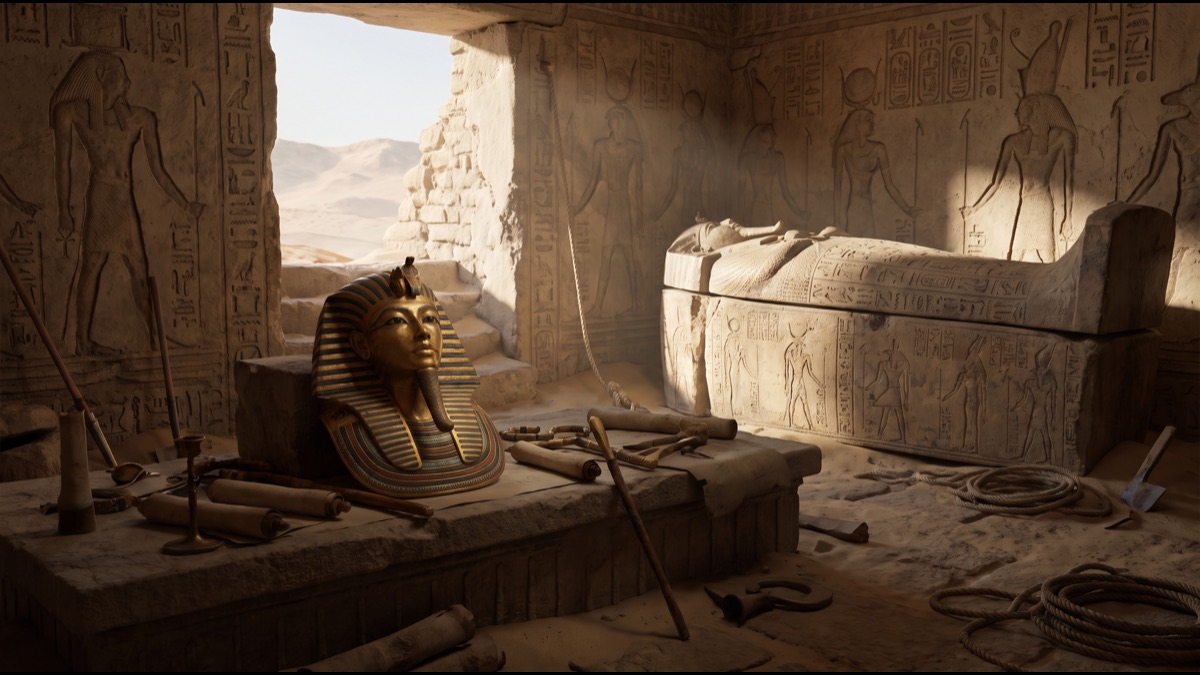
Introduction
The term pharaoh refers to the kings — and occasionally queens — who ruled ancient Egypt for roughly three thousand years, from unification around 3100 BCE until the Roman annexation in 30 BCE. Far more than political rulers, pharaohs occupied a unique religious position: they were considered the living embodiment of the god Horus and, after death, were believed to merge with Osiris, god of the afterlife, making kingship in Egypt inseparable from religion.
The word itself comes from the Egyptian per-aa, meaning 'great house,' originally referring to the royal palace before it evolved, in the New Kingdom, into a title for the ruler himself.
What Made a Pharaoh Different from Other Ancient Kings
A pharaoh's core responsibility was maintaining maat — the cosmic principle of order, balance, and truth — against the constant threat of isfet, or chaos. This meant a pharaoh was simultaneously head of state, commander of the army, chief judge, and high priest of every temple in Egypt, though in practice, priests conducted most day-to-day rituals on the pharaoh's behalf.
Pharaohs typically married within the royal family, sometimes marrying siblings, to preserve the divine bloodline, and maintained large households with multiple wives; the 'Great Royal Wife' held the most prominent official status among them. Succession generally passed to a son of the Great Royal Wife, though several periods saw succession disputes, co-regencies, and, rarely, women ruling as pharaoh in their own right.
Notable Pharaohs of the Old and Middle Kingdoms
Djoser (Third Dynasty, c. 2670 BCE) commissioned Egypt's first monumental stone structure, the Step Pyramid at Saqqara, designed by his official Imhotep, who was later deified. Khufu (Fourth Dynasty, c. 2589–2566 BCE) built the Great Pyramid of Giza, the largest pyramid ever constructed and the last surviving Ancient Wonder of the World.
Mentuhotep II (Eleventh Dynasty, c. 2055 BCE) reunified Egypt after the First Intermediate Period, launching the Middle Kingdom, while Senusret III (Twelfth Dynasty) expanded Egyptian control into Nubia and is remembered for powerful, individualized royal portraiture that broke from earlier idealized styles.
The New Kingdom's Most Famous Rulers
Hatshepsut (c. 1479–1458 BCE) was one of the few women to rule Egypt as pharaoh in her own right rather than as a regent, presiding over a prosperous period marked by extensive trade expeditions, notably to the land of Punt, and ambitious building projects including her mortuary temple at Deir el-Bahari.
Akhenaten (c. 1353–1336 BCE) briefly upended Egyptian religion by promoting near-exclusive worship of the sun disc Aten, relocating the capital to a new city, Akhetaten (modern Amarna), and commissioning a distinctive, more naturalistic art style. His religious reforms were reversed almost immediately after his death, largely under his son Tutankhamun (c. 1332–1323 BCE), who is far better known today for the near-intact state of his tomb, discovered in 1922, than for his brief and largely unremarkable political reign.
Ramesses II, often called Ramesses the Great (c. 1279–1213 BCE), reigned for 66 years, longer than almost any other pharaoh, fought the Battle of Kadesh against the Hittite Empire, and later signed one of history's earliest surviving peace treaties. He commissioned more monumental construction than any other pharaoh, including the rock-cut temples at Abu Simbel.
Cleopatra and the End of Pharaonic Rule
Cleopatra VII (69–30 BCE) was the last active pharaoh of Egypt, ruling as part of the Greek-speaking Ptolemaic Dynasty that governed Egypt after Alexander the Great's conquest. Fluent in Egyptian language alongside Greek — unusual among the Ptolemies — she formed political and personal alliances with Roman leaders Julius Caesar and later Mark Antony. Her defeat, alongside Antony, by Octavian's forces in 30 BCE ended nearly three thousand years of pharaonic rule and brought Egypt under direct Roman control.
Modern knowledge of these rulers comes from a combination of temple and tomb inscriptions, king lists such as the Turin Canon and the Palermo Stone, and the writings of later Greek and Roman historians, whose accounts sometimes conflict with the Egyptian evidence and must be treated with appropriate caution.
Sources
- The British Museum — Ancient Egypt collection, royal chronology resources
- The Metropolitan Museum of Art — Department of Egyptian Art, pharaonic history resources
- Encyclopaedia Britannica — Pharaoh reference entry covering role, title, and succession
- Egyptian Ministry of Tourism and Antiquities — Official information on royal monuments and temples
FAQ
What does the word pharaoh mean?
Pharaoh comes from the Egyptian term per-aa, meaning 'great house,' which originally referred to the royal palace itself before evolving, during the New Kingdom, into a title used directly for the ruler.
Could women become pharaoh in ancient Egypt?
Yes, though rarely. Hatshepsut and Cleopatra VII are the best-documented examples of women who ruled Egypt as pharaoh in their own right, rather than only as a queen consort or regent for a young king.
Who was the most powerful pharaoh?
There is no single agreed answer, but Ramesses II is often cited for his 66-year reign, extensive military campaigns, and unmatched building program, while Thutmose III is frequently credited with building Egypt's largest territorial empire through sustained military conquest.
Why were pharaohs considered gods?
Pharaohs were believed to be the living embodiment of the god Horus during their reign and to merge with Osiris, god of the afterlife, after death, making the position of pharaoh inseparable from Egyptian state religion rather than a purely secular kingship.
Who was the last pharaoh of Egypt?
Cleopatra VII is generally regarded as the last active pharaoh of Egypt. Her defeat alongside Mark Antony by Roman forces under Octavian in 30 BCE ended pharaonic rule and brought Egypt under direct Roman administration.
About the Author
doyouknow.app Editorial Team — We cross-reference primary inscriptions, museum scholarship, and peer-reviewed Egyptology to present the lives and reigns of Egypt's pharaohs as accurately as the surviving evidence allows.
Loved This Article?
Share it on WhatsApp → Share on WhatsApp
Get more guides in your inbox — Subscribe to our newsletter for weekly surprising stories from Egypt, Saudi Arabia, Dubai, and beyond.