Introduction
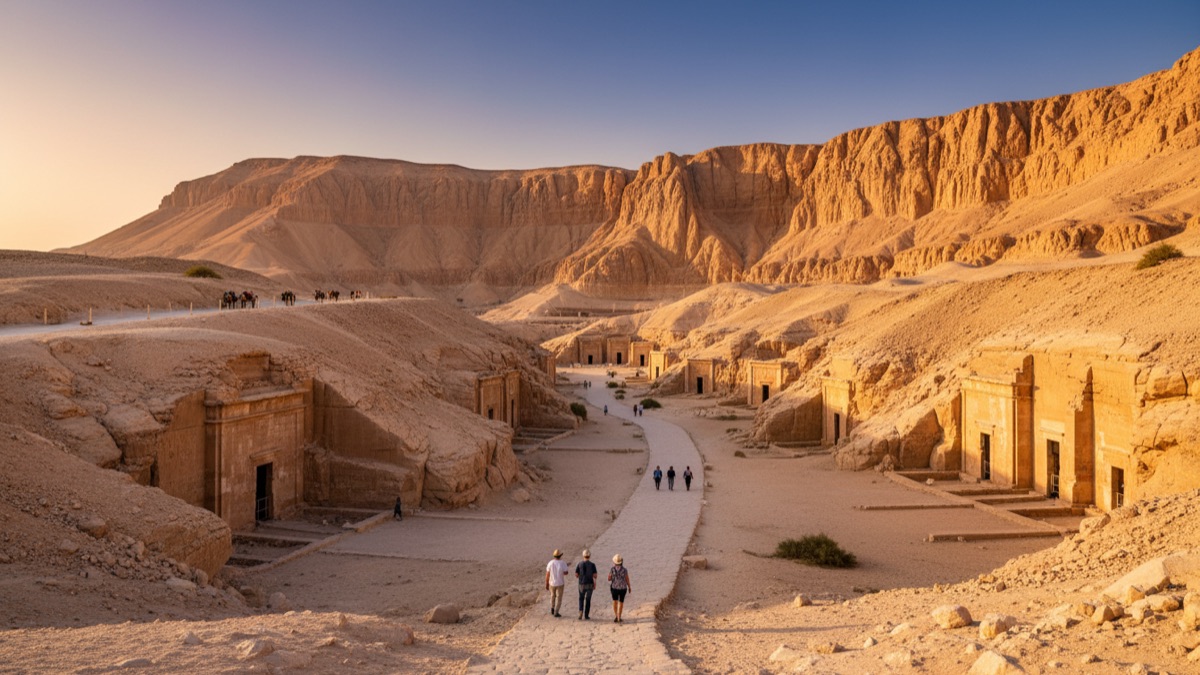
The Valley of the Kings sits on the west bank of the Nile opposite Luxor, ancient Thebes, and served as the royal burial ground for Egypt's New Kingdom pharaohs for roughly 500 years, from around 1550 to 1070 BCE. Instead of building visible pyramids, New Kingdom rulers cut their tombs directly into the limestone cliffs of a narrow, isolated desert valley, hoping the hidden, unmarked entrances would deter the tomb robbery that had plagued earlier pyramid burials.
More than 60 tombs and chambers have been identified in the valley, ranging from small pits to elaborate multi-chamber tombs decorated with detailed religious texts intended to guide the pharaoh through the afterlife.
Why Pharaohs Chose This Valley
The valley's geography made it a natural fortress: a single, easily guarded entrance, steep surrounding cliffs, and a pyramid-shaped mountain peak, al-Qurn, visible above the valley, which may have held symbolic significance as a natural echo of the pyramid form pharaohs had abandoned for security reasons.
Workers and their families lived in a dedicated village, Deir el-Medina, on the other side of the mountain, and were organized into specialized teams of quarrymen, plasterers, and painters who worked in shifts, leaving behind an unusually rich archive of personal letters, court records, and strike complaints that give historians remarkable insight into daily life in New Kingdom Egypt.
Tutankhamun's Tomb (KV62)
The valley's most famous tomb, KV62, belongs to Tutankhamun and was discovered by British archaeologist Howard Carter in November 1922, funded by Lord Carnarvon. Unlike almost every other royal tomb in the valley, it was found largely intact, having likely escaped the worst of ancient tomb robbers partly because its unusually small size and hastily built structure kept it hidden beneath debris from a later tomb's construction.
The tomb contained roughly 5,000 artifacts, including the pharaoh's iconic solid gold death mask, layered coffins, chariots, furniture, and jewelry — the single largest collection of intact pharaonic funerary goods ever found. Most of these objects are now displayed together at the Grand Egyptian Museum near Giza, though Tutankhamun's mummy remains in his original tomb in the valley.
Other Notable Tombs to Prioritize
Seti I's tomb (KV17) is widely regarded as the longest, deepest, and most elaborately decorated tomb in the valley, with vividly preserved painted reliefs, though it has limited access due to conservation concerns and is sometimes closed or requires a premium ticket.
Ramesses VI's tomb (KV9) features an extraordinary painted ceiling depicting the Book of the Sky and remains one of the most visually striking tombs generally open to standard ticket holders. Nefertari's tomb, though located in the nearby Valley of the Queens rather than the Valley of the Kings, is often paired with a valley visit and is celebrated for what many consider the best-preserved painted decoration of any tomb in the entire Theban necropolis.
Tickets and Practical Visiting Tips
A standard general admission ticket to the Valley of the Kings covers entry into three tombs, chosen from a rotating group of tombs kept open for conservation reasons; tombs of exceptional interest, including Tutankhamun's and Seti I's, typically require a separate, additional ticket. Photography inside tombs may require a separate photo permit, and flash photography is generally prohibited to protect the painted surfaces.
The valley has very little shade and can become extremely hot, particularly from May through September, so visiting early in the morning is strongly recommended. A small tram from the visitor center to the tomb entrances is included in admission, and comfortable walking shoes are essential given the uneven terrain and staircases within several tombs.
Sources
- Egyptian Ministry of Tourism and Antiquities — Official visiting information for the Valley of the Kings
- UNESCO World Heritage Centre — Ancient Thebes with its Necropolis, including the Valley of the Kings
- Theban Mapping Project — Detailed archaeological documentation of individual tombs
- Encyclopaedia Britannica — Valley of the Kings reference entry
FAQ
How many tombs are in the Valley of the Kings?
More than 60 tombs and chambers have been identified in the Valley of the Kings, ranging from small undecorated pits to large, elaborately painted multi-chamber royal tombs, though only a rotating selection is open to visitors at any given time.
Is Tutankhamun's mummy still in the Valley of the Kings?
Yes. While the roughly 5,000 objects found in his tomb are now displayed at the Grand Egyptian Museum, Tutankhamun's mummy remains in his original tomb, KV62, in the Valley of the Kings, viewable with the appropriate ticket.
Do I need a separate ticket for Tutankhamun's tomb?
Yes. The standard Valley of the Kings ticket covers three rotating tombs, and premium tombs including Tutankhamun's (KV62) and Seti I's (KV17) generally require a separate, additional ticket purchased on-site.
How long does it take to visit the Valley of the Kings?
Most visitors spend two to three hours in the valley, though this depends on how many tombs are included in your ticket and how much time you spend at each one, plus travel time on the internal tram from the visitor center.
When is the best time to visit the Valley of the Kings?
Early morning is best, both to avoid crowds at the most popular tombs and because the valley offers very little shade; temperatures can become extremely hot, especially between May and September.
About the Author
doyouknow.app Editorial Team — We combine official antiquities guidance with archaeological documentation projects to keep our Valley of the Kings visiting information accurate and current.
Loved This Article?
Share it on WhatsApp → Share on WhatsApp
Get more guides in your inbox — Subscribe to our newsletter for weekly surprising stories from Egypt, Saudi Arabia, Dubai, and beyond.