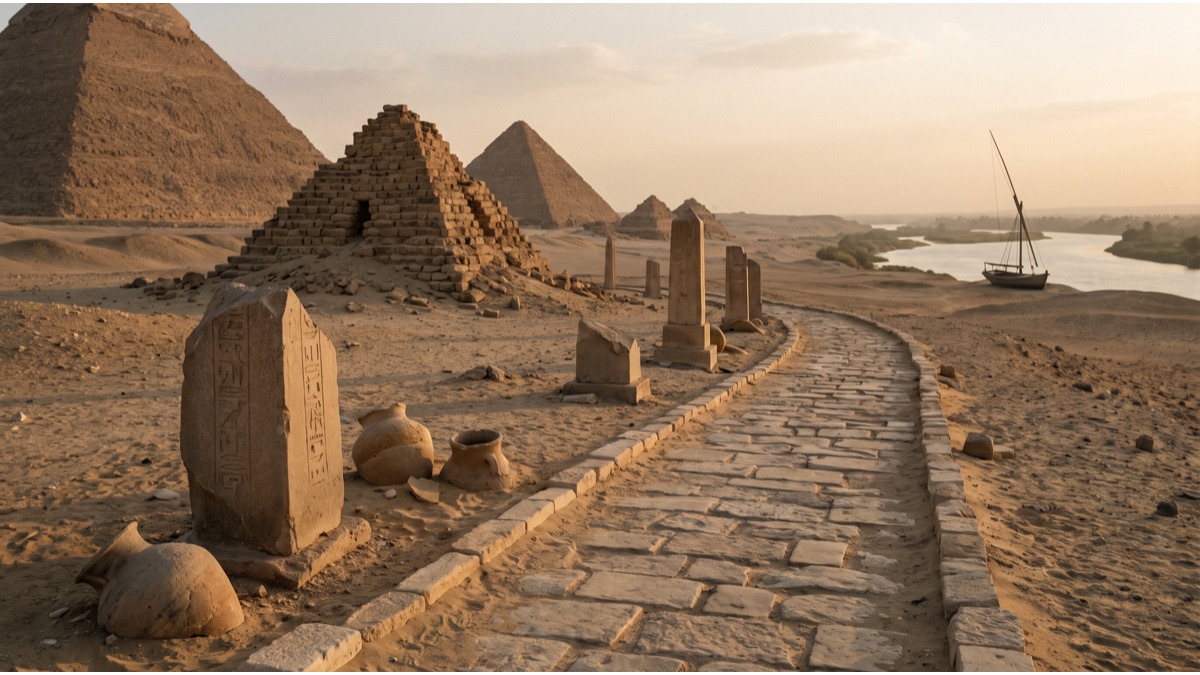
Introduction
Ancient Egyptian civilization spans roughly 3,000 years, making it one of the longest-lived civilizations in human history — longer than the time separating us from Cleopatra herself. Anchored by the predictable annual flooding of the Nile River, Egypt developed a stable agricultural surplus that allowed for centralized government, monumental architecture, and a rich written record that historians still study today.
Rather than a single continuous empire, Egyptologists divide this history into distinct Kingdoms separated by periods of fragmentation known as Intermediate Periods. Understanding this framework makes sense of everything from the pyramids to the pharaohs to the eventual Greek and Roman conquest.
Unification and the Early Dynastic Period (c. 3100–2686 BCE)
Egyptian history conventionally begins with the unification of Upper Egypt (the southern Nile Valley) and Lower Egypt (the northern Nile Delta) around 3100 BCE, traditionally credited to a king named Narmer, who may be the same figure known in later king lists as Menes. This unification created the world's first large territorial state and established the dual crown — combining the White Crown of Upper Egypt and the Red Crown of Lower Egypt — as a symbol of pharaonic authority that persisted for millennia.
The capital was established at Memphis, near modern Cairo, and the foundations of Egyptian writing, administration, and religion were laid during this formative period.
The Old Kingdom: Age of the Pyramid Builders (c. 2686–2181 BCE)
Known as the 'Age of the Pyramids,' the Old Kingdom saw the construction of the Step Pyramid of Djoser at Saqqara — Egypt's first monumental stone building, designed by the architect Imhotep — followed by the Pyramids of Giza under Khufu, Khafre, and Menkaure during the Fourth Dynasty. Royal power was near-absolute, and the pharaoh was regarded as a living god responsible for maintaining maat, the cosmic order.
The Old Kingdom eventually weakened as regional governors, called nomarchs, accumulated independent power, and a series of low Nile floods likely triggered famine and administrative collapse, ending in the First Intermediate Period, a roughly 150-year era of fragmented, competing local rule.
The Middle Kingdom: Reunification and Literature (c. 2055–1650 BCE)
Mentuhotep II of Thebes reunified Egypt around 2055 BCE, launching the Middle Kingdom, often considered a classical age of Egyptian literature, art, and administrative reform. Pharaohs of the Twelfth Dynasty expanded Egyptian control into Nubia to the south and undertook major irrigation projects in the Faiyum region to expand farmland.
The Middle Kingdom ended as central authority weakened again and the Hyksos, a group of Western Asian origin, gained control of the Nile Delta, ushering in the Second Intermediate Period.
The New Kingdom: Egypt's Imperial Age (c. 1550–1077 BCE)
After Ahmose I expelled the Hyksos around 1550 BCE, Egypt entered its most powerful and prosperous era, the New Kingdom, expanding into an empire stretching from Nubia to the Levant. This period produced some of Egypt's most famous rulers: Hatshepsut, one of the few female pharaohs to rule in her own right; Akhenaten, who briefly imposed worship of a single sun god, the Aten; his son Tutankhamun, who restored traditional religion; and Ramesses II, whose long reign and prolific building projects, including the temples at Abu Simbel, made him the archetypal pharaoh in popular imagination.
New Kingdom pharaohs were buried in rock-cut tombs in the Valley of the Kings near Thebes (modern Luxor) rather than pyramids, a shift intended partly to deter tomb robbery.
The Late Period, Greek Conquest, and Cleopatra (c. 1077 BCE–30 BCE)
Following the New Kingdom, Egypt experienced cycles of foreign rule and fragmentation, including periods of Libyan, Nubian, and Assyrian control, before Persia conquered Egypt in 525 BCE. Alexander the Great took Egypt from Persian control in 332 BCE, and after his death his general Ptolemy founded the Ptolemaic Dynasty, a Greek-speaking royal line that ruled Egypt from Alexandria for nearly 300 years while adopting many pharaonic traditions.
The Ptolemaic era ended with Cleopatra VII, the last active pharaoh of Egypt, whose defeat alongside Mark Antony by the Roman forces of Octavian in 30 BCE brought Egypt under direct Roman control, closing the era of pharaonic rule after nearly three millennia.
Sources
- The British Museum — Ancient Egypt collection and historical overview
- The Metropolitan Museum of Art — Department of Egyptian Art, historical timeline resources
- UNESCO World Heritage Centre — Memphis and its Necropolis — Pyramid Fields
- Encyclopaedia Britannica — Ancient Egypt reference entry with kingdom periodization
FAQ
How long did ancient Egyptian civilization last?
Ancient Egyptian civilization, from the unification around 3100 BCE to the Roman conquest in 30 BCE, spanned roughly 3,000 years, making it one of the longest continuous civilizations in recorded history.
What are the three main kingdoms of ancient Egypt?
Egyptologists divide ancient Egyptian history into the Old Kingdom (Age of the Pyramids), the Middle Kingdom (a classical age of literature and reform), and the New Kingdom (Egypt's imperial age), separated by unstable Intermediate Periods.
Who was the first pharaoh of Egypt?
Narmer, who may correspond to the later-recorded king Menes, is traditionally credited with unifying Upper and Lower Egypt around 3100 BCE, making him the first ruler of a unified Egyptian state.
How did ancient Egypt end?
Pharaonic rule effectively ended in 30 BCE when Cleopatra VII, the last active pharaoh, was defeated by Roman forces under Octavian, bringing Egypt under direct Roman administration.
Why did ancient Egyptian pharaohs stop building pyramids?
By the New Kingdom, pharaohs shifted to rock-cut tombs hidden in the Valley of the Kings, partly because the highly visible pyramids of earlier eras had proven vulnerable to tomb robbery.
About the Author
doyouknow.app Editorial Team — We synthesize peer-reviewed Egyptology and major museum collections to present ancient Egyptian history in a clear, accurate timeline for general readers.
Loved This Article?
Share it on WhatsApp → Share on WhatsApp
Get more guides in your inbox — Subscribe to our newsletter for weekly surprising stories from Egypt, Saudi Arabia, Dubai, and beyond.