Introduction
Hieroglyphs were ancient Egypt's formal writing system, used for roughly 3,600 years, from around 3200 BCE until the last known hieroglyphic inscription, carved at the Temple of Isis on the island of Philae, in 394 CE. The word itself comes from Greek, meaning 'sacred carving,' reflecting how Greek and Roman visitors encountered the script primarily on temple walls and monuments long after it had become a specialized, largely religious form of writing rather than everyday communication.
Contrary to the popular assumption that hieroglyphs were purely pictorial symbols, each representing a single idea, the system was in fact a sophisticated mixture of different sign types working together, closer in structure to systems like ancient Chinese writing than to a simple picture-based code.
How the Writing System Actually Worked
Hieroglyphic writing combined three main categories of signs. Phonograms represented sounds, ranging from single consonants to combinations of two or three consonants (Egyptian writing did not record vowels). Logograms represented entire words or ideas directly, often paired with a phonetic spelling of the same word for clarity. Determinatives were silent signs placed at the end of a word to clarify its meaning or category — for example, distinguishing between words that sounded similar but referred to entirely different concepts.
Egyptologists estimate the full hieroglyphic sign inventory at around 700 to 1,000 distinct signs during the classical Middle Egyptian phase of the language, though a much smaller functional core of a few hundred signs handled the vast majority of everyday religious and monumental texts.
Cartouches and Royal Names
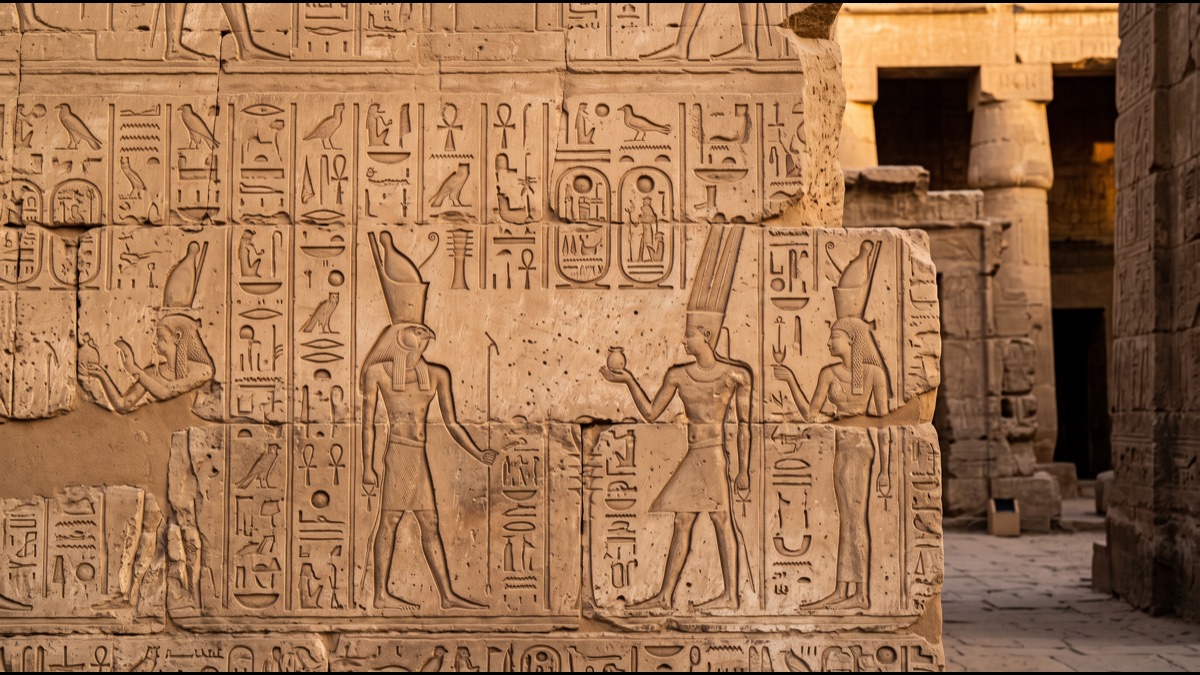
Royal names were typically enclosed in an oval frame called a cartouche, a French term coined by Napoleon's soldiers who thought the shape resembled a rifle cartridge. This convention proved enormously important for decipherment: because cartouches clearly marked royal names, early codebreakers working from the Rosetta Stone could isolate the phonetic spelling of known rulers like Ptolemy and Cleopatra and use those signs as a starting point to expand outward into the rest of the script.
Hieroglyphs could also be written in multiple directions — left to right, right to left, or top to bottom — with the direction indicated by which way the animal and human figures in the text faced, always read starting from the direction the figures were looking toward.
Hieratic and Demotic: The Everyday Scripts
Formal hieroglyphs were largely reserved for monuments, temple walls, and religious texts, since carving detailed pictorial signs was slow and impractical for daily use. For everyday writing on papyrus, Egyptians used hieratic, a cursive, simplified script derived from hieroglyphs, used from roughly the same period onward for administrative records, letters, and literature.
By around 700 BCE, an even more simplified and rapid script called Demotic emerged for daily administrative and legal use, eventually appearing alongside hieroglyphs and Greek on the Rosetta Stone itself. Egyptian writing eventually transitioned to the Coptic alphabet, based on Greek letters with a handful of added characters, which remains in liturgical use in the Coptic Orthodox Church today.
How Hieroglyphs Were Deciphered
Knowledge of how to read hieroglyphs was completely lost for well over a thousand years after the script fell out of use, as later generations, including medieval Arab and European scholars, could only speculate about its meaning. The breakthrough came from the Rosetta Stone, discovered in 1799, whose trilingual text in hieroglyphic, Demotic, and Greek gave scholars a way to work backward from known Greek words toward the Egyptian scripts.
French scholar Jean-François Champollion achieved the decisive decipherment in 1822 by correctly identifying that hieroglyphs combined phonetic and logographic signs in one integrated system, a discovery that founded modern Egyptology and made the millions of surviving hieroglyphic inscriptions across Egypt's temples and tombs readable again.
Sources
- The British Museum — Rosetta Stone object record and hieroglyphic decipherment history
- Encyclopaedia Britannica — Hieroglyphic writing reference entry
- Oriental Institute, University of Chicago — Academic resources on ancient Egyptian language and writing systems
- Egyptian Ministry of Tourism and Antiquities — Official information on Egyptian temple inscriptions
FAQ
Are hieroglyphs just pictures?
No. While hieroglyphic signs look pictorial, the system combined phonetic signs representing sounds, logographic signs representing whole words, and silent determinative signs clarifying meaning, functioning as a full writing system rather than simple picture symbols.
How many hieroglyphic signs are there?
Egyptologists estimate around 700 to 1,000 distinct signs during the classical Middle Egyptian phase of the language, though a smaller core of a few hundred signs accounted for the vast majority of everyday religious and monumental texts.
What is a cartouche?
A cartouche is the oval frame used to enclose royal names in hieroglyphic writing. It proved crucial to decipherment because it clearly marked where a ruler's name appeared, letting scholars isolate known names like Ptolemy to begin decoding the script.
When did people stop using hieroglyphs?
The last known hieroglyphic inscription was carved at the Temple of Isis on the island of Philae in 394 CE. After that, the script fell out of use, and knowledge of how to read it was lost until its decipherment in 1822.
What is the difference between hieroglyphs, hieratic, and Demotic?
Hieroglyphs were the formal, pictorial script used on monuments and temples. Hieratic was a faster, cursive version used for everyday writing on papyrus. Demotic, developed later, was an even more simplified script used for daily administrative and legal documents.
About the Author
doyouknow.app Editorial Team — We rely on academic Egyptology resources to explain how hieroglyphic writing actually functioned as a linguistic system, beyond the popular picture-symbol misconception.
Loved This Article?
Share it on WhatsApp → Share on WhatsApp
Get more guides in your inbox — Subscribe to our newsletter for weekly surprising stories from Egypt, Saudi Arabia, Dubai, and beyond.