Introduction
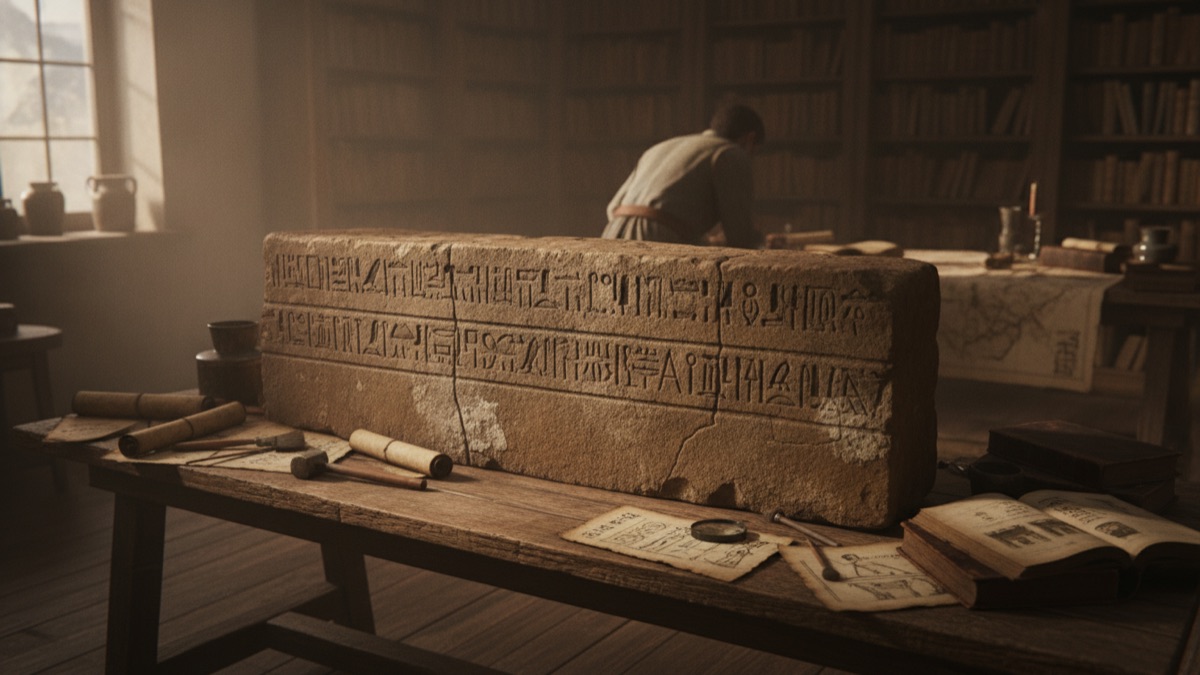
The Rosetta Stone is a fragment of a granodiorite stele that became the single most important tool in unlocking one of history's great linguistic mysteries: how to read ancient Egyptian hieroglyphs, a writing system that had been unreadable for over a thousand years by the time the stone was rediscovered. It is not, contrary to popular imagination, a mysterious or magical object — it is a fairly ordinary bureaucratic decree, and its significance lies entirely in the fact that the same text was carved in three different scripts.
Today it is one of the most visited objects in the British Museum in London, and also one of the most contested, at the center of an ongoing repatriation debate between Egypt and the United Kingdom.
Discovery During Napoleon's Egyptian Campaign
The stone was discovered in July 1799 by French soldiers under Napoleon Bonaparte's expeditionary force, who were rebuilding a fort near the town of Rosetta (Rashid) in the Nile Delta. It had been reused as building material in a much later structure, a common fate for ancient inscribed stones throughout history.
French scholars accompanying the military expedition quickly recognized its significance, but after France's defeat by British and Ottoman forces in Egypt, the stone was surrendered to the British under the terms of the 1801 Capitulation of Alexandria and shipped to England, arriving at the British Museum in 1802, where it has remained on public display, with brief exceptions, ever since.
What the Rosetta Stone Actually Says
The inscription is a decree issued by a council of Egyptian priests in 196 BCE, affirming the royal cult of the young pharaoh Ptolemy V and detailing tax exemptions and temple donations granted to Egypt's priesthood. It is administratively significant but not otherwise dramatic — a routine piece of Ptolemaic-era religious and political bureaucracy, similar to several other surviving decrees from the same period.
Its historical importance comes entirely from its trilingual format: the same decree appears in hieroglyphic script (used for religious and formal texts), Demotic script (the everyday administrative script of the time), and Ancient Greek (the language of Egypt's Ptolemaic ruling class), allowing scholars who could already read Greek to work backward toward decoding the other two.
How It Unlocked Hieroglyphs
British polymath Thomas Young made early progress in the 1810s, correctly identifying that some hieroglyphic signs were phonetic (representing sounds) rather than purely symbolic, and successfully worked out several signs in royal names encircled by an oval frame known as a cartouche. Real progress accelerated after Young shared his findings, but he never fully cracked the system.
French scholar Jean-François Champollion built on this foundation and made the decisive breakthrough in 1822, correctly demonstrating that hieroglyphic writing combined phonetic signs with logographic (word-representing) signs in a single integrated system, rather than being either purely symbolic or purely phonetic as earlier theories had assumed. This insight, announced in his famous Lettre à M. Dacier, effectively founded the modern academic discipline of Egyptology and unlocked the ability to read the vast body of surviving hieroglyphic inscriptions across Egypt.
The Repatriation Debate
Egypt's Supreme Council of Antiquities has formally and repeatedly requested the permanent return of the Rosetta Stone, arguing it was taken during a period of military occupation and holds unmatched significance to Egyptian national and cultural identity. The British Museum has maintained the stone is a key part of world history best preserved and displayed in a global institution, a position it applies broadly across contested items in its collection, and to date has not agreed to a permanent transfer.
This dispute mirrors similar repatriation debates over other major artifacts removed from their countries of origin during the colonial era, and its outcome remains unresolved, with periodic renewed public campaigns coinciding with anniversaries of the stone's discovery.
Sources
- The British Museum — Official Rosetta Stone object record and history
- Egyptian Ministry of Tourism and Antiquities — Official Egyptian position on repatriation of key artifacts
- Encyclopaedia Britannica — Rosetta Stone reference entry, including decipherment history
- Collège de France — Archival resources on Jean-François Champollion's decipherment work
FAQ
Who discovered the Rosetta Stone?
French soldiers under Napoleon Bonaparte's expeditionary force discovered the Rosetta Stone in July 1799 while rebuilding a fort near the town of Rosetta (Rashid) in Egypt's Nile Delta, where it had been reused as building material.
What language is written on the Rosetta Stone?
The Rosetta Stone contains the same decree written in three scripts: Egyptian hieroglyphs, Egyptian Demotic script, and Ancient Greek, which allowed scholars to use their knowledge of Greek to work toward decoding the two Egyptian scripts.
Who deciphered the Rosetta Stone?
French scholar Jean-François Champollion made the decisive breakthrough in 1822, building on earlier progress by British polymath Thomas Young, correctly showing that hieroglyphs combined phonetic and word-based signs in one integrated writing system.
Is the Rosetta Stone in Egypt or England?
The Rosetta Stone has been held at the British Museum in London since 1802. Egypt's Supreme Council of Antiquities has formally requested its permanent return, but the British Museum has not agreed to a permanent transfer.
What does the Rosetta Stone actually say?
The inscription is a routine decree issued by Egyptian priests in 196 BCE affirming the royal cult of the young pharaoh Ptolemy V and detailing tax exemptions and temple donations, not a mysterious or dramatic text.
About the Author
doyouknow.app Editorial Team — We rely on museum object records and the documented history of Egyptology's founders to explain the Rosetta Stone's discovery and decipherment accurately.
Loved This Article?
Share it on WhatsApp → Share on WhatsApp
Get more guides in your inbox — Subscribe to our newsletter for weekly surprising stories from Egypt, Saudi Arabia, Dubai, and beyond.