Introduction
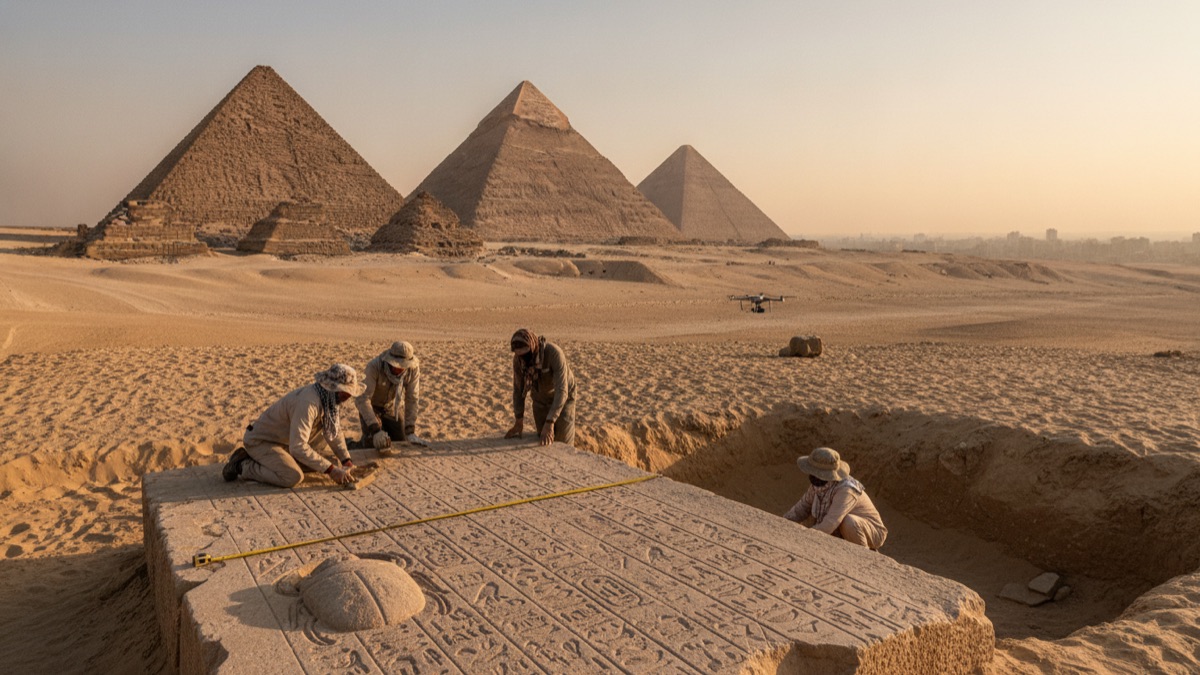
The Pyramids of Giza are the last surviving structures of the Seven Wonders of the Ancient World, and the only one still largely intact after more than 4,500 years. Rising from the desert plateau on the western edge of Cairo, the three main pyramids — built for the pharaohs Khufu, Khafre, and Menkaure — remain the most recognizable monuments on Earth and the anchor of Egypt's entire tourism economy.
They were built during Egypt's Fourth Dynasty, roughly between 2600 and 2500 BCE, at a time when the Egyptian state had already been unified for centuries and had the administrative capacity to organize massive, decades-long construction projects. Understanding the Pyramids means understanding how a Bronze Age civilization without iron tools, the wheel for heavy hauling, or draft animals like horses managed to move millions of tons of stone with millimeter-level precision.
Who Built the Pyramids
The Great Pyramid of Giza was built for Pharaoh Khufu (also known by his Greek name, Cheops), who reigned around 2589–2566 BCE. It is the largest of the three, originally standing 146.6 meters tall. Erosion and the removal of its outer casing stones over the centuries have reduced its height to about 138.5 meters today, though it remained the tallest human-made structure on the planet for almost 3,800 years, a record unmatched until the construction of Lincoln Cathedral in England around 1311 CE.
The second pyramid belongs to Khafre, Khufu's son, and appears taller than his father's pyramid from certain angles simply because it sits on higher ground — it is in fact slightly smaller. Khafre's pyramid complex also includes the Great Sphinx. The third and smallest of the main pyramids belongs to Menkaure, Khafre's successor, and is roughly one-tenth the volume of the Great Pyramid.
A persistent myth holds that the pyramids were built by enslaved people. Archaeological excavations of a nearby workers' village since the 1990s — led by Egyptologists Mark Lehner and Zahi Hawass — uncovered bakeries, breweries, medical facilities, and worker cemeteries with skeletal evidence of healed fractures treated by physicians. This evidence strongly supports the current scholarly consensus that the pyramids were built by a rotating, paid labor force of Egyptian farmers, likely conscripted during the Nile flood season when fieldwork was impossible, alongside a permanent core of skilled craftsmen.
How They Were Built
The Great Pyramid alone contains an estimated 2.3 million blocks of limestone and granite, with an average weight of about 2.5 tons each; the largest granite blocks in the King's Chamber weigh as much as 80 tons. Most of the limestone was quarried locally at Giza, while fine white casing stone came from Tura, across the Nile, and granite for internal chambers was transported over 800 kilometers from Aswan.
Engineers and archaeologists broadly agree that workers used ramps — straight, spiraling, or internal — combined with sledges, wooden rollers, and levers to move and raise the blocks. A 2018 discovery of an ancient administrative papyrus, the Diary of Merer, describes in detail how limestone blocks were ferried by boat along the Nile and a purpose-built canal system directly to the Giza plateau, confirming that water transport played a central role.
The precision remains remarkable by any era's standards: the base of the Great Pyramid is level to within about 2.1 centimeters, and its sides are aligned to true north with an accuracy of a fraction of a degree, likely achieved using astronomical observations of circumpolar stars.
Why They Were Built
The pyramids were royal tombs, built as part of a broader funerary complex designed to secure the pharaoh's transition into the afterlife. Ancient Egyptians believed the king's spirit, or ka, needed a preserved body and a monumental resting place to endure eternally alongside the gods. Each pyramid complex included a mortuary temple, a valley temple near the Nile, and a causeway connecting them, along with smaller subsidiary pyramids for queens.
The scale of the projects also served a political function, demonstrating the pharaoh's power to mobilize the resources and labor of the entire Egyptian state, reinforcing the centralized religious and administrative order of the Old Kingdom.
Visiting the Pyramids Today
The Giza Plateau is open to visitors daily, typically from early morning until sunset, with earlier opening hours generally offering cooler temperatures and smaller crowds. A general admission ticket covers the plateau and exterior viewing of all three pyramids; separate, limited-availability tickets are required to enter the interior of the Great Pyramid or Khafre's pyramid, and tickets for the Khufu solar boat museum area are sold separately as well.
The pyramids sit at the edge of Greater Cairo, roughly a 30–45 minute drive from downtown depending on traffic, making a half-day or full-day trip from the city straightforward. Many visitors combine the plateau with a stop at the nearby panorama point for the classic wide-angle photo of all three pyramids in a single frame, and continue on to the Grand Egyptian Museum, a short drive away.
Camel and horse rides are widely available around the site; agree on a price in writing or via a licensed operator before mounting, as informal price disputes are the most common complaint from visitors. Sun protection, closed shoes, and water are essential, since the plateau offers very little shade.
Sources
- UNESCO World Heritage Centre — Memphis and its Necropolis — the Pyramid Fields from Giza to Dahshur
- Egyptian Ministry of Tourism and Antiquities — Official site and antiquities portal for Giza Plateau visiting information
- Ancient Egypt Research Associates (AERA) — Peer-reviewed excavation reports on the Giza workers' village
- Encyclopaedia Britannica — Great Pyramid of Giza reference entry
FAQ
How old are the Pyramids of Giza?
The Great Pyramid was built around 2560 BCE for Pharaoh Khufu, making it roughly 4,500 years old. The Khafre and Menkaure pyramids followed within the next several decades, all during Egypt's Fourth Dynasty.
Were the Pyramids built by slaves?
No. Archaeological evidence from the workers' village near the pyramids, including bakeries, medical treatment records, and worker cemeteries, indicates the pyramids were built primarily by a rotating, paid labor force of Egyptian farmers and a core of skilled craftsmen, not by enslaved people.
Can you go inside the Great Pyramid?
Yes. A separate, limited-capacity ticket allows visitors to climb through narrow interior passages to the King's Chamber. Tickets are sold at the site and can sell out, especially in peak season, so arriving early is recommended.
How long did it take to build the Great Pyramid?
Most estimates, based on the size of the labor force and construction rate implied by the Diary of Merer papyrus, suggest the Great Pyramid took approximately 20 years to complete.
Are the Pyramids of Giza close to Cairo?
Yes. The Giza Plateau sits on the western edge of Greater Cairo, roughly 30–45 minutes from downtown by car depending on traffic, making it an easy half-day trip for most visitors staying in the capital.
About the Author
doyouknow.app Editorial Team — Our coverage of Egypt's ancient monuments combines Egyptology research with practical, current visiting information to help readers separate documented history from popular myth.
Loved This Article?
Share it on WhatsApp → Share on WhatsApp
Get more guides in your inbox — Subscribe to our newsletter for weekly surprising stories from Egypt, Saudi Arabia, Dubai, and beyond.