Introduction
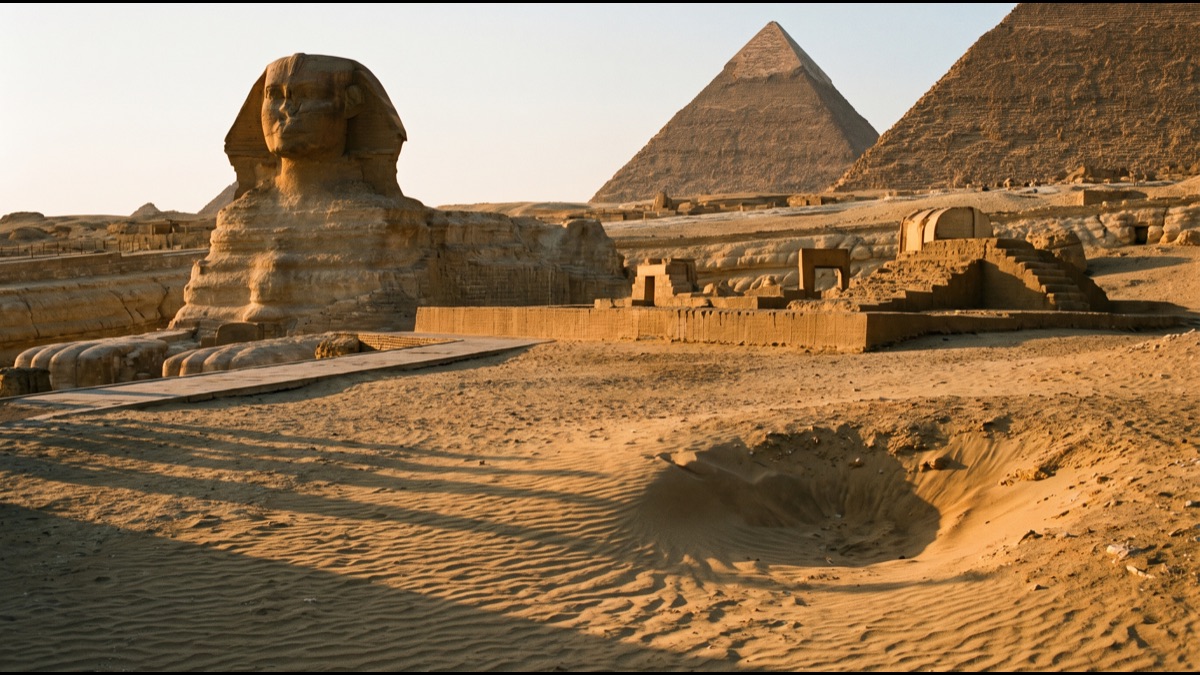
The Great Sphinx of Giza is one of the largest and oldest monumental sculptures in the world: a recumbent lion with a human head, carved directly from the limestone bedrock of the Giza Plateau. Standing guard beside the pyramid complex of Khafre, it has fascinated travelers, historians, and conspiracy theorists alike for millennia, precisely because so much about its original purpose remains genuinely debated among scholars.
Unlike the pyramids, which were built from quarried and transported blocks, the Sphinx was carved in place from a single mass of natural limestone left behind after workers cut blocks for Khafre's pyramid complex, making it a unique feat of subtractive rather than additive construction.
Size and Construction
The Sphinx measures approximately 73 meters (240 feet) long and about 20 meters (66 feet) tall, making it the largest monolithic statue in the world. Its body was carved from the layered limestone bedrock, while its head — proportionally smaller than a lion's body would naturally require — was carved from a harder, higher-quality layer of stone, which likely explains why the face has survived better than the softer body, which shows significant erosion.
Smaller blocks of limestone were used to build up parts of the body and add a stone beard and a uraeus (cobra) on the forehead, fragments of which are now displayed in the British Museum and the Cairo Museum.
Who Built the Sphinx and Whose Face Is It
Most Egyptologists attribute the Sphinx to Pharaoh Khafre, builder of the second Giza pyramid, dating it to around 2500 BCE, largely because of its location within Khafre's pyramid complex and stylistic similarities between the Sphinx's face and known statues of Khafre. This remains the mainstream scholarly consensus, though a minority of researchers have proposed alternative dates or attributions, none of which have gained broad acceptance in peer-reviewed Egyptology.
The original name of the monument is unknown; ancient Egyptians most likely referred to it using a term related to 'living image,' and the name 'Sphinx,' derived from Greek mythology's lion-bodied, riddle-posing creature, was applied by later Greek visitors and has no connection to the monument's original Egyptian meaning.
The Mystery of the Missing Nose
A persistent modern myth claims Napoleon's soldiers shot off the Sphinx's nose with cannon fire during his 1798 Egyptian campaign. This is demonstrably false: sketches and written descriptions of the noseless Sphinx predate Napoleon's arrival by centuries, including drawings from the 1700s.
The most widely cited historical account comes from the 15th-century Egyptian historian al-Maqrizi, who wrote that a Sufi named Muhammad Sa'im al-Dahr defaced the Sphinx's face in 1378 CE in response to local peasants making offerings to it, which he considered idolatrous. He was reportedly executed by an angry mob for the act. Some Egyptologists remain cautious about this account and note that natural erosion and earlier deliberate damage may also have contributed.
The Sphinx Enclosure and the Dream Stele
The Sphinx sits within a large excavated pit called the Sphinx Enclosure, and directly between its front paws stands the Dream Stele, a granite slab erected by Pharaoh Thutmose IV around 1400 BCE. Its inscription describes how, as a young prince, Thutmose fell asleep in the Sphinx's shadow and dreamed that the monument — then partially buried in sand — promised him the throne of Egypt if he cleared the sand away, which he later did after becoming pharaoh.
This is one of the earliest surviving pieces of evidence that the Sphinx was already ancient, revered, and partly buried by the time of the New Kingdom, roughly a thousand years after its presumed construction.
Visiting the Sphinx Today
The Sphinx is included in the general Giza Plateau admission ticket and sits a short walk from Khafre's pyramid, connected historically by a causeway to Khafre's valley temple, which still stands nearby and is one of the best-preserved Old Kingdom temples in Egypt. Most visitors view the Sphinx from a raised platform in front of it, which offers the classic photo angle with the pyramids in the background.
Restoration work has been ongoing at intervals since the early 20th century to stabilize the body against erosion and past botched repairs; visitors should expect some areas of visible modern masonry blended with the ancient stone.
Sources
- Egyptian Ministry of Tourism and Antiquities — Official antiquities information on the Giza Plateau and the Sphinx
- The British Museum — Fragments of the Sphinx's beard and related Giza artifacts
- Encyclopaedia Britannica — Great Sphinx reference entry, including the Dream Stele
- Ancient Egypt Research Associates (AERA) — Peer-reviewed research on the Giza Plateau context of the Sphinx
FAQ
How old is the Great Sphinx?
Most Egyptologists date the Sphinx to around 2500 BCE, during the reign of Pharaoh Khafre, based on its location within his pyramid complex and stylistic comparisons to his known statues, making it roughly 4,500 years old.
Did Napoleon's soldiers shoot off the Sphinx's nose?
No. This is a popular myth. Sketches and written accounts describing the Sphinx without its nose predate Napoleon's 1798 arrival in Egypt by centuries. The most cited historical account attributes the damage to a deliberate act in 1378 CE.
How big is the Great Sphinx?
The Great Sphinx is approximately 73 meters (240 feet) long and about 20 meters (66 feet) tall, making it the largest monolithic statue in the world, carved from a single mass of limestone bedrock.
What is the Dream Stele?
The Dream Stele is a granite slab placed between the Sphinx's front paws by Pharaoh Thutmose IV around 1400 BCE, describing a dream in which the Sphinx promised him the throne if he cleared away the sand burying it.
Whose face is on the Great Sphinx?
The mainstream scholarly view holds that the face represents Pharaoh Khafre, based on the Sphinx's location within his pyramid complex and stylistic similarities to statues confirmed to depict him, though the identification is based on circumstantial rather than inscriptional evidence.
About the Author
doyouknow.app Editorial Team — Our reporting on the Sphinx draws on peer-reviewed Egyptology and museum archives to separate well-documented history from the persistent myths that surround Egypt's monuments.
Loved This Article?
Share it on WhatsApp → Share on WhatsApp
Get more guides in your inbox — Subscribe to our newsletter for weekly surprising stories from Egypt, Saudi Arabia, Dubai, and beyond.