Introduction
Mummification in ancient Egypt was a deliberate, technically sophisticated preservation process rooted in religious belief, not an accident of desert climate. Egyptians believed the soul, made up of several distinct parts including the ka and the ba, needed a recognizable, intact physical body to return to after death; without preservation, the journey to the afterlife could not succeed. What began as simple natural desiccation in shallow desert graves evolved, over roughly 3,000 years, into an elaborate embalming industry with specialized priests, workshops, and pricing tiers.
Our detailed knowledge of the process comes primarily from the Greek historian Herodotus, writing around 450 BCE, cross-checked against modern scientific analysis of actual mummified remains using CT scanning and other non-invasive techniques.
The Embalming Process Step by Step
Embalmers first removed the internal organs most prone to rapid decay. The brain was extracted through the nostrils using a hooked instrument, a process that destroyed the brain tissue itself since Egyptians did not consider the brain important to preserve. The liver, lungs, stomach, and intestines were removed through an incision in the left side of the abdomen, while the heart was deliberately left in place, believed to be the seat of intelligence and emotion and required for judgment in the afterlife.
The body cavity and removed organs were then packed and covered in natron, a naturally occurring salt compound mined from dry lake beds, which drew out moisture over a process lasting approximately 40 days. After drying, the body was cleaned, sometimes packed with linen or sawdust to restore its shape, treated with oils and resins, and finally wrapped in many layers of linen bandages, a process that itself could take another 15 to 30 days, bringing the total embalming period to roughly 70 days.
Canopic Jars and the Preserved Organs
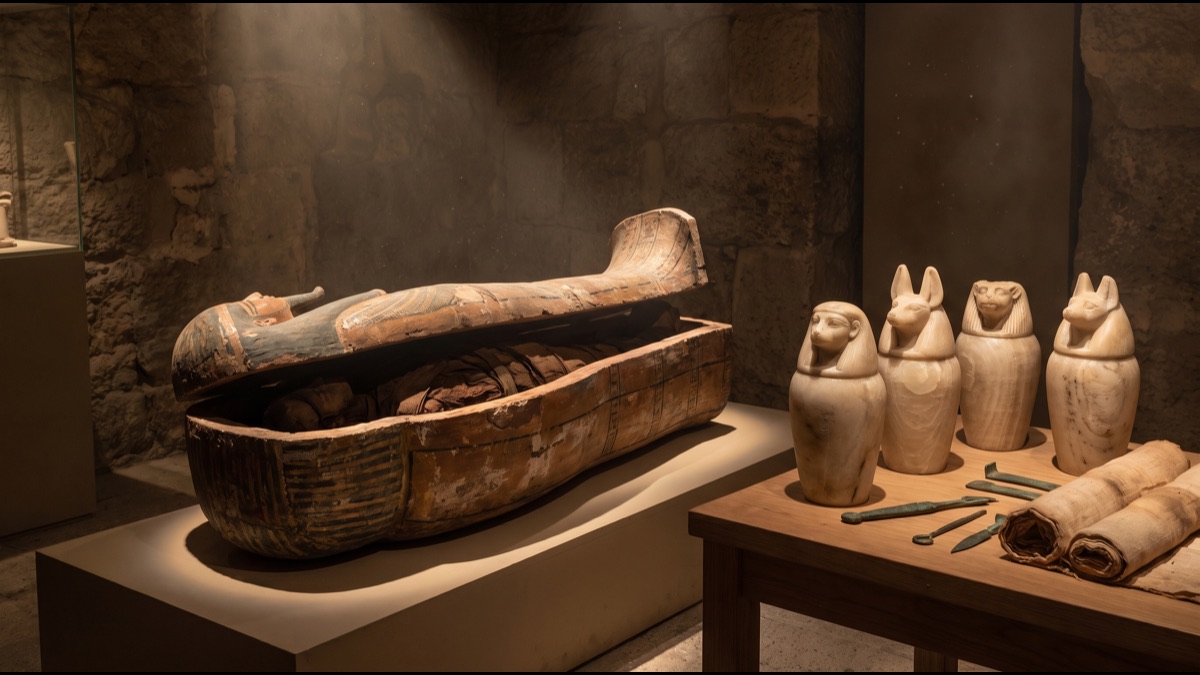
The four organs removed from the body — liver, lungs, stomach, and intestines — were individually preserved and stored in a set of four containers known as canopic jars, each traditionally protected by one of the Four Sons of Horus: Imsety (human-headed, protecting the liver), Hapy (baboon-headed, protecting the lungs), Duamutef (jackal-headed, protecting the stomach), and Qebehsenuef (falcon-headed, protecting the intestines).
These jars were placed in the tomb alongside the coffin, reflecting the belief that the deceased would need these organs restored in the afterlife, and their design and decoration evolved considerably across different dynasties.
Who Was Mummified
While mummification is most closely associated with pharaohs, the practice was never exclusively royal. Herodotus described at least three tiers of embalming service at different price points, and over time mummification became accessible to a much broader segment of Egyptian society, including officials, priests, and eventually many ordinary citizens who could afford at least a basic version of the process.
Egyptians also mummified animals on a massive scale, particularly cats, ibises, and crocodiles, both as beloved pets and, far more commonly, as religious offerings mass-produced for pilgrims to dedicate at animal-associated temples — millions of animal mummies have been recovered from dedicated catacombs.
Where to See Royal Mummies Today
Since April 2021, the mummies of 22 Egyptian kings and queens, including Ramesses II and Seti I, have been displayed in the Royal Mummies Hall at the National Museum of Egyptian Civilization (NMEC) in Fustat, Cairo, following a widely televised event known as the Pharaohs' Golden Parade that transported them from the older Egyptian Museum in Tahrir Square. The hall uses controlled lighting and climate conditions designed specifically for long-term preservation and respectful, dignified display.
Tutankhamun's mummy is a notable exception and remains in his original tomb, KV62, in the Valley of the Kings in Luxor, rather than at NMEC, allowing visitors to see it in its original archaeological context.
Sources
- National Museum of Egyptian Civilization (NMEC) — Official information on the Royal Mummies Hall
- Egyptian Ministry of Tourism and Antiquities — Official antiquities information on mummification and royal collections
- The British Museum — Mummification process and canopic jar collection resources
- Encyclopaedia Britannica — Mummy and mummification reference entry
FAQ
How long did Egyptian mummification take?
The full embalming process typically took around 70 days in total: roughly 40 days of drying the body with natron salt, followed by an additional 15 to 30 days for cleaning, treating, and wrapping the body in linen bandages.
Why did Egyptians remove the brain but leave the heart?
Ancient Egyptians did not consider the brain important and discarded it, extracting it through the nostrils. The heart, however, was left in place because it was believed to be the seat of intelligence and emotion, and it was required for judgment in the afterlife.
What are canopic jars used for?
Canopic jars were a set of four containers used to individually store and preserve the liver, lungs, stomach, and intestines removed during mummification, each traditionally protected by one of the Four Sons of Horus.
Was mummification only for pharaohs?
No. While pharaohs received the most elaborate treatment, ancient sources describe multiple tiers of embalming service at different price points, and mummification eventually became accessible to a broad range of Egyptian society, not only royalty.
Where can I see real Egyptian mummies today?
Since 2021, 22 royal mummies have been displayed in the Royal Mummies Hall at the National Museum of Egyptian Civilization in Cairo. Tutankhamun's mummy is a notable exception and remains in his original tomb in the Valley of the Kings, Luxor.
About the Author
doyouknow.app Editorial Team — We combine classical historical sources with modern scientific studies of mummified remains to present mummification as an accurately documented process rather than popular myth.
Loved This Article?
Share it on WhatsApp → Share on WhatsApp
Get more guides in your inbox — Subscribe to our newsletter for weekly surprising stories from Egypt, Saudi Arabia, Dubai, and beyond.