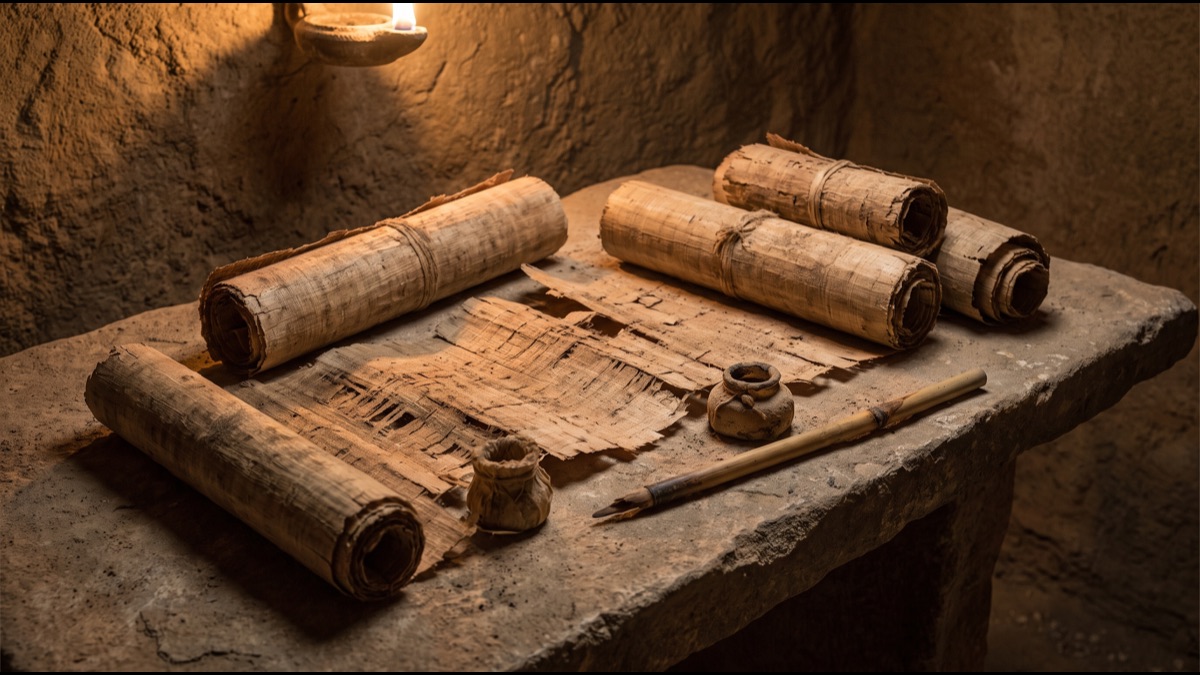
An Egyptian boy destined for the scribal profession could expect to spend more than a decade in school before he was considered fit to hold an official government post, starting as young as five or six years old and continuing well into his teens. In a society where the overwhelming majority of the population could neither read nor write, becoming a scribe was one of the only realistic routes out of manual labor and into positions of genuine administrative power, and the education required to get there was correspondingly demanding, structured, and, by surviving accounts, frequently brutal.
Scribal training was not a casual apprenticeship picked up on the side of other work. It was a formal, years-long curriculum centered on mastering two entirely different writing systems, enormous amounts of memorization and copying, and a body of literature specifically designed to instill discipline and impress upon young students exactly how much better their prospective career was compared to every other trade available to them. Much of what is known about this education comes directly from the students' own surviving practice work: thousands of broken pottery shards and flakes of limestone covered in corrected exercises, mistakes, and copied texts.
The stakes of this training were genuinely high. A successful scribe could rise to manage granaries, oversee construction projects, draft royal correspondence, or serve in the temple bureaucracy, all positions carrying real influence in a civilization that ran on written records for taxation, law, religion, and administration. An unsuccessful one, or a family that could not secure a place for their son in scribal school at all, generally remained locked into the same physical labor that scribal texts so often mocked.
What follows traces the actual mechanics of that training: where it happened, what age it started, which scripts students had to master and in what order, what they physically wrote on before they were trusted with papyrus, how harshly they were disciplined, and what becoming a fully qualified scribe actually opened up for someone in ancient Egyptian society.
Why Scribal Training Began So Young
Surviving evidence suggests boys destined for scribal careers typically began their formal education somewhere between the ages of five and ten, a considerably younger starting point than is often assumed for a civilization without universal schooling. Starting young was less about any particular pedagogical theory and more a practical necessity given how much material had to be absorbed: two complete writing systems, formal literary Egyptian distinct from everyday spoken language, mathematics sufficient for accounting and land measurement, and enough religious and administrative knowledge to eventually function in a temple or government office.
Most students entering this track came from families that were already at least moderately established, since scribal training required a family to forgo a young son's labor for many years while also frequently covering fees, materials, and, in some periods, room and board at a temple or palace institution. This meant scribal education, while theoretically a path to social mobility, was in practice heavily weighted toward boys whose families already had some existing connection to administration, the priesthood, or a trade requiring literacy.
There is no strong evidence that girls were formally trained as scribes in significant numbers during most of pharaonic history, though isolated evidence of literate women, particularly among royalty and high elite households, does survive; scribal schools as an institution were overwhelmingly, if not exclusively, a training ground for boys, reflecting the broader gendered structure of formal administrative and religious roles across most of ancient Egyptian history.
The Scribal Schools Attached to Temples and the Royal Court
Formal scribal education in ancient Egypt was generally organized around two main institutional settings: schools attached directly to major temple complexes, and a more elite track connected to the royal court and central administration, sometimes referred to in modern scholarship by the Egyptian term "kap," associated with training alongside young royal or high-official household members. Temple-attached schools were considerably more common and accessible to the broader population of literate-track families, since temples functioned as major administrative and economic institutions in their own right, requiring a constant supply of trained scribes to manage their considerable landholdings, grain stores, and religious record-keeping.
These schools were not separate purpose-built buildings in the way a modern school is; instruction often took place within temple precincts themselves, in courtyards or designated rooms, under the direct supervision of senior scribes who combined the roles of teacher, disciplinarian, and, eventually, professional sponsor for their most capable students. The relationship between an experienced scribe and his students carried real weight beyond the classroom, since a well-regarded senior scribe's endorsement could meaningfully shape which administrative post a graduating student was eventually placed into.
The royal court track, while smaller in absolute numbers, offered the most direct route to the highest administrative positions in the country, training boys alongside young members of elite and occasionally royal households and exposing them early to the specific vocabulary, protocol, and record-keeping conventions used at the very top of Egyptian government. Graduates of this track were disproportionately likely to go on to hold the most powerful non-royal offices in the administration, including positions overseeing entire regions or major state projects.
Learning Two Scripts at Once: Hieratic and Hieroglyphic
A defining and genuinely difficult feature of Egyptian scribal education was the requirement to master two distinct writing systems that functioned quite differently from one another. Hieroglyphic script, the formal, highly pictorial system most associated with monumental inscriptions, temple walls, and religious texts, was slow and labor-intensive to write, with hundreds of individual signs a student had to learn to recognize and reproduce accurately. Hieratic, by contrast, was a cursive, heavily simplified adaptation of hieroglyphic signs designed specifically for fast handwriting with a reed brush on papyrus or pottery, used for the overwhelming majority of everyday administrative, legal, and literary writing.
Students generally learned hieratic first and used it as their primary working script throughout their careers, since the vast bulk of actual scribal work, tax records, letters, contracts, literary copying, was conducted in hieratic rather than the far more time-consuming hieroglyphic forms. Hieroglyphic training came later and was reserved primarily for scribes headed toward temple and monumental inscription work, where the formal, decorative register of the script was specifically required rather than merely traditional.
The difficulty of this dual-script requirement is difficult to overstate by modern standards: a fully trained scribe needed to recognize and correctly reproduce well over seven hundred distinct hieroglyphic signs in their various contextual forms, alongside fluent command of hieratic's more compressed, ligature-heavy letterforms, all while also mastering the formal literary register of the Egyptian language, which by the New Kingdom period differed meaningfully from the everyday spoken language of the time, functioning somewhat like a classical register students had to learn as if it were almost a second language layered on top of their native speech.
Why Students Practiced on Broken Pottery Before Papyrus
Papyrus was expensive to produce, requiring a labor-intensive process of slicing, layering, pressing, and drying the pith of the papyrus plant, and was accordingly reserved for finished documents, literary copies intended to last, and formal administrative records rather than the endless trial-and-error of a beginning student. Instead, scribal students overwhelmingly practiced on ostraca, a term covering both broken pieces of pottery and flakes of limestone, both of which were abundant, essentially free, and perfectly serviceable surfaces for ink applied with a reed brush.
Thousands of these practice ostraca have survived from sites associated with scribal training, particularly from the village of Deir el-Medina, home to the workers who built the royal tombs in the Valley of the Kings, where an unusually literate community left behind an extraordinarily rich record of everyday writing practice, corrected exercises, personal letters, and even sketches doodled in the margins by bored or restless students.
Graduating from ostraca to papyrus marked a genuine milestone in a student's training, generally reserved for students who had already demonstrated reliable command of basic sign forms and could be trusted not to waste an expensive material on work that would simply need to be redone. Even after that graduation, papyrus remained a comparatively precious resource throughout a scribe's career, frequently reused by scraping off earlier text or writing on the reverse side of documents no longer needed for their original purpose.
The Harsh Discipline Described in Surviving Scribal Texts
Surviving scribal literature, much of it produced by scribes themselves reflecting on their own training, describes an educational environment that was frequently harsh, physically disciplined, and openly built around fear of punishment as a primary motivator. Several surviving texts include direct references to beatings as a routine feature of correcting mistakes or ensuring diligence, phrased in ways that suggest corporal punishment was not viewed as an exceptional measure but as an ordinary, expected part of how a student was kept on task.
One frequently cited line from surviving instructional literature captures this attitude bluntly, describing a boy's ear as being "on his back" in the sense that he only truly listens when struck, a phrase that appears in variant forms across several different surviving scribal texts and strongly suggests this was a widely shared pedagogical assumption rather than an isolated sentiment from a single unusually severe teacher.
Alongside physical discipline, scribal texts also make extensive use of direct comparison and shame as motivational tools, repeatedly urging students to apply themselves by contrasting the comfortable, respected life of a successful scribe against the physical misery awaiting anyone who failed to complete their education, a rhetorical strategy most fully developed in the genre of text known today as the Satire of the Trades.
The Satire of the Trades and Its Role in Scribal Education
The Satire of the Trades, sometimes called the Instruction of Khety, is among the most widely copied pieces of ancient Egyptian scribal literature, surviving in numerous copies made by students across centuries, which itself is strong evidence of how central the text was to standard scribal curriculum. Structured as advice from a father to his son on the eve of the son's entry into scribal school, the text systematically works through a long list of other trades and professions, describing each one in exaggeratedly miserable, physically degrading terms.
Metalworkers are described as having fingers like crocodile skin from the heat and filth of their work, farmers are portrayed as perpetually exhausted and cheated by tax collectors, laundrymen are depicted washing filthy garments alongside crocodiles at the riverbank, and soldiers are described enduring beatings and near-starvation on campaign, each profession rendered in the bleakest possible terms specifically to make the comparatively comfortable, secure life of a literate scribe seem overwhelmingly preferable by contrast.
Modern scholars generally read the text less as objective social commentary and more as deliberate, almost propagandistic motivational literature aimed squarely at scribal students themselves, reinforcing the message that the difficulty of their current studies was a worthwhile trade-off against manual trades whose difficulties were permanent rather than temporary, a rhetorical device whose survival in so many student copies suggests it worked as intended across many generations of Egyptian schoolchildren.
How Students Were Actually Tested and Corrected
Ancient Egyptian scribal education did not rely on a single standardized exam in the modern sense; instead, students were continuously assessed through the ongoing correction of their copying and composition work, with senior scribes reviewing student ostraca, marking errors, and requiring corrected passages to be rewritten until they met an acceptable standard. Surviving ostraca frequently show a teacher's model text alongside a student's attempted copy, sometimes with visible corrections or annotations added directly onto the student's surface.
Copying was the dominant pedagogical method throughout scribal education: students copied classic literary texts, wisdom instructions, hymns, and model letters repeatedly, a method that simultaneously trained handwriting accuracy, built vocabulary and command of formal literary Egyptian, and exposed students to the specific texts considered culturally and professionally essential for an educated scribe to know by heart or near enough to it.
Beyond copying, students were also trained and effectively tested in practical skills tied directly to future job functions: basic arithmetic and measurement calculations relevant to land surveying and taxation, model letter-writing exercises mimicking real administrative correspondence, and, for students on tracks toward temple work, memorization of religious formulas and ritual texts, meaning the testing was continuously embedded in the curriculum rather than concentrated into a single final assessment.
What a Qualified Scribe Actually Did for a Living
Once trained, scribes filled an extraordinarily broad range of roles across ancient Egyptian society, since functional literacy was the fundamental technical requirement underlying virtually the entire administrative apparatus of the state. Scribes managed tax assessment and collection records, tracked grain stores and redistributed rations, drafted and copied legal contracts and land transfer documents, recorded court proceedings, and maintained the census-like population and labor records the state needed to organize large public projects, including the construction of royal monuments.
Temple scribes handled an equally significant but distinct body of work, copying and maintaining religious texts, recording temple income from land and offerings, and managing the considerable economic operations many major temples ran as landholding institutions in their own right, a role that placed literate temple staff at the center of both religious and economic life in their regions.
Beyond pure administration, scribes also functioned as the closest ancient Egyptian equivalent to professional writers, copying and preserving works of literature, wisdom instructions, and historical and religious texts that would otherwise have been lost, meaning the modern understanding of ancient Egyptian civilization depends directly and heavily on the survival of documents produced by exactly this trained scribal class.
Scribal Work as a Genuine Path to Social Mobility
Because ancient Egyptian society was overwhelmingly agrarian and organized around physical labor for the vast majority of its population, the scribal profession represented one of the few genuinely available routes for a family of modest but not destitute means to place a son into a position of real administrative authority and comparative physical comfort within a single generation. A successful scribe was generally exempt from the physically grueling conscripted labor obligations that fell on much of the ordinary population, a distinction Egyptian scribal literature returns to repeatedly and explicitly as one of the profession's central appeals.
Successful scribes could rise through an internal administrative hierarchy toward positions of genuine regional or even national influence, becoming overseers of specific departments, managers of major construction or agricultural projects, or senior temple administrators, positions that came with material wealth, household staff, and social standing well beyond what their family of origin may have held.
This mobility, however, had real limits: the highest positions in Egyptian government remained concentrated among established elite families with existing court connections, and while scribal literacy could meaningfully raise a family's status over a generation or two, it rarely erased the practical advantages already held by families with prior wealth, land, or direct court access, meaning scribal education functioned as a genuine but not unlimited mechanism for social advancement.
How Few Ancient Egyptians Could Actually Read and Write
Modern scholarly estimates of literacy in ancient Egypt vary depending on period, region, and exactly how literacy itself is defined, but most estimates place functional literacy at a small minority of the total population, commonly cited in a rough range of roughly one to a few percent of Egyptians overall across most of pharaonic history, with somewhat higher rates concentrated in administrative centers, temple towns, and among specific occupational communities such as Deir el-Medina's workers.
This scarcity is precisely what made scribal skill so valuable and scribal status so distinct: in a population where the overwhelming majority could neither read a tax record nor write a simple letter, the ability to do so functioned as a genuinely rare and defensible professional credential, roughly analogous in its social weight to a specialized technical or legal qualification in a modern economy with much broader baseline literacy.
This same scarcity also explains why ancient Egyptian bureaucracy, despite its considerable administrative sophistication, still depended so heavily on oral communication and personal relationships alongside written records: illiterate officials and workers regularly relied on scribes to read documents aloud to them and to write on their behalf, meaning scribes functioned not merely as record-keepers but as an essential interpretive layer between the written state apparatus and the largely non-literate population it governed.
Famous Surviving Scribal Training Papyri and Ostraca
The Papyrus Anastasi collection, a group of New Kingdom period papyri now held primarily in the British Museum, includes some of the richest surviving evidence of scribal training content, containing model letters, exercises in composing formal correspondence, and passages explicitly instructing students on proper scribal conduct and diligence, giving modern scholars an unusually direct window into what an advanced scribal student was actually expected to produce.
The enormous body of ostraca recovered from Deir el-Medina remains the single richest archaeological source for everyday scribal practice specifically, since the site's unusually literate community of royal tomb workers left behind not just formal training exercises but personal letters, legal disputes, work rosters, and even literary compositions written by individuals well beyond their initial student years, offering a far broader picture of ongoing literate life than training-specific materials alone could provide.
Multiple surviving copies of instructional wisdom literature, including the Satire of the Trades and other similar genre texts often grouped under the modern label of Egyptian "instruction" literature, exist specifically because they were repeatedly assigned as copying exercises across generations of students, meaning their survival in such numbers is itself a direct artifact of how central they were to the standard scribal curriculum rather than simply a matter of chance preservation.
The Later Stages of a Scribe's Career
Completing basic scribal education did not mark the end of a scribe's professional development; younger scribes typically continued working under the direct supervision of more senior scribes for a considerable additional period, effectively serving an extended professional apprenticeship within an actual administrative office, temple, or workshop before being trusted with fully independent responsibility over significant records or decisions.
Specialization also generally occurred well after the foundational years of general scribal training, with individual scribes gradually moving toward specific areas such as temple ritual and religious text copying, military administration and logistics record-keeping, land survey and boundary documentation, or medical text transmission, each specialization carrying its own additional body of specific vocabulary, formulas, and conventions layered on top of the general scribal foundation.
The most successful and well-connected scribes could eventually reach positions with titles indicating genuinely significant authority, including overseer roles managing entire departments or major state projects, and in rare, well-documented individual cases, scribes rose to become some of the most powerful non-royal officials in the entire Egyptian state, a trajectory that began, for every one of them, with the same basic training on broken pottery shards as a young child.
Why the Scribal System Endured for So Long
The core structure of Egyptian scribal training, early entry, dual-script mastery, extensive supervised copying, and gradual advancement through demonstrated competence, remained recognizably stable across an enormous span of Egyptian history, persisting with meaningful continuity across multiple dynasties and periods of political disruption precisely because the underlying administrative need it served, a reliable, sufficiently large supply of literate officials, never disappeared even as specific rulers and ruling dynasties came and went.
This continuity is itself part of why the surviving evidence for scribal training is so unusually rich compared to evidence for many other aspects of daily ancient Egyptian life: because the same core texts, exercises, and disciplinary literature were copied and recopied by students across many centuries, modern archaeologists and historians have access to an unusually dense, cross-referenced body of material documenting essentially the same educational system operating with only gradual change over an extraordinarily long stretch of time.
That endurance also reflects something genuinely distinctive about how ancient Egyptian civilization understood the written word itself: as a technology of state power, religious permanence, and personal legacy simultaneously, meaning the training required to wield it competently was never treated as a minor technical skill but as one of the single most consequential things a young person could master, a status the system's own surviving literature was, quite deliberately, written to reinforce.
Sources
- Wikipedia — overview of the ancient Egyptian scribal profession and its administrative role
- Wikipedia — background on the Satire of the Trades and its role in scribal education
- The British Museum — collections information on Papyrus Anastasi and related New Kingdom scribal texts
- The Metropolitan Museum of Art — curatorial background on Egyptian scribal statuary, ostraca, and writing equipment
FAQ
At what age did Egyptian scribal training begin?
Most evidence suggests boys began somewhere between roughly ages five and ten, since the full curriculum of two scripts, formal literary language, and arithmetic took many years to complete.
Why did students practice on pottery instead of papyrus?
Papyrus was expensive and labor-intensive to produce, so beginning students practiced on ostraca, broken pottery shards and limestone flakes, which were abundant and effectively free.
What is the Satire of the Trades?
It is a widely copied piece of scribal instructional literature that mocks the physical misery of other professions to convince students that enduring difficult scribal training was worthwhile by comparison.
How many ancient Egyptians could actually read and write?
Most scholarly estimates place functional literacy at a small percentage of the overall population across most of pharaonic history, making scribal skill a genuinely rare professional credential.
Did scribes learn hieroglyphic or hieratic script first?
Students generally learned hieratic, the faster cursive script used for everyday administrative writing, first, with the more formal hieroglyphic script typically introduced later for those headed toward temple and monumental work.
Was becoming a scribe a real path to social mobility?
Yes, though with limits; scribal literacy could meaningfully raise a family's status and exempt a scribe from grueling physical labor obligations, but the very highest offices remained concentrated among already-elite families.
About the Author
We reference Wikipedia and other authoritative sources to explain the background and current understanding of this topic.
Loved This Article?
Share it on WhatsApp → Share it on WhatsApp
Get more guides in your inbox — Subscribe to our newsletter for weekly surprising stories from Egypt, Saudi Arabia, Dubai, and beyond.