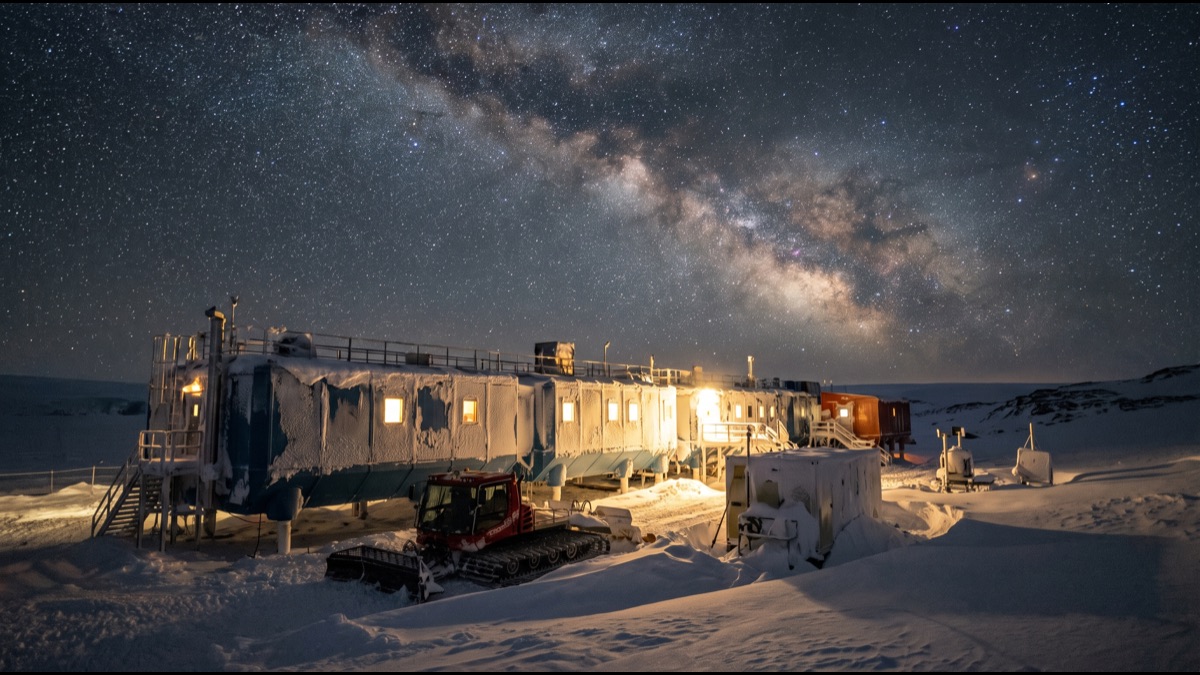
For roughly four months of the year, the sun never rises above the horizon at the South Pole, and for the people who choose to stay through it, evacuation becomes physically impossible long before the darkness even begins. Winter-over crews at Antarctic research stations commit to a season of total isolation unlike almost anything else on Earth, cut off not by choice in the moment but by weather and logistics that make rescue genuinely unavailable regardless of what happens.
Understanding how these small crews actually survive, both physically and psychologically, means understanding a combination of careful selection, redundant engineering, and deliberately structured routine that together turn an environment actively hostile to human life into something survivable for months at a stretch.
Why Winter Isolation in Antarctica Is Genuinely Absolute
Antarctica's winter combines extreme cold, in the interior often dropping below minus sixty degrees Celsius, with near-total darkness at the highest latitudes and weather severe enough to ground aircraft for weeks at a time even when flights would otherwise be theoretically possible.
Unlike almost any other remote posting on Earth, from oil rigs to submarines to even the International Space Station, an Antarctic winter station generally cannot be reached or left at all for a defined, months-long period, not merely inconveniently but as a matter of genuine physical impossibility given aircraft operating limits in extreme cold and darkness.
This absoluteness is precisely what distinguishes the psychological experience of an Antarctic winter from other forms of isolation. A crew member knows with certainty that no matter what develops, medical emergency, personal conflict, equipment failure, or simple homesickness, no one is coming and there is no way out until the season itself changes.
Researchers who study extreme environments frequently compare wintering in Antarctica to long-duration spaceflight specifically because of this combined isolation and confinement, and space agencies including NASA have in fact used Antarctic winter stations as genuine analogue environments for studying how crews cope psychologically ahead of future long-duration missions to the Moon or Mars.
Why Evacuation Becomes Physically Impossible
Aircraft require a minimum temperature to operate safely, since jet fuel and hydraulic fluids can become dangerously unreliable in extreme cold, and standard runway conditions become unusable once temperatures fall far enough below the threshold most aircraft and their fuel systems are certified for.
Combined with near-total darkness across much of the season, which makes visual landing at unlit polar runways extraordinarily hazardous, and frequent severe storms called blizzards that can ground flights even at more moderate temperatures, the practical flying window at interior stations essentially closes for months at a time.
Some coastal stations retain narrow emergency flight windows using specially equipped aircraft and highly experienced polar pilots, but even these remain genuinely last-resort options reserved for the most severe emergencies, since the risk to the aircraft and crew attempting the flight is itself substantial.
Ground transport offers no meaningful alternative either, since a surface traverse across the ice sheet during the darkest, coldest months would take considerably longer than any medical or logistical emergency could tolerate, and would itself expose a rescue team to essentially the same extreme conditions threatening the person they were attempting to reach.
How Crews Are Actually Selected for Winter
National Antarctic programmes select winter-over personnel through a considerably more rigorous process than summer staffing, since a poor psychological fit discovered in October cannot simply be resolved by sending someone home the way it might be at almost any other remote workplace.
Candidates typically undergo psychological screening and structured interviews specifically assessing how they are likely to cope with prolonged confinement, limited social variety, and the complete absence of green space, fresh food, or ordinary daylight cues for months at a time.
Programmes also deliberately weigh interpersonal compatibility across an entire winter roster, since a crew that might individually be perfectly capable can still struggle badly if the mix of personalities proves incompatible under sustained close-quarters pressure with genuinely nowhere else to go.
Practical skills beyond a candidate's core scientific or technical role weigh heavily in selection decisions too, since a small isolated crew benefits enormously from members who can also cook, perform basic first aid, or troubleshoot mechanical problems, versatility that becomes considerably more valuable than narrow specialisation once outside support is genuinely unavailable.
How Stations Keep Crews Alive Physically
Winter stations maintain substantial fuel reserves and fully redundant backup power generation, since a complete power failure during extreme cold and total isolation would be genuinely life-threatening within hours rather than merely inconvenient the way it would be almost anywhere else.
Food supplies for the entire winter arrive during the brief summer resupply window and must be calculated with considerable margin, since no further deliveries are possible once the season closes, requiring careful planning around both caloric needs and psychological variety in what is available to eat.
Heating, water supply typically produced by melting snow or ice, and waste management systems are all built with meaningful redundancy specifically because a station cannot simply call for a repair technician, and crews include personnel cross-trained to maintain and repair critical systems themselves.
Fire is treated as an especially severe risk during the isolated winter months, since firefighting resources are limited and a serious blaze could destroy critical shelter or equipment with no possibility of outside reinforcement arriving in time, so stations maintain rigorous fire prevention protocols, regular drills, and dedicated firefighting equipment year-round.
How the Polar Night Actually Differs by Station
The experience of darkness varies considerably depending on a station's exact latitude. At the geographic South Pole itself, the sun does not rise for approximately six months of the year, producing a single continuous polar night broken only by a prolonged twilight period at each end.
Coastal stations positioned closer to the Antarctic Circle experience a considerably shorter true polar night, sometimes only several weeks of complete darkness, with a longer period of dim twilight on either side rather than the extended continuous darkness experienced further inland.
This distinction matters considerably for planning purposes, since stations with a shorter true polar night can maintain somewhat more normal outdoor activity and light exposure for a larger portion of the winter season compared with stations sitting under months of genuinely unbroken darkness.
The return of the sun after the polar night is itself treated as a significant occasion at most stations, with the first sunrise following months of darkness often marked by informal gatherings and photography, a moment crew members frequently describe as one of the most memorable of the entire winter posting.
What Happens to Sleep and the Body Clock
Without a natural sunrise or sunset to anchor it, the human circadian rhythm can drift substantially during an Antarctic winter, and many crew members report sleep becoming noticeably less regular despite station schedules deliberately maintaining a fixed daily routine.
Stations combat this by enforcing strict artificial lighting schedules and encouraging fixed meal and activity times specifically to substitute for the natural light cues that would ordinarily regulate sleep, since disrupted circadian rhythm is strongly linked to worsened mood and cognitive performance.
Specialised light therapy, using bright artificial light exposure at set times to mimic a natural daylight pattern, has become a standard tool at many stations specifically to help stabilise crew members' sleep and mood through the darkest months of the season.
How Stations Manage Psychological Strain
Beyond physical survival, station management devotes considerable deliberate effort to structuring the winter season psychologically, including scheduled social events, hobby groups, exercise facilities, and traditions such as marking the winter solstice with a dedicated celebration.
Regular scheduled communication with family, though often limited by low bandwidth and time-zone-shifted satellite windows rather than constant connectivity, remains an important psychological anchor that most modern stations prioritise considerably more than earlier expeditions were able to.
Some programmes provide access to remote mental health professionals via video or radio link, and station leadership is typically trained specifically to recognise early warning signs of psychological strain in crew members before a manageable difficulty develops into a genuine crisis.
Personal hobby projects, from woodworking to amateur astronomy to writing, are actively encouraged and often supported with dedicated workshop space, since having a genuinely absorbing personal project has been repeatedly linked in post-winter debriefs to better overall psychological resilience across the isolated season.
What Winter-Over Syndrome Actually Looks Like
Researchers studying polar isolation have documented a recognisable pattern sometimes called winter-over syndrome, involving irritability, difficulty concentrating, mild depression, and interpersonal friction that tends to emerge partway through a long isolated winter season rather than at its start.
The pattern is thought to result from the combined effects of disrupted circadian rhythm, reduced sensory variety, limited social contact beyond a small fixed group, and the psychological weight of knowing that no matter what happens, departure remains genuinely impossible for a defined further stretch of time.
Most crew members experience only a mild version of this pattern and manage it well given adequate structure and support, but its well-documented existence is precisely why station psychological support and pre-season screening receive as much serious attention as they do.
How Small Crews Manage Interpersonal Conflict
With a winter crew sometimes numbering only a handful of people at the smallest stations, unresolved interpersonal friction has nowhere to dissipate the way it naturally might in a larger community with more social variety and physical space to create distance.
Stations address this partly through deliberate physical design, providing private quarters and quiet spaces where individuals can genuinely withdraw when needed, and partly through cultural norms actively encouraged by leadership around conflict resolution and mutual tolerance for differing personalities under pressure.
Structured group activities, shared responsibilities for cooking and maintenance, and traditions that mark the passage of the season all serve a dual purpose beyond their practical function, giving the group shared positive experiences that help offset the friction inherent to prolonged close confinement.
Some stations rotate cooking duty among all crew members regardless of their formal role, partly out of practical necessity and partly because sharing a task most people find genuinely stressful under normal circumstances turns out to build considerably more mutual goodwill than assigning it permanently to a single designated cook.
What Science Actually Continues Through Winter
Far from being a dormant season, winter is scientifically valuable specifically because certain atmospheric, astronomical, and glaciological measurements are only meaningful when taken during total darkness and extreme cold, conditions unavailable at any other time of year.
Astronomical observatories at interior stations take advantage of the exceptionally dry, stable, dark atmosphere for observations that would be considerably degraded by the presence of any sunlight, making the winter season scientifically essential rather than merely something to be endured.
Atmospheric researchers continue monitoring ozone, greenhouse gases, and other measurements requiring continuous year-round data collection, meaning winter crews maintain active ongoing research responsibilities throughout the season rather than simply keeping the station's systems running until spring.
Some of the most consequential long-term climate datasets in existence, including continuous ice-core and atmospheric composition records, depend entirely on this uninterrupted winter data collection, meaning a gap caused by an unstaffed winter would represent a genuinely irreplaceable loss to decades of accumulated scientific record.
How Emergency Medical Situations Are Actually Handled
Every winter-over crew includes at least one trained medical professional, and station medical facilities are equipped considerably beyond what a facility of similar size would carry anywhere with normal emergency access, precisely because outside help is not a realistic option for months.
For situations beyond what on-site medical staff can manage, stations maintain telemedicine links to specialist physicians elsewhere in the world, allowing remote guidance for procedures the on-site doctor may never have personally performed but can be talked through in real time.
In the most severe cases, an extremely hazardous specialised winter rescue flight has occasionally been attempted as an absolute last resort, a decision made only when the alternative is considered certain to be worse, and one that remains rare specifically because of how genuinely dangerous the flight itself is.
Perhaps the most famous such episode involved a doctor stationed at the South Pole who diagnosed her own breast cancer during the winter of 1999 and had to self-administer chemotherapy using equipment and medication airdropped by parachute, since even that emergency did not meet the threshold considered severe enough to justify a genuine winter landing attempt.
The people who spend a winter at an Antarctic research station are not simply enduring an unusually harsh posting; they are participating in one of the most carefully engineered forms of extreme human isolation on the planet, one where survival depends as much on psychological preparation and social structure as on generators, fuel reserves, and heated walls.
Sources
- Wikipedia — overview of South Pole station operations and winter conditions
- U.S. National Science Foundation — official information on the U.S. Antarctic Program
- British Antarctic Survey — research on polar isolation and station operations
- NASA — comparative research on isolation, drawing parallels between Antarctic stations and spaceflight
FAQ
Can anyone leave an Antarctic station during winter if there's an emergency?
Generally no — most stations are completely cut off from flights for roughly eight months, and a genuine medical emergency may require an extremely risky specialised winter rescue flight only as an absolute last resort.
How many people typically stay at a station over winter?
Winter crews are usually a small fraction of summer staffing, often somewhere between ten and around eighty people depending on the station, chosen specifically for psychological resilience.
Do Antarctic winter crews actually go through psychological screening?
Yes — candidates typically undergo psychological evaluation and interviews specifically assessing how they are likely to cope with prolonged isolation and confinement before being selected.
Is it literally dark for the entire winter?
At the South Pole itself the sun does not rise for about six months; at coastal stations closer to the Antarctic Circle the polar night is considerably shorter.
What happens if the power system fails during winter?
Stations maintain redundant backup generators and fuel reserves specifically because a total power failure during extreme cold and total isolation would be genuinely life-threatening.
About the Author
We reference Wikipedia, the U.S. National Science Foundation, the British Antarctic Survey, and NASA to explain the background and current understanding of this topic.
Loved This Article?
Share it on WhatsApp → Share it on WhatsApp
Get more guides in your inbox — Subscribe to our newsletter for weekly surprising stories from Egypt, Saudi Arabia, Dubai, and beyond.