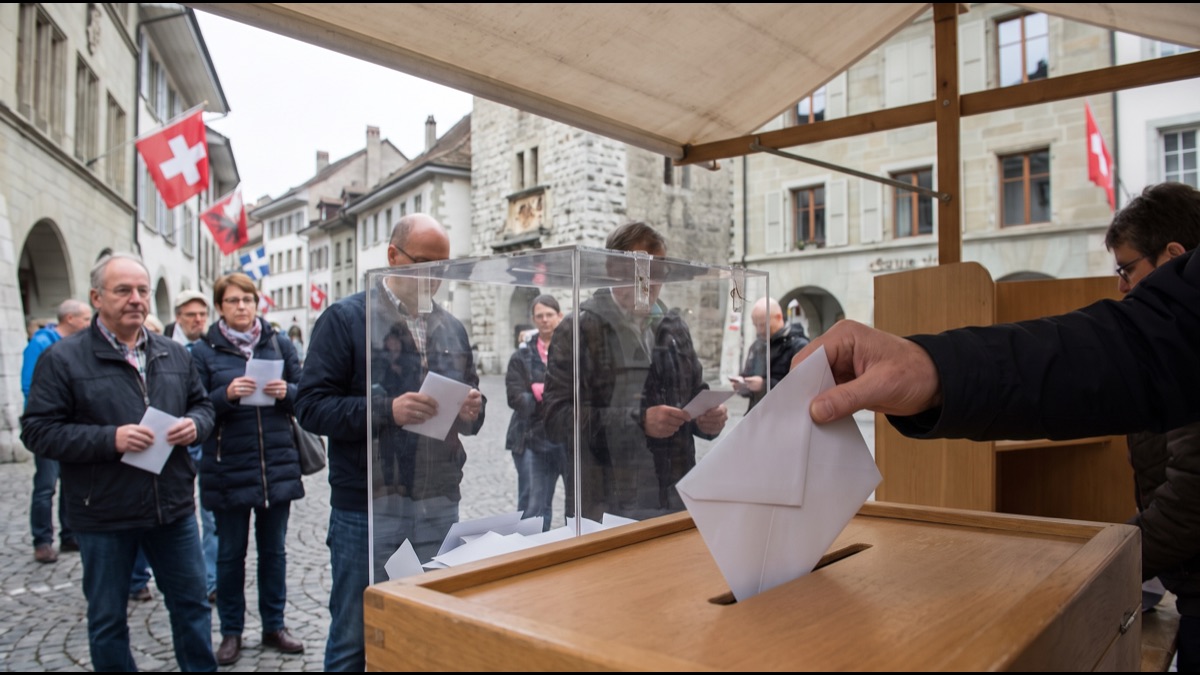
Swiss voters can end up deciding national policy at the ballot box several times a year, on questions ranging from pension reform to minaret construction to fighter jet purchases. Switzerland's system of direct democracy goes considerably further than the referendum mechanisms found in most other democracies, giving ordinary citizens formal, structured routes to force a national vote on both proposed new laws and existing legislation they object to.
Understanding how this actually functions means understanding three distinct legal instruments working together, the popular initiative, the mandatory referendum, and the optional referendum, each triggered differently and each producing a different kind of binding outcome once the votes are counted.
Why Switzerland's System Is Genuinely Unusual
Most democracies rely almost entirely on elected representatives to make law, treating direct popular votes as rare, exceptional events reserved for genuinely constitutional questions. Switzerland instead built direct citizen participation into its ordinary legislative process as a routine, recurring mechanism rather than an occasional exception.
This structure traces back to Switzerland's decentralised political tradition, built historically from largely autonomous cantons that jealously guarded local self-governance, a legacy that shaped a national constitution deliberately designed to keep considerable lawmaking power directly in citizens' hands rather than concentrated in a distant parliament.
The practical result is that Swiss citizens vote on national ballot questions considerably more often than citizens of almost any other country, with a typical year including multiple separate national votes covering everything from tax policy to environmental regulation to foreign relations.
Foreign observers sometimes assume this system must produce constant political chaos or gridlock, yet Switzerland has instead built a reputation for exceptional political and economic stability, a combination that political scientists frequently cite as evidence that direct democracy and effective governance are not inherently in tension provided the surrounding institutions are designed carefully enough.
What a Popular Initiative Actually Requires
A federal popular initiative allows citizens to propose a specific amendment to the constitution directly, bypassing parliament entirely at the proposal stage, provided organisers can collect 100,000 valid signatures from Swiss citizens within an 18-month window.
Once the signature threshold is verified by federal authorities, the proposal must be put to a national vote regardless of parliament's own view of the idea, though parliament may draft and simultaneously present a formal counter-proposal for voters to consider alongside the original initiative text.
Because a successful initiative amends the constitution directly rather than ordinary legislation, it requires the same double-majority standard used for other constitutional changes, and successful initiatives typically still require follow-up implementing legislation before the new constitutional principle becomes fully operational in practice.
The 18-month signature-collection window is itself a genuine practical constraint, since gathering 100,000 handwritten signatures on paper petitions, still the required format for validity, demands sustained volunteer organisation and campaigning rather than a quick online push, meaning many attempted initiatives fail to qualify for a vote at all.
How a Mandatory Referendum Actually Differs
Certain categories of decision automatically trigger a mandatory national vote regardless of whether any citizen group requests one, including any proposed amendment to the federal constitution and any decision to join certain international organisations or treaties.
This category exists specifically because Switzerland's constitutional tradition treats changes of that magnitude as requiring direct popular consent as a matter of basic legitimacy, rather than trusting parliament alone to make a decision of that fundamental a nature on the country's behalf.
Mandatory referendums require the same double majority as popular initiatives, meaning a proposal must win both a majority of the national popular vote and a majority of individual cantons, a considerably higher bar than a simple nationwide majority alone would represent. This threshold is deliberately set high precisely because constitutional matters are considered to warrant unusually broad and durable consent before they can be locked into Switzerland's founding legal document.
Emergency federal decrees intended to remain in force for more than a year are also generally subject to this mandatory vote category, meaning even legislation adopted quickly to address an urgent situation must eventually receive direct popular endorsement if it is to remain part of ongoing law beyond its initial emergency justification.
How an Optional Referendum Actually Works
An optional referendum allows citizens to challenge a law parliament has already passed, provided organisers gather 50,000 valid signatures within 100 days of the law's official publication, forcing the legislation to a national vote before it can take effect.
This mechanism functions effectively as a citizen veto over ordinary legislation, and unlike a constitutional initiative it requires only a simple national popular majority to succeed, since it concerns an ordinary statute rather than a constitutional amendment.
The mere existence of the optional referendum threat shapes how parliament legislates well before any actual vote occurs, since lawmakers routinely negotiate compromises specifically to avoid a law being challenged and potentially overturned at the ballot box after having already passed through the normal legislative process.
Trade unions, business associations, and advocacy groups all maintain standing readiness to launch a referendum challenge against legislation they oppose, and this ever-present institutional capacity is precisely what gives the optional referendum its ongoing practical influence, well beyond the relatively small number of laws that are actually challenged to an eventual vote in any given year.
Why the Double Majority Rule Actually Exists
Constitutional changes, whether from a popular initiative or a mandatory referendum, require winning not just a nationwide popular majority but also a majority of Switzerland's 26 cantons, with each canton's overall result counting as a single vote in that second tally.
This dual requirement was deliberately designed to prevent a handful of large, densely populated cantons from consistently outvoting the country's many smaller, more rural cantons on constitutional matters, preserving a meaningful voice for less populous regions in the most consequential category of national decisions.
The double majority occasionally produces a result where the nationwide popular vote and the cantonal vote point in different directions, requiring the measure to fail overall, a genuinely rare but constitutionally significant outcome that periodically reignites public debate about whether the system still strikes the right balance.
How Often Swiss Citizens Actually Vote
National referendum votes are scheduled on four fixed dates spread across the calendar year, though any single voting day frequently bundles several entirely unrelated national questions together alongside separate cantonal and municipal ballot questions specific to each voter's home region.
A politically engaged Swiss citizen can realistically expect to vote on national policy questions somewhere between four and fifteen or more times in a typical year once cantonal and municipal questions are included, a frequency that would be considered extraordinary in most other democracies.
Voter turnout for these referendum days varies considerably depending on how contentious or high-profile a given question is, typically ranging from below half of eligible voters for routine technical matters to considerably higher participation for genuinely divisive national debates.
Most Swiss voters cast their ballot by post well ahead of the actual voting day rather than attending a physical polling station, a practice that has become the dominant method nationally and one credited with helping sustain relatively healthy turnout given how frequently citizens are asked to weigh in on national questions.
What Cantons Actually Contribute to the System
Switzerland's 26 cantons retain substantial autonomous authority over their own affairs, including their own tax rates, educational systems, and many local regulations, and many cantons additionally run their own parallel direct democracy mechanisms at the cantonal and municipal level.
Some cantons still hold a traditional open-air assembly called a Landsgemeinde, where eligible citizens gather physically in a public square and vote by a show of hands on cantonal matters, an increasingly rare practice but one that survives in a small number of cantons as a living continuation of very old direct democratic tradition.
This layered structure, with direct democracy operating simultaneously at the federal, cantonal, and municipal level, means an engaged Swiss citizen may participate in meaningfully more individual votes across their lifetime than almost any other citizen of a modern democracy.
Municipal-level direct democracy in particular can extend to remarkably granular local questions, with residents in some communities voting directly on matters such as naturalisation applications for individual foreign residents or specific local infrastructure projects, a level of citizen involvement in governmental decision-making unmatched almost anywhere else at comparable scale.
How Parliament Actually Responds to Initiatives
Facing a popular initiative it considers poorly drafted or unwise, parliament frequently drafts an alternative counter-proposal addressing similar underlying concerns in a way it considers more workable, presenting voters with a genuine choice between the original initiative, the counter-proposal, and the current status quo.
This counter-proposal mechanism gives parliament meaningful influence over the eventual outcome even when it cannot simply block a citizen-driven initiative from reaching a vote, since a well-crafted counter-proposal can peel away support from an initiative that voters might otherwise have approved.
Initiative organisers can also choose to withdraw their proposal if parliament's counter-proposal or an intervening legislative compromise satisfies their underlying concern, meaning many initiatives never actually reach a final vote despite having successfully collected the required signatures.
This negotiation dynamic between initiative organisers and parliament happens almost entirely outside public view, through private meetings and informal signalling long before any formal counter-proposal is published, meaning the visible referendum campaign voters eventually see often represents the tail end of a much longer process of behind-the-scenes political bargaining.
What Famous Referendums Have Actually Decided
Swiss voters have used this system to decide an unusually wide range of consequential national questions over the decades, including a 2009 vote banning the construction of new minarets, decisions on immigration quotas, and repeated votes on Switzerland's relationship with the European Union.
Switzerland was also notably one of the last countries in Europe to extend voting rights to women at the federal level, a change itself achieved only through a referendum in 1971 in which the existing entirely male electorate had to vote to extend suffrage to women.
More routine referendum questions cover matters like specific tax reforms, healthcare funding structures, infrastructure spending, and environmental regulation, meaning the system handles both the occasional genuinely landmark social question and a steady stream of more technical policy detail.
Switzerland has also used popular votes to decide questions with genuine international resonance, including referendums on joining the United Nations, which Swiss voters initially rejected before eventually approving membership decades later, illustrating how the system can produce a national position that shifts meaningfully over time as public opinion itself evolves.
Why the System Slows Down Legislative Change
The ever-present possibility of an optional referendum challenge encourages Swiss lawmakers to build unusually broad political consensus before finalising legislation, since a law passed through narrow partisan majority faces genuine risk of subsequent popular rejection at the ballot box.
This dynamic makes the Swiss legislative process noticeably slower and more consensus-driven than in many parliamentary systems where a governing majority can pass legislation relatively quickly without needing to seriously anticipate direct citizen override after the fact.
Supporters argue this deliberate slowness produces more durable, broadly accepted legislation precisely because it forces genuine compromise upfront, while critics contend it can make timely responses to urgent problems considerably harder to achieve than in more centralised legislative systems.
This tension became particularly visible during moments requiring rapid national decisions, such as economic crises or public health emergencies, when the ordinary pace of consensus-seeking legislation had to be balanced against the genuine need for swift government action, occasionally producing friction between emergency executive measures and the country's deeply held expectation of eventual popular input.
What Criticisms the System Actually Faces
Critics point out that a relatively small, well-organised, well-funded group can gather the necessary signatures for either type of referendum, meaning the system does not necessarily reflect a spontaneous broad citizen movement so much as it reflects whichever interest groups have the resources to run an effective signature campaign.
The system has also occasionally produced outcomes that sit uneasily alongside Switzerland's international human rights commitments, generating ongoing legal and political debate about how a directly expressed popular vote should be reconciled with treaty obligations the country has separately signed.
Campaign spending on referendum votes has also drawn scrutiny, since Switzerland historically imposed few disclosure requirements on how much money interest groups spend influencing a given vote, prompting recent legislative efforts to introduce greater transparency around campaign financing specifically for referendum and initiative campaigns.
Despite these tensions, the system remains deeply embedded in Swiss political identity and shows no meaningful sign of being scaled back, with direct democracy widely regarded across the political spectrum as a defining and largely non-negotiable feature of how the country governs itself.
What makes the Swiss system genuinely distinctive is not simply that citizens can vote directly on policy, several other countries offer some version of that, but that the mechanism operates as routine, structurally guaranteed infrastructure running continuously alongside ordinary parliamentary lawmaking rather than as an occasional, exceptional escape valve reserved for extraordinary moments.
Sources
- Wikipedia — overview of Switzerland's referendum and initiative system
- Swiss Federal Administration — official government information on federal votes
- Swiss Federal Chancellery — official records of referendum and initiative results
- Swiss Federal Assembly — parliamentary information on legislative process and counter-proposals
FAQ
How many signatures does a popular initiative actually need?
A federal popular initiative requires 100,000 valid signatures collected within 18 months to force a national vote on a proposed constitutional amendment.
Does a referendum result automatically become law?
A successful mandatory or optional referendum blocks or confirms existing legislation directly; a successful popular initiative requires further implementing legislation to be drafted afterward.
Why does Switzerland require both a national majority and a cantonal majority for some votes?
Constitutional changes need a double majority — of voters nationally and of individual cantons — specifically to prevent a few large, densely populated cantons from outvoting the rest of the country.
How often do Swiss citizens actually vote?
National referendum votes are typically held on four fixed dates a year, though a single voting day can include several unrelated questions at once.
Can a popular initiative actually change the constitution directly?
Yes — a successful popular initiative amends the federal constitution directly, which is why the signature threshold and double-majority requirement exist as safeguards.
About the Author
We reference Wikipedia, the Swiss Federal Administration, the Swiss Federal Chancellery, and the Swiss Federal Assembly to explain the background and current understanding of this topic.
Loved This Article?
Share it on WhatsApp → Share it on WhatsApp
Get more guides in your inbox — Subscribe to our newsletter for weekly surprising stories from Egypt, Saudi Arabia, Dubai, and beyond.