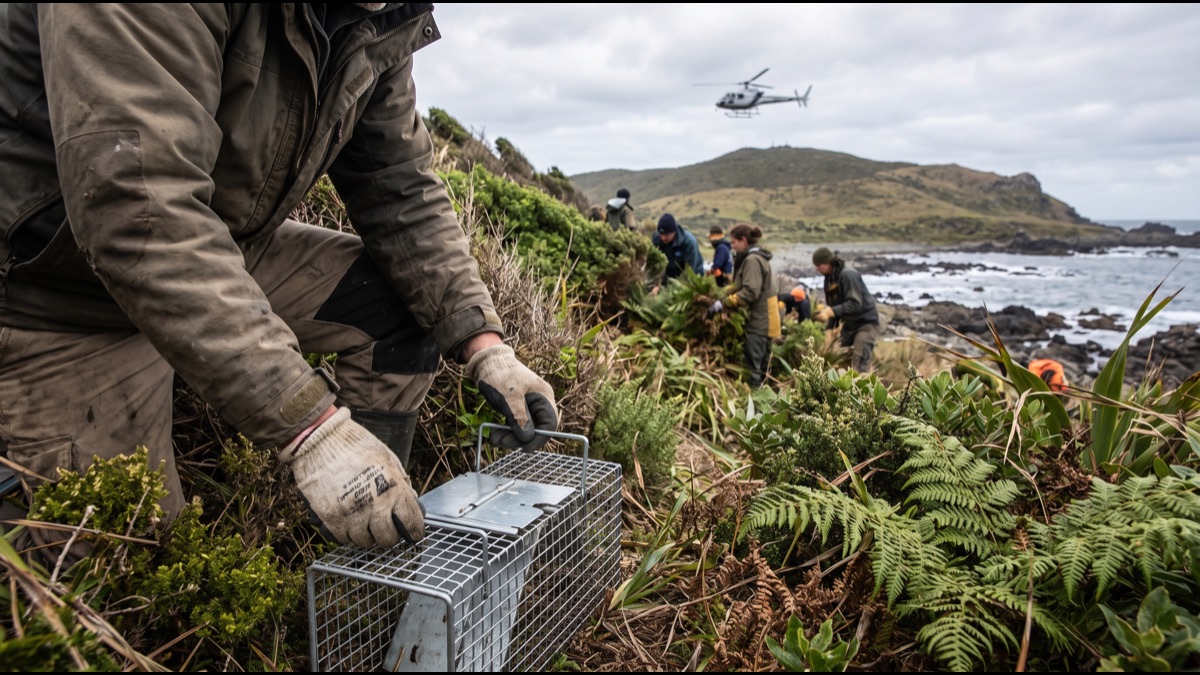
New Zealand's native birds evolved for millions of years with no land mammals at all, and that evolutionary innocence turned out to be their single greatest vulnerability once humans arrived. Species like the kiwi lost the ability to fly, many ground-nesting birds never developed defensive instincts against a mammalian predator, and when rats, stoats, and possums eventually reached these islands, the results were catastrophic and swift.
New Zealand's response has become one of the most ambitious conservation undertakings on the planet: not merely controlling introduced predator populations, but actually eliminating them completely from defined areas, including entire offshore islands, and working toward the extraordinary national goal of a country genuinely free of the mammalian predators that arrived with human settlement.
Why New Zealand's Birds Never Learned to Fear Predators
New Zealand separated from the ancient supercontinent Gondwana roughly 80 million years ago, before most modern land mammals had evolved, meaning the islands developed an ecosystem with birds, reptiles, and insects but essentially no native land mammals at all beyond a small number of bat species.
In the total absence of mammalian predators, evolutionary pressure pushed many bird species toward flightlessness and ground-nesting, since flight is metabolically expensive and offered no real survival advantage when nothing on the ground posed a genuine threat to a bird sitting on its nest.
This left New Zealand's native birds catastrophically unprepared for what arrived with human settlement. Species that had never needed to detect, evade, or defend against a land predator found themselves suddenly hunted by animals against which millions of years of evolution had given them absolutely no defence whatsoever.
The kakapo, a large flightless nocturnal parrot, exemplifies this vulnerability especially starkly, since its primary defence against a threat was to freeze completely motionless, an effective strategy against the aerial predators it evolved alongside but a fatal one against a mammal that hunts primarily by scent rather than sight.
How Introduced Predators Actually Arrived
Polynesian settlers arriving roughly 700 to 800 years ago brought the Pacific rat, which began the pattern of predation that would only intensify over subsequent centuries, already causing significant damage to ground-nesting bird populations well before European contact.
European settlement from the nineteenth century onward introduced a far more devastating wave of predators, including ship rats, stoats deliberately released to control introduced rabbits, and brushtail possums brought from Australia for the fur trade, none of which had any natural predator of their own in New Zealand to keep their populations in check.
The absence of natural population controls allowed these introduced species to multiply largely unchecked, and stoats in particular proved devastatingly effective hunters of ground-nesting birds and even flightless species like the kiwi, contributing directly to the extinction of numerous native bird species entirely.
Feral cats, deliberately introduced and later escaped or abandoned domestic cats that established wild breeding populations, compounded this pressure further, hunting a wide range of native bird, reptile, and invertebrate species and proving especially difficult to control given how widely dispersed and adaptable feral cat populations became across the country.
Why an Island Is Actually Easier to Clear Than a Mainland
An island's surrounding water functions as a natural barrier against reinvasion, meaning that once a predator population has genuinely been eliminated from an island, ongoing reinfestation pressure is dramatically lower than it would be on connected mainland territory where predators can simply walk or swim back in.
This geographic isolation is precisely why New Zealand's conservation programme has achieved its most dramatic successes on offshore islands first, since a defined, water-bounded area with a known predator population is a fundamentally more tractable eradication problem than an open mainland landscape.
Dozens of New Zealand's offshore islands have now been declared genuinely predator-free following intensive eradication campaigns, several of which now serve as secure sanctuaries where critically endangered native bird species can be relocated with meaningfully reduced predation risk.
Some of these successfully cleared islands are genuinely tiny, covering only a handful of hectares, while others span thousands of hectares of rugged terrain, demonstrating that island size alone does not determine eradication feasibility so long as the surrounding water barrier remains fully intact against reinvasion.
How Aerial Poison Operations Actually Work
For larger or more rugged islands where ground-based trapping alone would be impractical, conservation teams distribute poison bait via helicopter across the entire target area in carefully calculated concentrations, timed specifically to coincide with periods when target predator populations are most vulnerable.
Bait formulation and distribution patterns are calculated based on the specific target species' feeding behaviour and territory size, with operations typically conducted in seasons when target predators are actively foraging and natural alternative food sources are scarce, maximising the likelihood that predators will actually consume the bait.
A single aerial operation rarely achieves complete eradication on its own, and most successful island campaigns combine an initial aerial poison drop with follow-up ground-based trapping, hunting dogs specifically trained to detect surviving individuals, and additional targeted poison applications to eliminate any remaining animals.
What 1080 Actually Is and Why It's Controversial
Sodium fluoroacetate, commonly known by its compound number 1080, is the primary poison used in New Zealand's aerial eradication operations, chosen specifically because it breaks down relatively quickly in the environment and because New Zealand's native plants and invertebrates have no natural exposure history to it.
The compound remains genuinely controversial within New Zealand, with critics raising concerns about risk to some native species that can also be affected by it, potential water contamination, and the ethics of aerial poisoning at landscape scale, generating an ongoing and often heated public debate that predates and continues alongside the eradication programme.
Conservation agencies respond to these concerns by using bait formulations, deterrent additives, and precise timing specifically designed to minimise the risk to non-target native species, while independent monitoring tracks actual environmental outcomes following each operation to assess whether those mitigation measures are genuinely working as intended.
Public consultation, including hearings and formal submission processes, typically precedes any large-scale 1080 operation, giving affected communities and interest groups a genuine opportunity to raise concerns before an operation proceeds, a process that has itself become a routine and expected part of how New Zealand conducts landscape-scale conservation work.
How Teams Actually Confirm an Island Is Predator-Free
Declaring an island genuinely predator-free requires considerably more than an absence of sightings immediately following an eradication operation, since a small number of surviving individuals can easily go undetected for months while still posing a genuine risk of repopulating the entire island.
Teams deploy extensive networks of tracking tunnels, chew cards, motion-triggered cameras, and detection dogs across the island for an extended monitoring period, typically many months, specifically searching for any sign whatsoever of a surviving target predator before any declaration of success is considered credible.
Only after this extended monitoring period produces genuinely zero detections does an island receive official predator-free status, a designation that unlocks subsequent conservation investment, including the potential relocation of critically endangered native species that would otherwise have no genuinely safe habitat available to them.
What Predator Free 2050 Actually Aims to Achieve
Announced in 2016, Predator Free 2050 is New Zealand's formal national goal of eliminating rats, stoats, and possums from the entire country, not merely from isolated offshore islands, by the middle of this century, an ambition without genuine precedent anywhere else on Earth at anything close to this scale.
The programme coordinates government funding, community volunteer trapping networks, iwi-led Māori conservation initiatives, and ongoing technological research into more efficient detection and control methods, recognising that mainland-scale eradication will require tools and approaches considerably beyond what worked on smaller, water-isolated islands.
Most conservation scientists regard full mainland eradication by 2050 as a genuinely uncertain outcome given the immense scale and continuous reinvasion pressure involved, though they broadly credit the goal itself with mobilising conservation funding, public engagement, and technological innovation at a scale that would likely not otherwise have occurred.
Community volunteer trapping networks have become a genuinely significant component of the effort, with tens of thousands of ordinary residents maintaining backyard traps and reporting data to shared national databases, turning what began as a purely scientific and governmental undertaking into something with meaningful grassroots public participation across the country.
How Biosecurity Actually Prevents Reinvasion
Achieving predator-free status on an island is only the beginning of an indefinite ongoing responsibility, since a single pregnant rat arriving via boat, cargo, or even swimming from a nearby infested landmass could theoretically reestablish an entire population within a relatively short period.
Strict biosecurity protocols govern any vessel, equipment, or supplies transported to predator-free islands, including mandatory inspection procedures, specially designed rodent-proof packaging requirements, and permanent bait stations maintained around likely landing points specifically to intercept any predator that does manage to arrive.
These biosecurity measures never end once an island achieves predator-free status; they become a permanent, indefinite operational commitment, since the underlying reinvasion risk from nearby infested areas never genuinely disappears regardless of how successful the initial eradication effort was.
What Happens to Bird Populations After Eradication
Native bird populations on successfully cleared islands frequently rebound dramatically once released from predation pressure, with species that had been reduced to small remnant populations sometimes recovering to healthy, self-sustaining numbers within just a few years of an island achieving predator-free status.
Conservation teams frequently use newly cleared, predator-free islands as translocation sites for critically endangered species from elsewhere, deliberately establishing new populations in a genuinely safe environment as an insurance measure against the total loss of a species from any single remaining population.
Some of New Zealand's most celebrated conservation success stories, including the recovery of previously critically endangered bird species from populations numbering only a handful of individuals, trace directly back to this combination of island eradication followed by careful, monitored translocation.
The black robin, once reduced to a single breeding female before an intensive management programme including predator-free island translocation, remains one of the most frequently cited examples internationally of a species recovery that would have been essentially impossible without a genuinely safe, predator-cleared habitat available to receive the remaining individuals.
How Māori Conservation Knowledge Actually Contributes
Māori iwi across New Zealand hold traditional ecological knowledge and a cultural relationship with native species, described through the concept of kaitiakitanga, or guardianship responsibility, that has become an increasingly central and formally recognised part of the country's conservation planning and decision-making.
Numerous predator eradication and island restoration projects are now iwi-led or jointly managed in genuine partnership between Māori communities and government conservation agencies, reflecting a broader shift in New Zealand conservation policy toward recognising indigenous governance and knowledge as essential rather than merely advisory.
This partnership model has proven particularly valuable for islands and areas holding specific cultural significance, where local iwi bring both traditional ecological understanding of the specific landscape and long-term community commitment to a restoration project extending well beyond any single funding cycle.
Some translocated bird populations have also carried significant cultural and spiritual importance for the iwi involved, meaning a successful island restoration project frequently represents the return of a culturally significant species to ancestral land in addition to its purely ecological conservation value.
Why the Mainland Presents a Genuinely Harder Problem
Unlike an island, mainland New Zealand offers no natural water barrier against reinvasion, meaning any cleared mainland area faces continuous pressure from surrounding uncleared territory, requiring either permanent fencing, indefinitely sustained control effort, or genuinely nationwide simultaneous eradication to achieve a lasting result.
Predator-proof fencing has emerged as one practical mainland solution, with specially engineered fence designs creating cleared "mainland island" sanctuaries, though the capital cost and ongoing maintenance burden of fencing make this approach genuinely impractical to scale across the entire country.
Achieving true nationwide eradication will likely require technological breakthroughs beyond current tools, including more efficient long-range detection methods and potentially genetic biocontrol approaches still under active research, meaning Predator Free 2050's ultimate success may depend as much on future innovation as on scaling up methods that already work on islands today.
Researchers are actively investigating genetic biocontrol methods, including approaches that would spread inherited traits reducing a target species' fertility through its wild population over successive generations, though these techniques remain years away from any real-world deployment and raise their own distinct set of ecological and ethical questions that will need careful public and scientific scrutiny before adoption.
What New Zealand has already demonstrated beyond doubt is that complete predator eradication from a defined area, once considered essentially impossible at any meaningful scale, is genuinely achievable with sufficient resources, monitoring rigour, and sustained commitment. Whether that success can eventually extend across an entire country remains conservation's most ambitious open question.
Sources
- Wikipedia — overview of Predator Free 2050 and New Zealand conservation history
- New Zealand Department of Conservation — official government conservation and eradication programme information
- Forest & Bird — New Zealand's leading independent conservation organisation
- Manaaki Whenua – Landcare Research — scientific research on predator control methods
FAQ
How can an entire island actually be made predator-free?
Teams use a mix of aerially distributed poison bait, ground-based trapping, and hunting dogs, then confirm total absence of predators through months of intensive monitoring before declaring success.
Is Predator Free 2050 actually realistic for the whole country?
It is an extraordinarily ambitious goal that most conservation scientists consider genuinely uncertain, especially for the mainland, though offshore islands have already proven full eradication is achievable at smaller scale.
Why are New Zealand's native birds so vulnerable to introduced predators?
They evolved for millions of years with no land mammal predators, so many species lost the ability to fly or nest defensively, leaving them with no natural defences against rats, stoats, and possums.
Does eradicating predators actually harm native wildlife too?
Some native species can be affected by broad-scale poison operations, so programmes use bait formulations and timing specifically designed to minimise the risk to non-target native animals.
How do islands actually stay predator-free after eradication?
Ongoing biosecurity measures, including strict quarantine protocols for visitors and cargo and permanent monitoring networks, are required indefinitely to prevent reinvasion.
About the Author
We reference Wikipedia, the New Zealand Department of Conservation, Forest & Bird, and Manaaki Whenua – Landcare Research to explain the background and current understanding of this topic.
Loved This Article?
Share it on WhatsApp → Share it on WhatsApp
Get more guides in your inbox — Subscribe to our newsletter for weekly surprising stories from Egypt, Saudi Arabia, Dubai, and beyond.