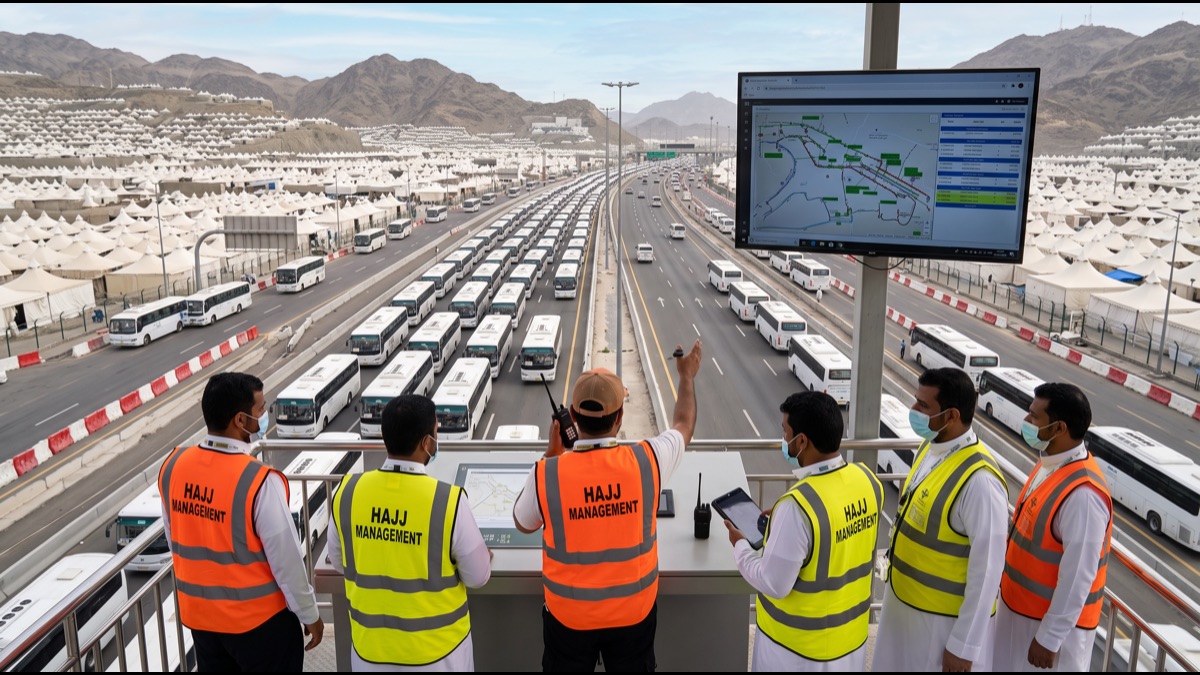
Every year, in the space of about five days, several million people from more than a hundred countries converge on a compact set of sites outside Mecca to perform a sequence of rites that, for religious reasons, have to happen in roughly the same place, at roughly the same time, for essentially everyone at once. Hajj is arguably the largest recurring exercise in coordinated human movement on the planet, and the fact that it functions at all, year after year, without descending into permanent chaos, is the product of an enormous and continuously revised logistics operation run mostly by the Saudi state, layered on top of a religious obligation that predates the modern nation-state by well over a millennium. Understanding how that operation actually works — the quotas, the platforms, the trains, the tents, the hospitals, and the hard lessons learned from past tragedies — helps explain both why Hajj mostly succeeds and why certain risks, heat above all, remain stubbornly difficult to fully eliminate.
A Few Days, Several Million People, One Valley
Hajj compresses an extraordinary amount of movement into an extraordinarily short window. The core rites unfold over roughly five days, during which pilgrims move in a defined sequence between Mecca, Mina, Mount Arafat, and Muzdalifah — a handful of locations within a relatively small geographic radius that were never designed, in any physical sense, to hold a temporary population in the millions.
What makes the logistics genuinely difficult is not just the raw numbers but the timing constraint. Unlike a music festival or a major sporting event, Hajj's key rites — the Day of Arafat above all — must happen on specific days tied to the Islamic lunar calendar, for every pilgrim, simultaneously. There is no staggering the crowd across a week the way an airport staggers departures; nearly everyone needs to be in the same place on the same day, which is precisely what makes crowd engineering the central technical challenge of the entire event.
The Hajj Quota System
Because Mecca's holy sites have a hard physical capacity, Saudi Arabia allocates a Hajj quota to each country rather than allowing unlimited numbers of pilgrims to arrive. The modern quota framework traces back to a 1987 resolution coordinated through the Organisation of Islamic Cooperation, which established a formula loosely tied to each country's Muslim population — historically framed as a set proportion of a country's Muslim residents per year, though the precise ratios have been adjusted over time and vary somewhat by country and circumstance.
National governments and their religious affairs ministries then subdivide their allocated quota domestically, distributing places among citizens who apply, often through lottery systems, waiting lists, or an approved network of licensed operators, since demand in most Muslim-majority countries substantially exceeds the number of places available in any given year. Saudi authorities have periodically adjusted total quotas upward as infrastructure capacity has expanded, while also tightening enforcement against pilgrims attempting to perform Hajj without a valid permit.
Nusuk: The Digital Front Door to Hajj
In recent years, the Saudi Ministry of Hajj and Umrah has consolidated much of the registration, permitting, and package-booking process into Nusuk, an official digital platform intended to replace a patchwork of paper documentation, in-person agency visits, and country-specific systems with a single centralized interface. Through Nusuk, eligible pilgrims can register within their national quota, select accredited service packages covering accommodation and transport, and manage visa-linked documentation electronically.
The platform reflects a broader Saudi push to digitize Hajj administration end to end, reducing reliance on informal brokers and unlicensed operators who have historically been a source of fraud, overcharging, and unsafe accommodation arrangements for pilgrims from countries with weaker enforcement of official channels. Digital permits issued through Nusuk are also cross-checked at access points around Mecca during the Hajj period, part of a wider effort to ensure that only pilgrims holding valid, verified permits are present in the most congested zones during peak days.
Licensed Travel Agencies and Foreign-Pilgrim Coordination
The overwhelming majority of pilgrims arriving from outside Saudi Arabia travel through licensed Hajj tour operators — companies accredited both by their home country's religious affairs authority and by Saudi Arabia itself — rather than arranging Hajj independently. These operators handle group visas, coordinate flight and ground arrivals, secure accommodation packages in Mecca, Mina, and Medina, and are contractually responsible for ensuring their pilgrims stay within the bounds of their permitted itinerary.
This agency-based model gives Saudi authorities a manageable set of accountable intermediaries rather than millions of individual travelers to track, and it allows national governments to negotiate service standards and pricing tiers for their citizens. It also means that a significant share of the practical burden of managing language barriers, medical needs, and group logistics for any given nationality falls on these licensed operators working alongside Saudi ministries rather than on Saudi authorities alone.
The Al Mashaer Al Mugaddassah Train
One of the most consequential pieces of Hajj-specific infrastructure is the Al Mashaer Al Mugaddassah metro line, a dedicated light-rail system built specifically to move pilgrims between Mecca, Mina, Muzdalifah, and Arafat during the Hajj period, largely bypassing the ground-level congestion that plagued earlier, purely road-based movement between the sites. The line was developed with the explicit goal of cutting the multi-hour journeys pilgrims previously faced on overcrowded roads down to a fraction of that time.
The train operates at a scale and intensity almost unmatched by any other transit system in the world for the handful of days it runs each year, moving enormous numbers of pilgrims in a tightly compressed operating window before sitting largely unused for the rest of the year. Its stations are themselves significant crowd-management infrastructure, engineered with multiple platforms and staged boarding to prevent the kind of platform overcrowding that would be dangerous given the volumes involved.
Buses and the Wider Ground-Transport Network
Alongside the rail line, a very large coordinated fleet of buses handles the bulk of pilgrim movement to, from, and within the holy sites, particularly for pilgrims whose accommodation or itinerary doesn't align neatly with train stations, and for movement between Mecca and Medina or between airports and the holy sites more broadly. Bus routes, schedules, and designated pickup zones are managed through coordination between the Ministry of Hajj and Umrah, transport authorities, and the licensed tour operators responsible for specific pilgrim groups.
Saudi authorities also operate a color-coded and zone-based routing system during peak Hajj days, assigning specific groups to specific routes and time windows in an effort to prevent every vehicle and every pilgrim from attempting to move through the same corridor simultaneously. This kind of staggered, zoned movement is fundamentally a crowd-engineering exercise as much as a transport one, since the danger during Hajj rarely comes from any single mode of transport failing, but from too many people and vehicles attempting to occupy the same physical space at the same moment.
Choreographing Mina, Arafat, and Muzdalifah
The central logistical challenge of Hajj is the tightly sequenced movement of pilgrims between Mina, Mount Arafat, and Muzdalifah over a few consecutive days, each leg of which needs to happen within a defined religious time window. Pilgrims travel from Mina to Arafat on the Day of Arafat, spend the day there, move to Muzdalifah after sunset, and then return to Mina to perform the stoning ritual at the Jamarat — a sequence that effectively requires several million people to change location multiple times within roughly 48 hours.
Saudi authorities manage this through a combination of pre-assigned movement schedules by group and nationality, staggered departure windows, dedicated pedestrian and vehicle corridors, and continuous real-time monitoring to detect where crowd density is building faster than expected. The goal, according to Saudi Ministry of Hajj and Umrah planning documents released ahead of recent Hajj seasons, is to keep movement continuous and low-density rather than allowing large stationary crowds to accumulate at any single choke point, since stalled, densely packed crowds are consistently the precondition for the most dangerous incidents.
The 2015 Mina Crush and What It Forced Saudi Arabia to Confront
In September 2015, a crowd crush near Mina during the stoning ritual became one of the deadliest incidents in modern Hajj history, drawing international scrutiny of Saudi crowd-management practices and prompting an extended, and at times contentious, public accounting of what went wrong. Reuters and other international outlets reported that the crush occurred amid the convergence of large pilgrim groups moving in different directions along the same route at the same time, a scenario crowd-safety researchers have long identified as a primary trigger for fatal crush events.
The tragedy prompted a substantial reassessment of Hajj's underlying crowd-flow design rather than only incremental fixes, and it remains a reference point that shapes how Saudi authorities discuss, plan, and publicly justify subsequent safety investments. It is discussed here as a documented historical event central to understanding why current Hajj infrastructure looks the way it does, not as a closed or uncontroversial matter — questions about the exact casualty toll and the precise sequence of events were, and in some respects remain, disputed between Saudi authorities and independent researchers.
Redesigning the Jamarat Bridge and Pedestrian Flow
In the years following 2015 and building on an earlier multi-level Jamarat Bridge redevelopment completed in 2006 after prior deadly incidents at the same site, Saudi authorities expanded and restructured pedestrian routes around the stoning ritual specifically to prevent bidirectional crowd convergence — the same underlying failure mode implicated in multiple past Mina incidents. Newer designs emphasize one-directional pedestrian flow, multiple separated levels, and wider approach and exit corridors intended to keep crowd density below dangerous thresholds even at projected peak volumes.
Alongside physical redesign, Saudi authorities introduced stricter, more granular timed permits governing exactly when specific groups are authorized to perform the stoning ritual, spreading what used to be heavily concentrated peak-hour crowds across a longer window. Crowd-safety researchers studying pilgrimage and mass-gathering events generally regard this combination — physical route redesign paired with scheduled, staggered access — as the most effective known approach to reducing crush risk at fixed pinch points, though no design fully eliminates risk when volumes are this large.
The Tent City at Mina
For the days pilgrims spend at Mina, accommodation is provided in an enormous, semi-permanent tent city consisting of tens of thousands of fire-resistant fiberglass tents arranged across a dense grid, housing pilgrims by group, nationality, and package tier for the duration of their stay. The tents replaced an earlier generation of more flammable canvas structures following a major fire at Mina in 1997 that killed a significant number of pilgrims and destroyed thousands of tents, a disaster that directly drove the fireproofing overhaul still in use today.
Beyond fire safety, the tent city's layout is itself a piece of crowd-management infrastructure, with internal walkways, numbered zones, and capacity limits designed to keep pedestrian density inside the camp manageable even though the overall population density of Mina during Hajj is extraordinarily high by the standards of almost any other temporary human settlement on Earth.
Healthcare and Emergency Medical Response
Saudi Arabia deploys a substantial temporary healthcare infrastructure specifically for the Hajj period, including field hospitals, expanded emergency departments at permanent facilities in Mecca and the holy sites, mobile medical units, and thousands of additional medical personnel brought in specifically to handle the seasonal surge, according to figures the Saudi Ministry of Health publishes ahead of each Hajj season. Given the pilgrim population's demographics — a significant share are older adults, some managing chronic conditions, undertaking physically demanding rites in extreme heat — the medical burden during Hajj is disproportionately heavy relative to a population of similar size under ordinary conditions.
Emergency response during Hajj also has to account for the same crowd-density constraints that complicate general pilgrim movement: ambulances and medical teams frequently cannot simply drive to a location experiencing a mass-casualty event during peak congestion, which has pushed Saudi health authorities toward pre-positioning medical teams throughout the holy sites rather than relying solely on centralized hospitals pilgrims or ambulances would need to reach through dense crowds.
Heat: Hajj's Recurring, Worsening Risk
Because Hajj follows the lunar Hijri calendar rather than the solar calendar, it drifts backward through the seasons over a cycle of roughly 33 years, meaning it periodically falls during the peak of the Saudi summer, when daytime temperatures in and around Mecca routinely exceed 45°C and can climb well beyond that in direct sun. Unlike most of the other operational risks discussed here, heat is not something Saudi authorities can engineer away entirely, since much of Hajj's core ritual activity — standing at Arafat, walking between sites, performing the stoning ritual — happens outdoors, often in direct sunlight, by religious requirement.
Recent Hajj seasons that have coincided with summer months have seen a significant number of confirmed heat-related deaths among pilgrims, a trend that Saudi health authorities, the World Health Organization, and independent researchers studying extreme-heat mass gatherings have all flagged with increasing concern. Reporting from outlets including Reuters and Al Jazeera on recent Hajj seasons has documented that many of the fatalities involved pilgrims performing Hajj without registered permits, and therefore without access to the officially organized shading, transport, and medical support available to permit-holding pilgrims — underscoring how the quota and permit system connects directly to physical safety outcomes, not just administrative order.
Cooling Infrastructure and Heat Mitigation
In response, Saudi authorities have substantially expanded shaded walkways, misting systems, hydration points, and temporary cooling stations along the routes pilgrims use most heavily, particularly around Arafat and the corridors leading to the Jamarat. Saudi Arabia's National Center of Meteorology has also taken on a more prominent public role during recent Hajj seasons, issuing real-time heat advisories and coordinating with the Ministry of Health on when to intensify field medical deployment based on forecast conditions.
Public health messaging ahead of and during Hajj, echoing general heat-illness guidance from the World Health Organization, has increasingly emphasized hydration timing, recognizing early symptoms of heat exhaustion, and avoiding unnecessary outdoor movement during the hottest parts of the day wherever the ritual schedule allows some flexibility. Even so, researchers who study extreme-heat mass gatherings have generally cautioned that infrastructure and messaging can meaningfully reduce, but not eliminate, heat risk when a fixed-date religious obligation collides with genuinely dangerous ambient temperatures at this scale.
Security Coordination Across Government Bodies
Hajj security involves coordination across multiple Saudi government bodies rather than a single agency, including the Ministry of Interior, the Ministry of Hajj and Umrah, the Saudi Red Crescent Authority, civil defense forces, and specialized units established specifically for the Hajj period, working alongside the licensed tour operators responsible for individual pilgrim groups. This multi-agency structure reflects the reality that Hajj security spans everything from routine crowd management and traffic control to counter-terrorism planning and public-health emergency response, each requiring different institutional expertise.
The Saudi Press Agency has reported that authorities conduct extensive joint planning and simulation exercises in the months ahead of each Hajj season, testing coordination between these bodies under scenarios ranging from stampede risk to severe weather to mass medical emergencies, reflecting an operational model built around anticipating failure points before the pilgrim population arrives rather than responding reactively once problems emerge.
AI Crowd Monitoring and Smart Technology
In recent Hajj seasons, Saudi authorities have deployed artificial-intelligence-assisted crowd monitoring systems that analyze live video feeds from thousands of cameras positioned across the holy sites, aiming to detect dangerous crowd-density buildups before they escalate into the kind of bidirectional convergence implicated in past crush incidents. These systems are intended to flag emerging bottlenecks to control-room staff faster than manual observation alone would allow, feeding into real-time decisions about opening alternate routes, pausing entry to a zone, or redirecting bus and train capacity.
This technology sits alongside more conventional tools — drone surveillance, a dense network of fixed cameras, and centralized command centers coordinating across agencies — as part of a broader Saudi effort, described in Ministry of Hajj and Umrah communications, to shift crowd management from a reactive, on-the-ground practice toward a more predictive, data-driven one. Independent crowd-safety researchers have generally welcomed this shift while cautioning that technology can only act on the physical infrastructure available to it; better detection of a dangerous bottleneck is only useful if there is a real alternate route or an actual capacity to redirect people into.
Wristbands, Smart Cards, and Digital Identity
Saudi authorities have progressively expanded the use of wearable identification for pilgrims, including wristbands and smart cards linked to a pilgrim's registration data, medical information, accommodation assignment, and permitted itinerary. These tools serve several overlapping purposes: helping reunite separated pilgrims, particularly older travelers or those in very large groups, with their group or family; giving medical responders rapid access to basic health information during an emergency; and helping authorities verify, at access points, that a pilgrim present in a given zone holds a valid permit for that location and time.
The wristband and smart-card systems are also tied into the broader Nusuk digital ecosystem, reflecting a deliberate Saudi push to treat pilgrim identity, permitting, and physical location as a single integrated data layer rather than as separate paper-based systems that are harder to cross-check quickly during a fast-moving crowd-safety incident.
What the System Still Gets Wrong
Despite genuinely substantial investment and measurable improvement in crowd-crush prevention since 2015, Hajj logistics remain an area where Saudi authorities, independent researchers, and international media coverage do not fully align on how much risk has actually been eliminated versus displaced or reduced. Unregistered and unpermitted pilgrims — who bypass the quota system entirely and therefore fall outside the accommodation, transport, shading, and medical infrastructure built for permit holders — have repeatedly been identified in post-Hajj reporting as disproportionately represented among heat-related and other fatalities, a gap that infrastructure spending alone does not close.
Heat, more than crowd mechanics, is also the risk category where Saudi authorities themselves have been notably candid that engineering and enforcement can only do so much against a fixed religious calendar intersecting with rising regional temperatures, a dynamic climate researchers expect to intensify rather than ease as future Hajj seasons continue to cycle through the hottest months of the Saudi year. The honest picture, drawing on Saudi government statements alongside independent reporting, is one of a genuinely sophisticated and continuously improving system that has meaningfully reduced certain categories of risk while still facing others — heat chief among them — that remain only partially solved.
Sources
- Saudi Ministry of Hajj and Umrah — Official body overseeing Hajj planning, the Nusuk platform, quota administration, and licensed tour-operator accreditation.
- Saudi Press Agency — State news agency reporting on Hajj security planning, infrastructure announcements, and official statements each season.
- Reuters — International news coverage of the 2015 Mina crush, heat-related fatalities in recent Hajj seasons, and Saudi crowd-safety reforms.
- World Health Organization — Public health guidance on heat-illness prevention and mass-gathering health risk referenced by Saudi and international health authorities.
FAQ
How does Saudi Arabia decide how many pilgrims each country can send?
Saudi Arabia allocates Hajj quotas to each country, historically based on a formula tied to that country's Muslim population, and coordinates the numbers with the Organisation of Islamic Cooperation. National Hajj authorities then distribute their country's allocation among licensed travel agencies and applicants.
What is the Nusuk platform used for?
Nusuk is the Saudi Ministry of Hajj and Umrah's official digital platform for registering for Hajj, applying for permits, booking accredited packages, and managing visa and accommodation details, replacing much of the older paper-based and agency-only process.
Why did the 2015 Mina crowd crush happen, and what changed afterward?
The September 2015 crush near Mina, one of the deadliest incidents in modern Hajj history, occurred amid dense crowd convergence during the stoning-of-the-devil ritual. It prompted Saudi authorities to redesign pedestrian routes, expand the Jamarat Bridge, introduce stricter timed movement schedules, and invest heavily in crowd-flow monitoring technology.
Why is heat such a serious risk during Hajj?
Because Hajj follows the lunar Islamic calendar, it drifts through the seasons over roughly a 33-year cycle and periodically falls during the peak of the Saudi summer, when temperatures in Mecca can exceed 45°C. Recent Hajj seasons falling in summer months have seen a significant number of heat-related deaths, prompting expanded shading, cooling stations, and hydration campaigns.
How do pilgrims get between Mina, Arafat, and Muzdalifah?
Pilgrims move between the holy sites using a combination of the dedicated Al Mashaer Al Mugaddassah metro line, large fleets of coordinated buses, and walking along managed pedestrian corridors, with movement scheduled in waves to prevent the routes from becoming dangerously overcrowded at any single moment.
About the Author
We reference the Saudi Ministry of Hajj and Umrah, the Saudi Press Agency, Reuters, and the World Health Organization to explain the background and current understanding of this topic.
Loved This Article?
Share it on WhatsApp → Share it on WhatsApp
Get more guides in your inbox — Subscribe to our newsletter for weekly surprising stories from Egypt, Saudi Arabia, Dubai, and beyond.