A professional subtitler will routinely rewrite a perfectly accurate translation of a line of dialogue simply because the accurate version cannot physically be read in the amount of time the actor took to say it. Subtitling is not simply translation with timestamps attached; it is a genuinely distinct craft governed by strict, well-established rules about reading speed, timing precision, and exactly how a line of text has to be cut down or restructured to fit within a window most viewers never consciously notice at all.
Every subtitle that appears on screen has to satisfy several competing constraints simultaneously: appearing and disappearing in sync with the specific line of dialogue it represents, staying on screen long enough for an average viewer to actually read it completely, and doing all of this without overlapping distractingly with on-screen action or a scene cut.
Understanding how subtitlers actually solve this means looking at the specific technical and linguistic rules the profession has developed, reading speed limits measured in characters per second, minimum and maximum on-screen duration, and the deliberate, skilled editing decisions that trim spoken dialogue down into genuinely readable written text without meaningfully losing its actual meaning.
It also explains why a direct, word-for-word translation is often considered a subtitling failure rather than a success, and why the entire craft has had to adapt substantially as streaming platforms dramatically increased both the volume and the speed at which subtitles now need to be produced worldwide.
Why Reading Speed Is the Central Constraint
The single most important technical constraint in subtitling is reading speed, typically measured in characters per second, since research on average viewer reading ability has established fairly consistent limits for how much text a typical viewer can actually read and comprehend within a given amount of screen time.
Industry standard reading speed limits generally fall somewhere between roughly twelve and seventeen characters per second depending on the specific platform, language, and target audience, meaning a subtitle displayed for only two seconds can realistically contain only a limited number of characters before it becomes impossible for an average viewer to read it fully before it disappears.
This reading speed constraint is precisely why subtitlers frequently cannot use a fully accurate, complete translation of what a character actually says, since natural spoken dialogue is often considerably longer than what a viewer can realistically read within the exact amount of time that dialogue takes to be spoken on screen.
The Minimum and Maximum Time a Subtitle Can Stay Onscreen
Beyond reading speed, subtitling conventions also specify minimum and maximum display durations for any given subtitle, typically requiring a subtitle to remain visible for at least around one second even for very short lines of dialogue, since a subtitle flashing on screen for a fraction of a second is functionally unreadable regardless of how few characters it actually contains.
A maximum duration limit, commonly around six or seven seconds, exists for the opposite reason: a subtitle left on screen for too long, even for a genuinely long line of dialogue, starts to feel visually stale and can actively distract a viewer's attention away from the picture itself rather than supporting their understanding of it.
When a single line of dialogue is long enough to exceed this maximum duration at an acceptable reading speed, subtitlers split it across two or more sequential subtitles rather than displaying one overly long block of text, a technique requiring careful judgment about exactly where a sentence can be naturally divided without confusing or misleading the viewer mid-thought.
How Subtitles Actually Get Timed to Dialogue
Subtitle timing, formally called spotting or cueing, involves marking the precise timecode at which each subtitle should appear and disappear, work traditionally done by watching the film repeatedly and manually marking in and out points against the audio waveform and the actor's actual lip movement.
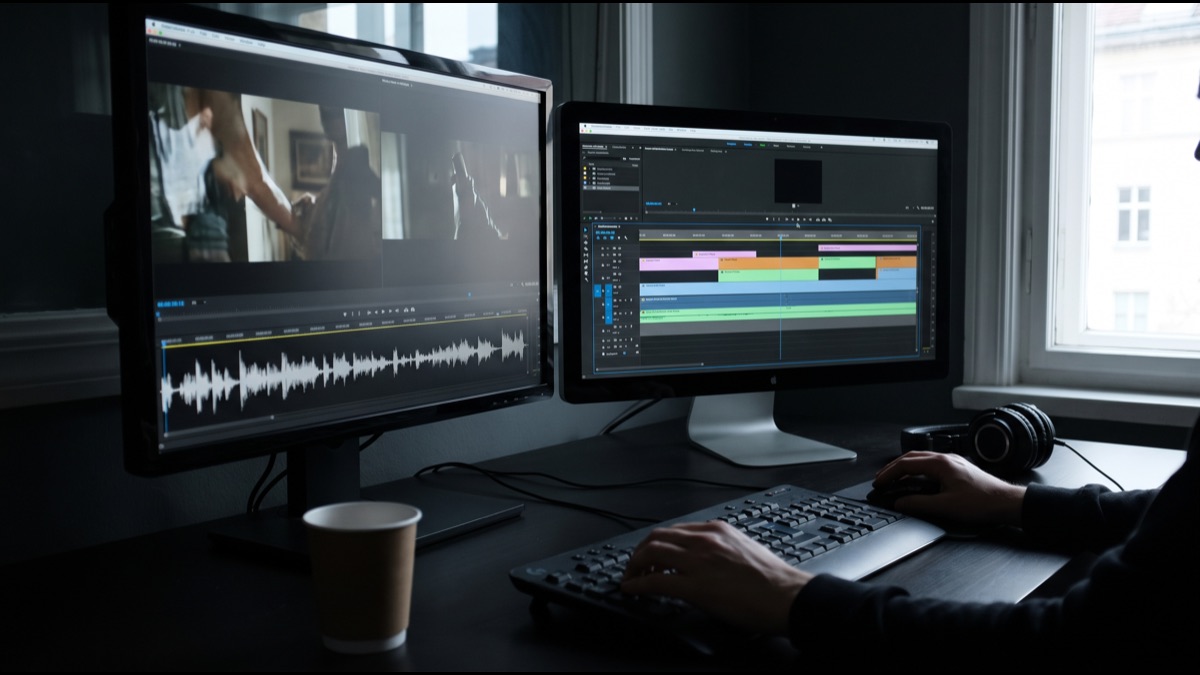
Modern subtitling software displays an audio waveform directly alongside the video timeline, allowing a subtitler to visually identify exactly when speech begins and ends down to individual video frames, considerably more precise than relying purely on ear alone to judge timing by listening.
Well-timed subtitles generally appear very close to when speech actually begins, often allowing a small, deliberate lead time of a few frames so a viewer's eye is not caught mid-read exactly as the character starts speaking, and disappear promptly once speech ends rather than lingering unnecessarily into the following silence or the next character's line.
Why a Literal Translation Often Fails as a Subtitle
A linguistically accurate, complete translation of a line of dialogue frequently contains meaningfully more characters than the target reading speed and available screen time allow, forcing subtitlers to condense, restructure, or selectively cut less essential information while still preserving a line's actual core meaning and emotional tone.
This condensing process is a genuine editorial skill in its own right, requiring a subtitler to identify precisely which words and phrases carry a line's essential meaning versus which elements, filler words, redundant phrasing, or information already conveyed visually on screen, can be safely trimmed without the viewer actually losing anything meaningful.
Professional subtitlers specifically train to distinguish between what a character says and what a viewer genuinely needs to read to understand the scene, since these two things are frequently not quite identical, particularly when spoken dialogue includes natural verbal habits, false starts, or repetition that would read as awkward or unnecessarily long if transcribed and translated word for word onto the screen.
How Line Breaks and Text Layout Actually Matter
When a subtitle spans two lines of text, where exactly that line break falls is not arbitrary; subtitling convention generally favors breaking at a natural grammatical pause, such as after a complete clause, rather than splitting in the middle of a phrase in a way that could momentarily confuse or slow down a reader's comprehension.
Line length itself is also constrained, typically limited to somewhere around thirty-five to forty-two characters per line depending on the specific platform and language, a limit driven partly by screen width and partly by the same underlying goal of keeping each individual line quickly and easily readable at a glance.
For languages that read right to left, including Arabic, subtitling software and platform specifications have to correctly handle text direction, punctuation placement, and line-break logic specifically adapted for that writing system, since directly applying left-to-right formatting conventions to right-to-left text produces genuinely broken, confusing, or even unreadable results.
Why Subtitles Have to Respect Shot Changes
Subtitling convention strongly discourages a single subtitle continuing to display across a hard cut between two different camera shots, since a viewer's eye naturally, if unconsciously, expects on-screen text to refresh along with a significant visual change, and a subtitle persisting unchanged across a cut can create a subtle, distracting sense that something is visually wrong.
When dialogue timing does not naturally align with shot changes, subtitlers sometimes have to adjust a subtitle's exact appear or disappear time slightly earlier or later than the dialogue's true acoustic boundary specifically to align better with a nearby shot change, a small, deliberate timing compromise made in service of overall viewing comfort.
This shot-change consideration is one of several rules illustrating that subtitling craft extends well beyond pure timing accuracy relative to audio alone, requiring genuine visual and editorial awareness of how subtitles interact with a film's broader cinematography and editing rhythm throughout an entire scene.
How Subtitles for the Deaf and Hard of Hearing Differ From Standard Subtitles
Subtitles specifically designed for deaf and hard-of-hearing viewers, sometimes called SDH, include additional information standard subtitles for hearing viewers typically omit entirely, most notably descriptions of significant non-dialogue sounds, a door slamming, ominous background music, or a phone ringing, information a hearing viewer would otherwise simply pick up directly from the audio track itself.
SDH subtitles also typically include speaker identification when it is not otherwise visually obvious who is speaking, such as during an off-screen phone call or when multiple characters' voices might otherwise be difficult for a deaf or hard-of-hearing viewer to reliably distinguish from subtitle text alone.
Producing genuinely effective SDH subtitles requires a meaningfully different editorial approach from standard subtitling, since the subtitler has to consciously identify and describe every piece of audio information a hearing viewer would otherwise absorb automatically and effortlessly, information a standard subtitle for a hearing audience simply never needs to represent in text at all.
Why Streaming Platforms Changed the Subtitling Industry So Dramatically
The dramatic global growth of streaming platforms has enormously increased both the sheer volume of content requiring subtitles and, often, the acceptable turnaround time for producing them, creating genuine industry-wide pressure toward faster subtitle production without meaningfully compromising the established quality and readability standards described throughout this article.
This pressure has driven meaningful growth in machine-assisted subtitling tools, including automated speech recognition for generating an initial rough transcript and machine translation for producing an early draft, though industry-standard practice still generally requires a skilled human subtitler to review, correct, and properly retime any machine-generated output before it is considered genuinely broadcast-ready.
Major streaming platforms have also published their own detailed, platform-specific subtitling style guides, some spanning many pages of highly specific technical and stylistic rules, reflecting how seriously the industry now treats subtitle quality as a core, measurable component of the overall viewing experience rather than a purely secondary, easily overlooked afterthought.
How Automatic Subtitle Generation Actually Compares to Human Work
Fully automated subtitle generation, relying entirely on speech recognition and machine translation without any human review at all, has improved considerably in recent years but still reliably struggles with several specific challenges: distinguishing between multiple overlapping speakers, correctly handling background noise or heavy accents, and, critically, producing the kind of concise, genuinely readable condensed phrasing skilled human subtitlers routinely produce as a matter of course.
Machine translation specifically tends to produce grammatically correct but stylistically stiff or unnatural phrasing that a skilled human subtitler would typically rewrite entirely for both naturalness and, just as importantly, to actually fit within the required character and timing constraints described earlier in this piece.
For high-profile, high-budget content specifically, the industry standard overwhelmingly still relies on trained human subtitlers, either working directly from scratch or carefully reviewing and substantially revising machine-generated first drafts, reflecting a broad professional consensus that fully automated subtitle quality has not yet reliably reached the bar considered acceptable for premium, professionally released content.
What Makes Subtitling Genuinely Different Skill From Dubbing
Subtitling and dubbing solve the same fundamental language-access problem in genuinely different ways, and each craft operates under a meaningfully different set of technical constraints: dubbing has to match translated dialogue to an actor's specific mouth movements and overall speaking rhythm, while subtitling has to fit translated meaning within strict reading-speed and screen-time limits that dubbing simply does not have to contend with at all.
This fundamental difference in constraint means the same original line of dialogue is frequently translated somewhat differently for a dubbed version compared to a subtitled version of the identical film, since each format's specific technical requirements can genuinely favor a meaningfully different phrasing choice for conveying essentially the same underlying meaning.
Viewers who consume the same film in both a subtitled and a dubbed version sometimes notice these genuine differences in translated dialogue, a direct, visible reflection of how significantly each format's distinct underlying technical constraints actually shape the specific translation choices a skilled localization team ultimately makes.
Why Cultural References Present a Genuinely Distinct Timing Challenge
Beyond straightforward linguistic translation, subtitlers frequently have to handle culturally specific references, jokes, idioms, or wordplay that may require considerably more explanatory text to convey properly to a different audience than the original line's brief screen time can realistically accommodate at an acceptable reading speed.
In these genuinely difficult cases, subtitlers often have to choose between a shorter but somewhat less precise translation that fits comfortably within timing constraints, or a more accurate but noticeably longer explanation that risks exceeding the target audience's practical reading speed limit within the available screen time.
This specific tension between genuine linguistic accuracy and hard technical timing constraints is widely considered one of the most creatively demanding aspects of professional subtitling work, requiring real judgment calls that go considerably beyond simple, mechanical, word-for-word language conversion.
What Well-Executed Subtitle Timing Actually Achieves
When subtitle timing, reading speed, line breaks, and shot-change alignment are all genuinely well executed together, the overall result is subtitles a viewer can read completely comfortably without ever having to consciously think about the subtitling process itself, an experience that feels seamless and effortless specifically because of the disciplined technical craft working quietly behind it.
This deliberate invisibility is, in a real sense, the entire measurable goal of professional subtitling: genuinely well-made subtitles draw no attention whatsoever to their own considerable underlying technical complexity, allowing a viewer's attention to remain fully on the film's actual story and performances rather than on the mechanics of reading translated text.
The next time a subtitle appears to sync effortlessly and perfectly with a line of dialogue, disappearing right as an actor finishes speaking without ever feeling rushed or lagging behind, that apparent effortlessness is itself the direct, visible product of the same disciplined technical rules, reading speed limits, precise timing, and careful editorial condensing, described throughout this entire article.
Why Arabic Subtitling Rules Differ Specifically From European Languages
Arabic, like every right-to-left written language, imposes genuinely unique challenges on subtitling software originally developed to serve left-to-right European languages, starting with how punctuation and numerals display within an Arabic sentence to how foreign words or phrases embedded within Arabic text are handled without breaking the natural reading direction.
Arabic words also tend to run visually longer on average than their English equivalents for the same meaning due to the connected nature of Arabic script, meaning Arabic subtitlers frequently face an additional challenge condensing text to fit within the same character-count limits used to measure reading speed across other languages.
Subtitling studios operating across the Arabic-speaking region have developed specialized style guides specifically addressing these differences, including precise rules for exactly when foreign names should be transliterated phonetically versus left as-is, reflecting growing maturity in this specialized corner of the global subtitling industry.
Sources
- Wikipedia — overview of subtitling conventions, technical standards, and industry practice
- Netflix Partner Help Center — published platform subtitling and timed text style guidelines
- BBC — subtitling and closed captioning technical guidelines for broadcast content
- Taylor & Francis Online — academic research on subtitle reading speed and viewer comprehension
FAQ
Why do subtitles sometimes not exactly match what a character actually says?
Reading speed limits mean a subtitle often cannot contain a fully complete, word-for-word translation, so subtitlers condense dialogue to preserve its core meaning while keeping it readable within the available screen time.
How fast do viewers actually need to be able to read a subtitle?
Industry standards typically target somewhere between roughly twelve and seventeen characters per second, a limit based on research into average viewer reading ability that directly constrains how much text any single subtitle can contain.
Why do subtitles usually disappear at a scene cut?
Subtitling convention discourages a single subtitle continuing across a hard camera cut, since viewers unconsciously expect on-screen text to refresh with major visual changes, so subtitlers often time subtitles to align with shot changes.
What is the difference between standard subtitles and SDH subtitles?
SDH subtitles, designed for deaf and hard-of-hearing viewers, add descriptions of significant non-dialogue sounds and speaker identification that standard subtitles for hearing audiences typically leave out entirely.
Can fully automated subtitles replace human subtitlers?
Not yet reliably for high-profile content; automated speech recognition and machine translation still struggle with overlapping speakers, natural condensing, and stylistic fit, so human review remains standard for premium releases.
Why are dubbed and subtitled versions of the same film sometimes translated differently?
Dubbing has to match an actor’s mouth movements and speaking rhythm, while subtitling has to fit within strict reading-speed and screen-time limits, so each format’s different constraints can favor a different phrasing choice.
About the Author
We reference Wikipedia and other authoritative sources to explain the background and current understanding of this topic.
Loved This Article?
Share it on WhatsApp → Share it on WhatsApp
Get more guides in your inbox — Subscribe to our newsletter for weekly surprising stories from Egypt, Saudi Arabia, Dubai, and beyond.