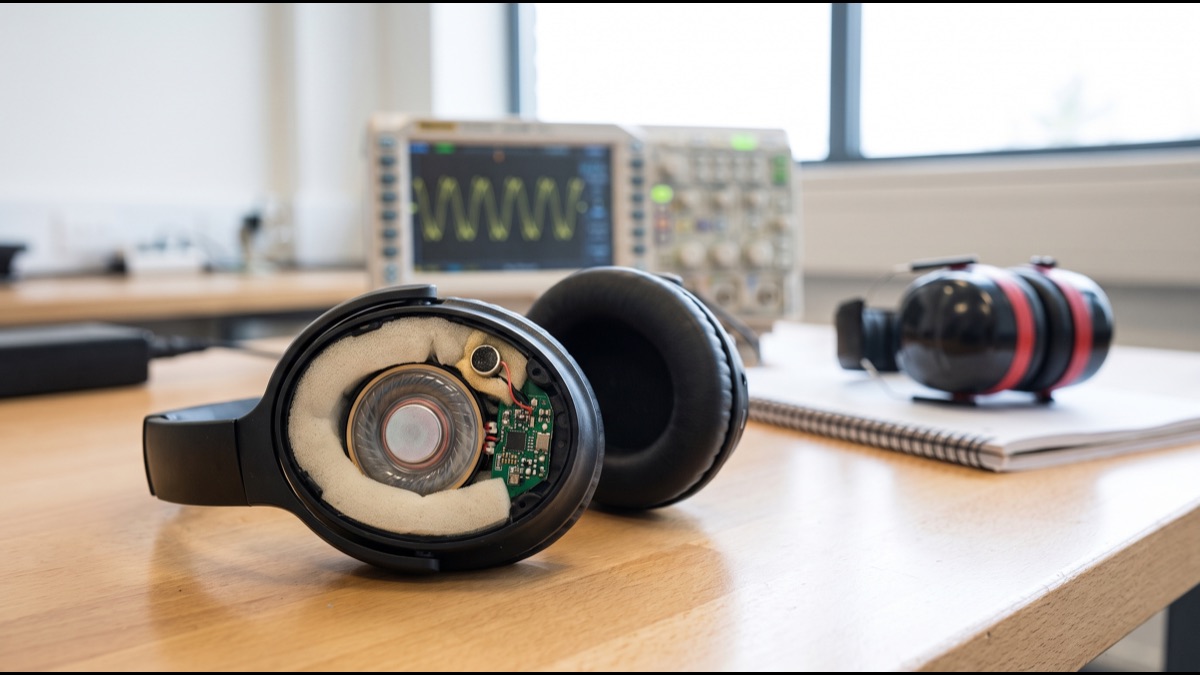
Noise cancellation removes the drone of an aircraft almost completely while barely touching the conversation two seats away, which many people read as a product limitation. It is not. It is a consequence of wavelength, and no amount of engineering will fully overcome it.
The system generates a sound wave that is the exact inverse of incoming noise, so the two sum to nothing at the eardrum. That works when the wave changes slowly across space and fails when it does not. Understanding why explains most of what people find puzzling, including why fit matters more than price and why wind makes things dramatically worse.
Why Sound Can Cancel Sound
Sound travels as pressure waves, and two waves of equal size but opposite phase sum to nothing, because one pushes exactly where the other pulls.
Noise cancellation exploits this by generating a wave that is the inverse of incoming noise, so the two combine near the ear and largely disappear.
The principle is straightforward but the execution is not, since the cancelling wave must match the incoming one in amplitude and timing continuously as the noise changes.
How Feedforward Microphones Work
A microphone on the outside of the earcup samples noise before it reaches the ear, giving the processor a brief window to compute and emit the inverse.
That window is extremely short, since sound travels the distance in a fraction of a millisecond, which is why the processing must be fast rather than merely accurate.
This arrangement handles steady noise well but cannot detect what leaks in through gaps, because it never measures what actually arrives at the ear.
Why Feedback Microphones Are Added
A second microphone inside the cup measures the sound actually reaching the ear, allowing the system to correct for whatever the first stage failed to remove.
This closes the loop, compensating for fit, leakage, and differences between individual ears that no external measurement could predict.
Most capable systems combine both, using the outer microphone for speed and the inner one for accuracy, which performs better than either alone.
What Determines Cancellation Quality
Performance depends on how precisely the system matches phase, since a mismatch not only fails to cancel but can add to the noise instead.
Physical fit matters enormously, because sound entering around a poor seal arrives without being sampled and therefore cannot be cancelled properly.
This is why the same headphones perform differently on different people, and why ear tip selection changes measured performance more than most electronic differences do.
Why Low Frequencies Cancel Best
Long wavelengths change slowly in space, so a cancelling wave computed at the microphone remains correct by the time it reaches the eardrum.
High frequencies have wavelengths comparable to the distance involved, meaning the correct cancelling signal at one point is wrong a centimetre away.
This is a physical limit rather than a processing shortcoming, and it explains why engine rumble disappears while nearby speech remains clearly audible.
How Passive Isolation Contributes
Physically blocking sound with dense material and a good seal reduces noise across all frequencies, including the high ones electronics cannot address.
Well-designed products combine passive isolation for high frequencies with active cancellation for low ones, since each covers the other's weakness.
This is why in-ear designs with a tight seal frequently outperform larger headphones at high frequencies despite having far less processing capability.
Why Cancellation Feels Like Pressure
Many people report a sensation resembling altitude change when cancellation is enabled, despite no actual pressure difference existing.
The current explanation is that the brain interprets the sudden absence of expected low-frequency sound as a pressure cue, since the two normally occur together.
The sensation typically fades with use, and some products deliberately allow a small amount of low-frequency sound through specifically to reduce it.
What Transparency Mode Actually Does
Transparency reverses the process, using external microphones to reproduce surrounding sound inside the ear rather than cancel it.
This is genuinely difficult because the reproduced sound must arrive with minimal delay, otherwise it conflicts with sound leaking in naturally and produces a hollow effect.
Latency is the main engineering constraint, and the improvement in transparency modes over recent generations comes largely from reducing it.
How Adaptive Systems Adjust
Newer products continuously analyse the noise environment and adjust cancellation strength, increasing it on a train and reducing it in a quiet room.
Some also detect fit quality by measuring how the internal microphone responds, and compensate for a poor seal by altering the filtering.
This addresses the largest source of real-world variation, since fit differs between people and changes as headphones shift during use.
Why Wind Ruins Performance
Air moving across an external microphone creates turbulence at the diaphragm, which the system reads as extremely loud noise and attempts to cancel.
The result is a loud rumble that is generated by the headphones rather than present in the environment, which is worse than no cancellation at all.
Products address this with mesh screens, microphone placement, and software that detects wind and reduces reliance on the affected microphone.
What Cancellation Cannot Remove
Speech is the least effectively cancelled common noise, because it is concentrated in frequencies where the physics stops working well.
Sudden sounds are also poorly handled, since the system responds to conditions it has already measured and cannot anticipate an impulse.
This is why open-plan offices remain difficult, as the noise people most want removed is precisely the type least amenable to cancellation.
How Battery Life Is Affected
Cancellation requires continuous processing and amplification, which consumes power whether or not audio is playing.
This is why headphones report shorter battery life with cancellation enabled, and why some continue to cancel in a low-power mode after audio stops.
Efficiency has improved substantially through dedicated processing chips, which perform the filtering at far lower power than general-purpose processors.
Why Aviation Was the Original Use
The technology was developed for pilots, where sustained engine noise caused fatigue and made radio communication difficult over long flights.
Aircraft cabin noise is dominated by low frequencies and is highly consistent, which is close to the ideal case for cancellation to work well.
Consumer adoption followed the same logic, since air travel remains the environment where the benefit is most immediately obvious.
How Cars Use the Same Principle
Several manufacturers build cancellation into vehicles, using microphones in the cabin and the existing speakers to reduce engine and road noise.
This allows lighter sound insulation, which reduces weight and improves efficiency, meaning the system pays for itself beyond comfort alone.
The approach works because a car cabin is an enclosed space with predictable noise sources, though cancellation is only effective near the occupants' heads.
Why Room-Scale Cancellation Fails
Cancelling noise across an entire room is impractical because the correct cancelling signal differs at every point, so a solution at one location fails elsewhere.
Effective cancellation therefore requires the listener to be at a known position relative to the speaker, which headphones guarantee and rooms do not.
This is why noise-cancelling windows and similar products have not materialised despite the underlying principle being well understood.
What Hearing Protection Requires
Cancelling headphones reduce perceived loudness but are not certified hearing protection, which must attenuate reliably including when unpowered.
Industrial protection is rated by measured attenuation across frequencies, and cancellation products are generally not tested to those standards.
Some hybrid products exist for industrial use, combining certified passive attenuation with active cancellation for the low frequencies passive material handles poorly.
How It Changes Listening Volume
The main health benefit is indirect, since removing background noise lets people listen at lower volume and still hear detail clearly.
Research has found that listeners in noisy environments raise volume substantially, frequently into ranges that carry genuine risk over sustained periods.
This makes cancellation a protective technology in practice, though only if the user actually lowers the volume rather than keeping it unchanged.
Why Measurements Are Hard to Compare
Manufacturer figures are frequently quoted as a single decibel number, which conceals that performance varies enormously across the frequency range.
Independent testing uses artificial heads and reports attenuation curves, which show where cancellation works and where it does not far more usefully.
Because fit dominates real-world results, laboratory figures with a fixed artificial ear can differ substantially from what an individual experiences.
What Bone Conduction Limits
Sound reaches the inner ear through skull vibration as well as through the ear canal, and cancellation addresses only the latter.
This sets a floor on achievable attenuation, since noise conducted through bone bypasses everything the headphones do.
The limit is around a level that only matters in extremely loud environments, but it means perfect silence is unattainable regardless of the technology.
Why Cheap Implementations Sound Worse
Inadequate processing produces audible hiss, since the system introduces its own noise while attempting to remove ambient noise.
Poorly tuned filtering also alters the frequency response of music, which is why some products sound noticeably different with cancellation enabled.
Better implementations compensate for this in the audio path, keeping the intended sound signature consistent whether cancellation is on or off.
How Fit Testing Improved Results
Several products now play a test tone and measure the response inside the ear, reporting whether the seal is adequate before use.
This addresses a genuine problem, since many people use tips that are too small and lose substantial performance without realising it.
The measurement takes seconds and frequently produces a larger improvement than switching to a more expensive product would.
What Comes Next Technically
Processing improvements are extending useful cancellation into higher frequencies by placing microphones closer to the ear canal and reducing latency further.
Machine learning approaches aim to separate speech from noise selectively, allowing announcements through while cancelling everything else.
These remain constrained by the same physics, which means the gains are incremental rather than a change in what is fundamentally achievable.
How to Judge a Product Sensibly
Fit matters more than specification, so trying different tips and confirming a proper seal produces more benefit than comparing cancellation ratings.
Comfort determines whether the product is used, and headphones that clamp uncomfortably provide no benefit once they are left at home.
Beyond that, transparency quality and call performance frequently differentiate products more than cancellation, which has become broadly comparable at the upper end.
What the Technology Actually Achieves
Cancellation removes the steady low-frequency background that causes fatigue rather than producing silence, which is a narrower claim than marketing implies.
The benefit is real and measurable in exactly the environments it was designed for, including aircraft, trains and traffic.
Understanding the limits prevents the common disappointment of expecting speech and sudden sounds to disappear, which the physics does not permit.
Why Open-Back Headphones Cannot Cancel
Open designs deliberately allow air and sound to pass through the rear of the driver, which improves how spacious the audio sounds but removes any acoustic barrier.
Cancellation depends on the ear being in a partially sealed volume where the generated wave and the incoming noise combine predictably.
Without that enclosure the acoustic conditions vary too much for the system to model, which is why serious cancellation only appears in closed and in-ear designs.
How Earbuds Achieve Comparable Results
Small earbuds have far less space for processing and battery yet frequently match larger headphones, because a sealed ear canal is an excellent acoustic starting point.
The tip forms a barrier extremely close to the eardrum, which shortens the distance the cancelling wave must remain accurate over and extends useful cancellation upward in frequency.
The tradeoff is that performance collapses entirely with a poor tip fit, which makes results far more variable between individuals than over-ear designs.
Why Cancellation Interacts With Bass
Removing low-frequency background noise makes the low end of music audible at volumes where it would previously have been masked entirely.
Some products increase bass output when cancellation is active, which is a tuning choice rather than a consequence of the cancellation itself.
This is a substantial part of why the same headphones can seem to have a different sound signature depending on whether cancellation is enabled.
What Happens With Only One Earbud
Using a single earbud generally reduces cancellation quality, since some systems rely on comparing signals between both sides to estimate the noise environment.
The uncancelled ear also continues to receive the full noise, which the brain combines with the treated side, reducing the perceived benefit substantially.
This is why the effect feels far weaker with one earbud than half as good, which is what a simple expectation would predict.
Why Calls Are a Separate Problem
Cancellation protects the wearer from ambient noise, but the person on the other end hears whatever the outward-facing microphones pick up.
Separating a voice from background noise for transmission is a different task from cancellation, relying on beamforming and increasingly on trained models.
This is why products with excellent cancellation frequently perform poorly on calls, since the two capabilities share hardware but almost no processing.
How Sealed Ears Change Your Own Voice
A sealed ear canal traps sound conducted through the skull, which makes the wearer's own voice sound unnaturally loud and boomy.
This effect makes people speak more quietly than they intend, which is why callers frequently report that someone wearing earbuds is difficult to hear.
Transparency modes reduce it by reintroducing external sound, which is a substantial reason people enable them while talking rather than for awareness.
Why Sleep Products Work Differently
Devices intended for sleep prioritise physical comfort and passive isolation over cancellation strength, since lying on a large earcup is impractical.
They also typically mask remaining noise with generated sound rather than attempting to remove it, because masking requires no processing accuracy.
This is a reasonable approach given that the disturbances that wake people are usually sudden and high-frequency, which cancellation handles worst.
Why Firmware Updates Change Performance
Cancellation behaviour is defined largely in software, so manufacturers can alter filtering, adaptation and transparency after a product has shipped.
Updates have both improved and degraded performance in documented cases, since tuning involves tradeoffs between cancellation strength, hiss and audio neutrality.
This makes reviews a snapshot rather than a permanent verdict, and it is a genuine reason performance can differ from what was measured at launch.
Noise cancellation works by generating a wave that is the exact inverse of incoming noise, so the two sum to nothing near the eardrum. The principle is simple; matching amplitude and timing continuously as noise changes is not. The reason engine rumble vanishes while nearby speech does not is wavelength. Low frequencies change slowly across space, so a cancelling wave computed at the microphone is still correct when it reaches the ear. High frequencies have wavelengths comparable to that distance, meaning the correct signal at one point is wrong a centimetre away. This is physics, not product quality, which is why no amount of engineering removes conversation from an open-plan office. What people can control matters more than what they buy. Fit dominates real-world performance, because sound entering around a poor seal is never sampled and therefore cannot be cancelled — which is why the same headphones perform differently on different people, and why a fit test takes seconds and frequently helps more than upgrading would. The other genuine benefit is indirect: removing background noise lets people listen at lower volume, which protects hearing, but only if they actually turn it down.
Sources
- Wikipedia — principles and history of active noise cancellation
- Acoustical Society of America — research on active noise control and psychoacoustics
- National Institute on Deafness and Other Communication Disorders — listening volume, noise exposure and hearing risk
- NASA — early aviation applications of active noise reduction
- US Centers for Disease Control and Prevention — hearing protection standards and attenuation ratings
FAQ
Why can't noise cancelling remove people talking?
Speech sits in frequencies whose wavelengths are close to the distance between microphone and eardrum, so the correct cancelling signal at one point is wrong a centimetre away.
Does a better product cancel more?
Only up to a point. Fit dominates real-world performance, because sound leaking around a poor seal is never measured and therefore cannot be cancelled at all.
Why do noise-cancelling headphones feel like pressure?
There is no actual pressure change. The brain appears to interpret the sudden absence of expected low-frequency sound as a pressure cue, and the sensation usually fades with use.
Why does wind make it so much worse?
Air moving across an external microphone creates turbulence that the system reads as very loud noise and tries to cancel, generating a rumble that was never in the environment.
Are they hearing protection?
Not certified protection. The real benefit is indirect — removing background noise lets you listen at lower volume, which protects hearing only if you actually lower it.
About the Author
We reference Wikipedia, Acoustical Society of America, National Institute on Deafness and Other Communication Disorders, NASA, and US Centers for Disease Control and Prevention to explain the background and current understanding of this topic.
Loved This Article?
Share it on WhatsApp → Share it on WhatsApp
Get more guides in your inbox — Subscribe to our newsletter for weekly surprising stories from Egypt, Saudi Arabia, Dubai, and beyond.