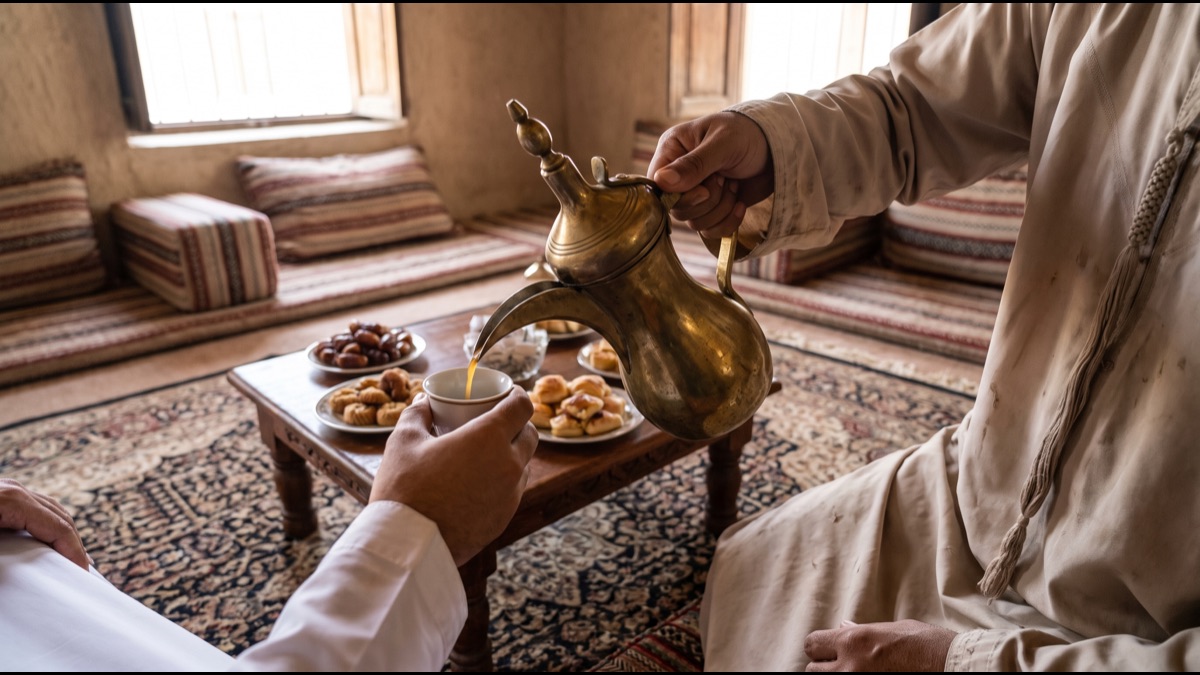
Long before glass towers reshaped the Gulf skyline, the majlis was already doing the work modern institutions now split among a living room, a courtroom, a town hall, and a coffee shop. The word itself comes from the Arabic root meaning "to sit," and a majlis is, at its simplest, a dedicated sitting space for receiving guests — but reducing it to furniture misses what actually made it central to Emirati social and civic life for generations, and why it still functions as a living institution rather than a museum piece today.
In traditional Emirati homes, the majlis was deliberately built as a space physically separate from the family's private living quarters, typically with its own dedicated entrance so guests, including men from outside the household, could arrive, sit, and be received without ever needing to pass through areas reserved for family privacy. That architectural separation was not incidental; it was the entire point, and it shaped how hospitality, business, and community governance actually operated in the region for centuries before oil wealth transformed the built environment around it.
Understanding the majlis means understanding it simultaneously as a physical room, a social institution, a historical mechanism for community decision-making, and a living cultural practice UNESCO now formally recognizes — and tracing how each of those layers actually developed explains why the tradition adapted so successfully to modern UAE governance rather than fading the way many older customs eventually do.
What a Majlis Physically Is
A traditional majlis is a dedicated reception room, historically built as a separate structure or wing from the main family house, furnished with low seating arranged around the perimeter of the room so that everyone present faces roughly inward toward one another, a layout deliberately designed to support open conversation rather than a hierarchical head-of-table arrangement.
The low seating itself, traditionally cushions and floor mattresses called majalis seating rather than raised chairs, reflects both practical adaptation to the desert climate and a deliberate social signal: sitting low and close to the ground put guests at a shared physical level regardless of individual social standing, reinforcing the majlis's function as a genuinely communal space rather than one organized around visible status hierarchy.
A separate guest entrance was a near-universal architectural feature of the traditional majlis specifically because it allowed the space to host visitors, including business associates, tribal elders, and members of the wider community, without requiring guests to enter through the family's private residential areas, a design solution that let hospitality remain genuinely open and frequent without compromising the household's domestic privacy.
The Majlis as a Space for Community Discussion
Beyond simple hospitality, the majlis historically functioned as the primary venue where community members gathered to discuss shared concerns, exchange news, debate local matters, and generally conduct the kind of informal but genuinely consequential social business that in other societies might happen across scattered institutions like town halls, cafes, and private clubs.
Tribal and community leaders held regular majlis sessions specifically to remain accessible to the people under their authority, a practice that established an expectation, still culturally significant today, that leadership in Emirati society should remain genuinely reachable through direct, face-to-face conversation rather than mediated exclusively through formal bureaucratic channels.
This discussion-forum function meant the majlis operated as a genuine information network long before modern communication technology existed, since news, opinions, and emerging community concerns circulated efficiently through repeated, regular majlis gatherings, giving the institution real social and political weight well beyond its architectural role as simply a place to sit and receive visitors.
Dispute Resolution and Informal Governance
The majlis historically served as a practical venue for resolving disputes between individuals or families, with respected elders or tribal leaders hearing both sides of a disagreement in the relatively informal, conversational setting the majlis provided, then working toward a resolution acceptable to the parties involved without necessarily invoking more formal legal mechanisms.
This dispute-resolution function relied heavily on the specific social dynamics the majlis space was built to support: because participants sat together at the same low level, facing one another in open conversation rather than through a formal, hierarchical courtroom-style arrangement, disputes could often be discussed with a degree of directness and mutual respect that more rigid formal settings sometimes struggle to replicate.
Decisions and informal rulings reached in a majlis carried genuine social weight within the community specifically because the process was witnessed collectively and conducted by leaders whose standing depended substantially on being seen as fair, wise, and genuinely accessible, creating a real accountability mechanism even in the absence of codified formal law governing every specific situation.
The Ruler's Majlis as Accessible Governance
At the highest level of Emirati political tradition, rulers historically held their own regular majlis sessions specifically open to ordinary citizens, a practice that let individuals bring grievances, requests, or concerns directly to a ruler or senior tribal leader without needing to navigate layers of formal bureaucratic intermediaries first.
This tradition of direct accessibility became one of the defining features distinguishing Gulf governance culture from more rigidly hierarchical or bureaucratic systems of rule found elsewhere, since a ruler's willingness to hold open majlis sessions was, and largely remains, viewed as a genuine marker of legitimate, responsive leadership rather than a purely ceremonial gesture.
The late Sheikh Zayed bin Sultan Al Nahyan, the UAE's founding president, was widely known for holding regular, genuinely accessible majlis sessions throughout his rule, a practice frequently cited as having meaningfully reinforced public trust in leadership during the UAE's formative post-unification years and helped establish accessible governance as a lasting expectation within the country's political culture.
Majlis Etiquette: Seating and Greeting
Majlis etiquette follows specific, widely understood conventions: guests are generally expected to remove their shoes before entering the seating area, greet each person present individually, typically moving around the room in sequence, and take a seat generally guided by the host or by unspoken conventions tied to age, social standing, or specific relationship to the host rather than seating themselves entirely at random.
Seating precedence in a formal or tribal majlis traditionally reflects a guest's relative status or relationship to the host, with more senior or honored guests typically seated closer to the host or in a position considered more prominent within the room's specific layout, a convention that requires genuine social awareness from both host and guest to navigate correctly and respectfully.
Conversation in a majlis traditionally follows its own informal etiquette as well, generally beginning with pleasantries, inquiries about family and wellbeing, and general news before moving toward whatever specific matter, if any, actually brought a particular guest to that specific gathering, a conversational rhythm that treats genuine hospitality as a prerequisite for substantive discussion rather than an afterthought to it.
Serving Arabic Coffee and Dates
Serving gahwa, traditional Arabic coffee, alongside dates is one of the most recognizable and consistently observed rituals within majlis hospitality, with the coffee itself typically prepared in a distinctive long-spouted pot called a dallah and poured in small quantities into small handleless cups called finjan, refilled repeatedly throughout a guest's visit.
The specific manner of serving carries its own embedded etiquette: the host or a designated server typically pours coffee for the most senior or most honored guest first, working through the room in a sequence reflecting the same status considerations that shape seating arrangements, and a guest is expected to hold their cup out to receive a refill only as long as they wish to continue drinking.
Dates, often several specific varieties, are traditionally served alongside the coffee both as genuine nourishment and as a symbolic gesture of generosity rooted in the historical importance of the date palm to Gulf agriculture and daily sustenance, reinforcing hospitality as something communicated through specific, deliberately chosen food and drink rather than through empty gesture alone.
The Cup-Shake: Signaling "Enough"
A guest signals they have had sufficient coffee through a specific, widely understood physical gesture rather than through spoken refusal: gently shaking the small cup from side to side when handing it back after finishing, a nonverbal signal immediately understood by the host or server as meaning no further refill is wanted at that particular moment.
This gesture-based system reflects a broader characteristic of majlis etiquette generally: much of the social communication happening within a majlis operates through shared, widely understood nonverbal cues and established convention rather than requiring explicit verbal negotiation for every small social decision, a pattern that makes the space feel comfortable and low-friction to those genuinely familiar with its unwritten rules.
For visitors unfamiliar with the custom, continuing to hold the cup upright without shaking it typically results in it simply being refilled again and again, a small but genuinely useful piece of practical etiquette knowledge for anyone attending a traditional majlis gathering for the first time and wishing to participate respectfully in its established customs.
UNESCO Recognition as Intangible Cultural Heritage
In 2015, UNESCO formally inscribed the majlis, described in the nomination as a cultural and social space, on its Representative List of the Intangible Cultural Heritage of Humanity, a joint nomination submitted by the United Arab Emirates, Saudi Arabia, Oman, and Qatar recognizing the tradition's shared importance across Gulf societies rather than treating it as belonging to any single country alone.
UNESCO's specific citation emphasized the majlis's ongoing social function as a space for exchanging news, discussing local and national issues, resolving disputes, extending hospitality, and passing down oral history and cultural knowledge between generations, explicitly framing the tradition as a living, actively practiced institution rather than a purely historical artifact worth preserving only in museums.
This international recognition has since reinforced deliberate government and cultural efforts across the UAE specifically to document majlis traditions, support their continued practice among younger generations, and incorporate majlis spaces and customs into contemporary cultural institutions, heritage villages, and public education about Emirati identity more broadly.
The Majlis in Modern UAE Government
Contemporary UAE governance has deliberately preserved and formally institutionalized the accessible-majlis tradition rather than allowing it to fade as government structures modernized: rulers and senior government officials across the individual emirates continue to hold regular majlis sessions specifically open to citizens wishing to raise concerns, requests, or feedback directly.
The Federal National Council, the UAE's federal advisory and legislative body, has itself been described by officials and scholars as drawing conceptually on majlis traditions of consultation and open discussion, adapting the underlying spirit of accessible governance into a more formal modern institutional structure while still retaining genuine continuity with the older tradition's core emphasis on direct accessibility.
Beyond formal government structures, contemporary Emirati leaders frequently hold public majlis sessions during national holidays and significant civic occasions specifically to reinforce the tradition's continued cultural relevance, a practice widely understood within the UAE as a deliberate, meaningful link connecting modern governance directly back to its specific historical and cultural roots.
Family Majlis Versus Formal or Ruler's Majlis
Not every majlis operates at the same formal register: a family majlis, generally smaller and considerably more informal, functions primarily as an everyday space for hosting relatives, close friends, and neighbors, with etiquette expectations that, while still genuinely present, are considerably more relaxed than those governing a formal tribal or ruler's majlis.
A formal or tribal majlis, by contrast, typically follows more elaborate, more strictly observed etiquette around seating precedence, greeting order, and conversational protocol, reflecting its historical role in handling genuinely consequential community business, dispute resolution, and interactions with visiting dignitaries or officials from outside the immediate community.
A ruler's majlis sits at the most formal end of this spectrum, generally involving the most elaborate protocol and the widest range of attendees, from ordinary citizens raising individual concerns to visiting diplomats and other heads of state, reflecting its specific historical and continuing function as a genuine mechanism of direct political access and accountability.
Majlis Architecture in Contemporary Emirati Design
Contemporary Emirati residential architecture continues to routinely include a dedicated majlis space, even in thoroughly modern villas and apartments, typically positioned near the main entrance and specifically designed with its own separate access point, a direct architectural continuation of the traditional emphasis on keeping guest reception distinct from private family living areas.
Modern majlis interiors frequently blend traditional design elements, including low seating arrangements, geometric patterned textiles, and Arabic calligraphy or traditional motifs, with genuinely contemporary furnishings, lighting, and construction materials, reflecting a broader and quite deliberate pattern across UAE architecture of preserving specific traditional spatial and social functions within thoroughly modern buildings.
Larger-scale contemporary majlis spaces, including those built for hotels, cultural centers, and government buildings, frequently draw explicitly on traditional majlis architectural vocabulary, including specific geometric patterning, particular material choices, and traditional Gulf design motifs, as a deliberate way of visually signaling cultural continuity and hospitality even within genuinely large-scale, thoroughly modern institutional buildings.
Passing the Tradition to Younger Generations
Cultural preservation efforts across the UAE increasingly emphasize actively teaching younger Emiratis both the practical etiquette and the deeper underlying cultural significance of majlis tradition, recognizing that rapid modernization and shifting daily social patterns could otherwise gradually erode familiarity with customs that were once absorbed almost automatically through routine daily practice.
Heritage villages, cultural centers, and school-based educational programs across the UAE frequently include dedicated majlis demonstrations and structured, hands-on etiquette instruction specifically designed to ensure younger Emiratis, and interested visitors from outside the country, understand both the practical customs and the broader historical and social significance underlying the tradition.
Emirati families themselves also continue to actively pass down majlis customs through direct, lived practice, with the specific rituals surrounding hosting, seating, coffee service, and general conversational etiquette typically learned informally by younger family members simply through repeated observation and gradual, hands-on participation in regular family and community majlis gatherings.
Why the Majlis Endured While Other Traditions Faded
Unlike many traditional customs that gradually declined as the Gulf region urbanized and modernized rapidly over just a few decades, the majlis tradition has persisted specifically because it continued serving a genuinely useful, actively functional social purpose rather than surviving purely as ceremonial nostalgia disconnected from real daily life.
The tradition's core underlying logic, providing a genuinely accessible, low-friction space for hospitality, direct community connection, and meaningful two-way communication between individuals and leaders, remains just as relevant to a fast-growing, highly connected, digitally saturated contemporary UAE as it was to earlier generations, even as the specific architectural and social forms surrounding the practice have visibly modernized alongside it.
This underlying continuity of genuine social function, rather than simple architectural or aesthetic preservation for its own sake, is precisely why the majlis persists today as a living, actively practiced institution rather than a purely historical curiosity, and why UNESCO recognition explicitly framed it as ongoing intangible heritage still actively shaping daily social life rather than a static cultural artifact belonging solely to the past.
Sources
- Wikipedia — overview of majlis tradition, history, and regional variations across the Gulf
- UNESCO Intangible Cultural Heritage — official inscription and description of the majlis as intangible cultural heritage
- UAE Ministry of Culture and Youth — background on Emirati cultural heritage preservation efforts
- Abu Dhabi Department of Culture and Tourism — heritage documentation on traditional Emirati architecture and hospitality customs
FAQ
What does the word "majlis" actually mean?
Majlis comes from the Arabic root meaning "to sit," and refers to a dedicated sitting or reception space for receiving guests, historically built separately from a family's private living quarters.
What was the majlis used for beyond hospitality?
Historically it served as a venue for community discussion, dispute resolution, and, at the ruler's level, accessible governance where citizens could raise concerns directly with leaders.
How do you signal you've had enough Arabic coffee in a majlis?
Gently shake the small cup from side to side when handing it back; holding it steady typically signals the host or server to pour another refill.
Is the majlis officially recognized as cultural heritage?
Yes; UNESCO inscribed the majlis on its Representative List of the Intangible Cultural Heritage of Humanity in 2015, in a joint nomination with Saudi Arabia, Oman, and Qatar.
Does the majlis tradition still exist in UAE government today?
Yes; rulers and senior officials across the UAE continue to hold regular majlis sessions open to citizens, and the Federal National Council draws conceptually on majlis traditions of consultation.
Do modern Emirati homes still include a majlis?
Yes; contemporary villas and apartments routinely include a dedicated majlis space near the main entrance with its own separate access, continuing the traditional separation from private family areas.
About the Author
We reference Wikipedia and other authoritative sources to explain the background and current understanding of this topic.
Loved This Article?
Share it on WhatsApp → Share it on WhatsApp
Get more guides in your inbox — Subscribe to our newsletter for weekly surprising stories from Egypt, Saudi Arabia, Dubai, and beyond.