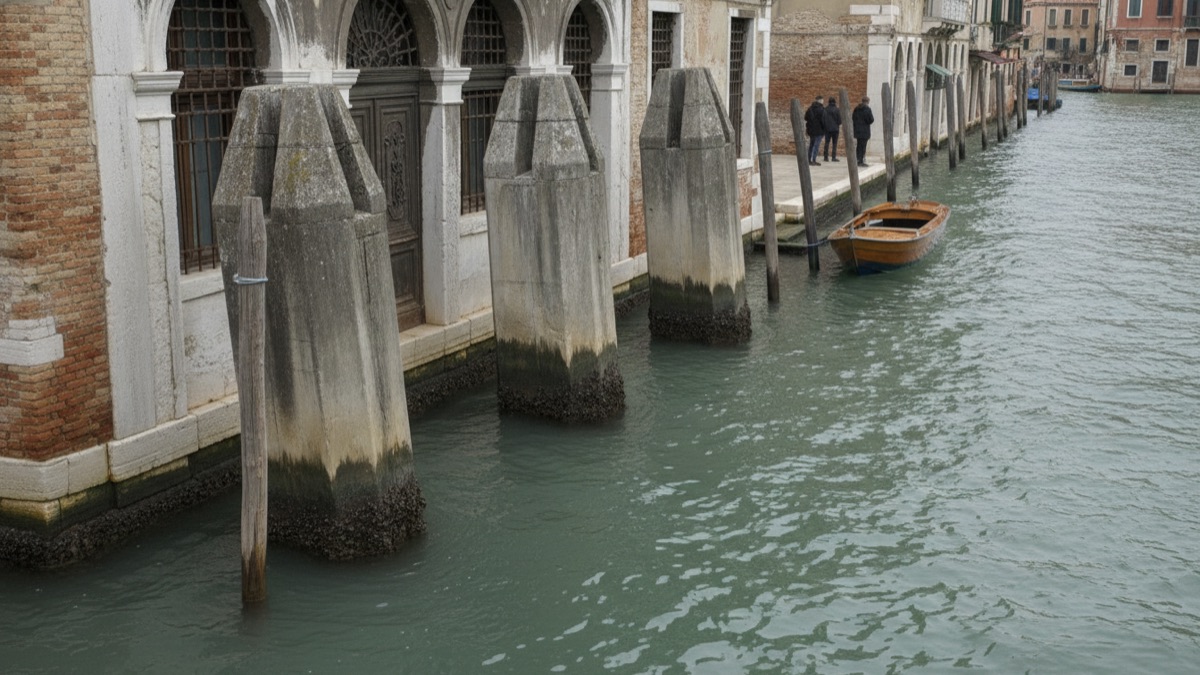
Venice was built on more than one million wooden support posts driven deep into the soft mud of a shallow lagoon over a thousand years ago, and remarkably, those same original posts are still down there today, load-bearing and functional, holding up buildings that have stood for centuries on a foundation most modern engineers would never have chosen if starting from scratch. The city is simultaneously sinking into that soft ground and facing a rising sea around it, a genuinely dangerous combination that has made Venice one of the most closely studied urban engineering problems anywhere in the world.
Understanding why Venice has not simply disappeared beneath the water by now means separating two related but genuinely distinct problems that often get lumped together in casual conversation: subsidence, the ground itself gradually settling and compacting downward, and rising sea levels, the actual water level around the city climbing upward, both problems pushing in the same dangerous direction but driven by entirely different underlying causes.
It also means looking at the specific, genuinely massive engineering response Italy eventually built to address this combined threat directly, a system of movable flood barriers that can physically seal off the entire lagoon from the open sea during exceptionally high tides, a project that took decades of construction, controversy, and cost overruns before finally becoming operational.
Together, the ancient wooden foundation technology and the strikingly modern movable barrier system represent two engineering solutions built roughly a thousand years apart, both aimed at solving fundamentally the same underlying problem: how to keep a city built directly on water from ultimately losing that fight.
Why Anyone Built a City on a Lagoon in the First Place
Venice's earliest settlers moved onto the lagoon's scattered small islands specifically seeking refuge from invading forces on the Italian mainland during the collapse of the Western Roman Empire, choosing the lagoon's shallow, difficult-to-navigate waters precisely because that same difficulty made the location genuinely hard for hostile forces to attack.
What began as a defensive refuge gradually grew into one of medieval Europe's most powerful maritime trading republics, with the lagoon's very inaccessibility to land armies becoming, over subsequent centuries, an economic and strategic advantage rather than merely a wartime necessity, since it made the city's port and warehouses genuinely difficult for rival powers to threaten directly.
This origin story matters directly for understanding the engineering challenge that followed, since Venice was never built on naturally solid, stable ground the way most historic cities were, and every single structure ever built there has had to specifically solve the fundamental problem of how to support real weight on genuinely soft, waterlogged lagoon sediment from the very outset.
How Wooden Posts Actually Support an Entire City
Venetian builders drove massive numbers of wooden posts, most commonly alder wood, vertically down through the lagoon's soft surface mud until each post reached a much firmer layer of compacted clay and sand sitting well beneath that soft upper layer, effectively transferring a building's actual weight down to that considerably more stable deeper foundation.
Once these wooden posts were driven into place, builders then laid horizontal wooden platforms and stone foundations directly across the tops of the closely packed posts, creating a genuinely stable base upon which the actual brick and stone buildings still standing throughout Venice today could then be constructed.
The specific type of wood used and the particular waterlogged, oxygen-poor lagoon environment surrounding it both turn out to matter enormously for the system's long-term durability, since wood decay is primarily caused by fungi and specific microorganisms that require oxygen to actually function, and completely oxygen-starved, waterlogged conditions genuinely slow this decay process dramatically compared to wood left exposed to open air.
Why the Wooden Foundations Have Genuinely Lasted for Centuries
The constant, complete submersion of Venice's wooden foundation posts is precisely what has allowed them to survive as long as they actually have, since wood that remains permanently and fully saturated with water, completely cut off from meaningful oxygen exposure, decays dramatically more slowly than wood exposed to alternating wet and dry conditions above the waterline.
Over the many centuries since these posts were originally driven into the lagoon bed, mineral deposits carried by the surrounding water have gradually infiltrated and hardened around the submerged wood fibers, a slow natural process that has actually made some of the oldest foundation posts measurably harder and more mineralized over time rather than progressively weaker.
This specific combination, oxygen-starved preservation plus gradual mineral hardening, is precisely why many of Venice's original medieval wooden foundations remain structurally sound today, provided they remain permanently submerged, a critical qualifying condition that makes any significant, sustained drop in the surrounding water table a genuinely serious direct threat to the buildings' fundamental structural integrity.
What Actually Causes Venice to Keep Sinking
Natural geological subsidence, the slow, gradual compaction and settling of sediment layers beneath the lagoon under their own accumulated weight over time, has always been occurring beneath Venice to some meaningful degree, a genuinely normal process common to many low-lying delta and lagoon environments worldwide, not something unique to this one particular location.
This entirely natural subsidence rate was dramatically accelerated during the twentieth century specifically by industrial groundwater extraction, since pumping large volumes of water out from underground aquifers to supply nearby mainland industrial facilities caused the sediment layers above those aquifers to compact and settle considerably faster than the underlying natural geological process alone would have caused.
Recognizing this specific man-made acceleration factor, authorities significantly restricted industrial groundwater pumping in the surrounding area starting in the 1970s, a policy change that measurably slowed Venice's overall subsidence rate considerably, though it did not fully halt the ongoing natural geological subsidence process, which continues at a much slower, but still genuinely nonzero, background rate even today.
How Rising Sea Levels Compound the Sinking Problem
While Venice's ground level has been slowly sinking, the actual sea level in the surrounding Adriatic has been simultaneously rising, driven by the same broader global climate factors, thermal expansion of ocean water and melting polar ice, affecting coastlines and low-lying cities worldwide, not any factor genuinely unique or specific to Venice's particular local situation.
These two entirely separate physical processes, the ground sinking downward and the sea level rising upward around it, combine directly and additively, meaning the effective height difference between the city and the surrounding water has been closing meaningfully faster than either individual factor alone would suggest if considered fully in isolation.
This combined effect is precisely why Venice now experiences measurably more frequent and more severe instances of acqua alta, the seasonal high-tide flooding that periodically submerges parts of the city, particularly St. Mark's Square, one of the lowest-lying points in the entire historic city center, compared to just several decades earlier in the twentieth century.
What the MOSE Flood Barrier System Actually Does
MOSE, an Italian acronym translating roughly to Experimental Electromechanical Module, is a system of large mobile floodgates installed across the three separate inlets connecting the Venice lagoon to the open Adriatic Sea, specifically designed to be raised during exceptionally high tide events to physically block excess seawater from actually entering the lagoon at all.
Under normal, everyday conditions, these individual gates lie flat and fully submerged on the sea floor, allowing ordinary tidal flow, shipping traffic, and marine ecosystem circulation to continue completely unimpeded, and are only actively raised using compressed air specifically when a forecasted tide is expected to exceed a height genuinely threatening to significantly flood the city.
This design, gates that remain invisible and fully inactive during normal daily operation but can be selectively raised only when genuinely needed for a specific severe tide event, reflects a deliberate engineering effort to protect the city from extreme flooding events without permanently disrupting the lagoon's essential everyday ecological and shipping function.
Why MOSE Took Decades to Actually Build
Serious formal planning for a large-scale movable flood barrier system began in earnest following the catastrophic 1966 flood, an exceptionally severe event that submerged much of Venice and served as the specific wake-up call that first made clear the city genuinely needed large-scale, purpose-built engineered flood protection beyond its existing historical defenses.
Actual construction of the MOSE system did not begin until decades later, and the project subsequently faced extensive delays, dramatic cost overruns running into the billions of euros beyond original estimates, and a genuinely serious corruption scandal that led to the arrest of several public officials, all factors that repeatedly pushed the system's completion date and operational readiness back significantly further.
This extended, genuinely troubled timeline reflects a pattern common to many extremely large-scale civil engineering projects worldwide: the underlying core engineering concept itself was relatively well understood from early on, while the political, financial, and organizational challenges of actually executing a project at this genuinely enormous physical and financial scale ultimately proved to be considerably more difficult and complex to manage than the engineering challenge alone.
How Effective the Barriers Have Actually Proven to Be
Since becoming operational, MOSE has been raised numerous times specifically to protect the city during forecasted exceptionally high tide events, and available data indicates the system has successfully prevented flooding that would otherwise have significantly submerged large sections of the historic city center on several separate documented occasions.
The system's specific operational reliance on advance tide forecasting means its overall practical effectiveness depends heavily on prediction accuracy, since gates genuinely need to be raised with sufficient lead time before an approaching high tide event actually arrives to be able to provide meaningful, effective protection for the city.
Some engineers and independent researchers studying the system have also raised open questions about its very long-term viability specifically as sea levels continue rising over the coming decades, since a barrier system explicitly designed around today's currently observed tide and flood patterns may eventually require significant future modification or even a full-scale engineering upgrade as underlying sea-level conditions continue to shift over an extended future timescale.
What Individual Building Owners Do Beyond the City-Wide Barriers
Beyond the large-scale MOSE lagoon-wide barrier system, individual property owners throughout Venice have adopted a range of smaller-scale, building-specific flood mitigation measures, including raised thresholds, portable waterproof barriers fitted to doorways, and in some cases, structurally raising a ground floor's actual usable elevation above its original historical level.
Ground-floor spaces throughout much of the historic city are now widely treated as inherently flood-prone by both residents and standard local practice, with valuable furnishings, important documents, and sensitive electrical systems commonly relocated to upper floors specifically as a routine, everyday precaution against acqua alta flooding events.
This combination of large-scale city-wide infrastructure alongside smaller individual building-level adaptation reflects a broader, pragmatic pattern seen in many flood-prone cities worldwide: major infrastructure genuinely reduces overall citywide flood frequency and severity, but rarely eliminates flood risk so completely and entirely that individual, building-level precautions actually become fully unnecessary.
Why Venice Remains a Globally Watched Case Study
Venice's specific combination of challenges, historic irreplaceable architecture, ongoing ground subsidence, and rising sea levels all occurring together in one location, makes it a widely and closely studied case for other low-lying coastal cities worldwide currently facing broadly similar long-term flooding threats, even though most of those other cities lack Venice's genuinely unique combination of centuries-old wooden foundations and comparably irreplaceable historic architecture.
Engineers and urban planners working in other seriously flood-threatened coastal cities regularly study both MOSE's specific engineering design and, just as importantly, its genuinely difficult multi-decade political and financial execution history, treating Venice as a genuinely instructive real-world example of both what large-scale flood protection infrastructure can actually achieve and the very real practical, financial, and organizational difficulties involved in successfully building it.
This close international attention reflects a wider recognition that as global sea levels continue to rise gradually over the coming decades, considerably more of the world's coastal cities will eventually need to seriously grapple with genuinely similar engineering and political questions Venice has already spent the past half-century working through, making the city's accumulated hard-won experience relevant well beyond its own specific lagoon.
What Venice Reveals About Living With Slow-Moving Environmental Change
Venice's still-ongoing, genuinely unresolved struggle against subsidence and rising water illustrates a broader, more general truth about slow-moving environmental threats: unlike a sudden, single-event disaster, a gradually worsening, incremental problem like subsidence or steadily rising sea levels rarely produces one single dramatic moment that forces immediate, decisive large-scale action.
Instead, meaningful response frequently requires sustained political will and consistent funding commitment extending across many years or even decades, a genuinely difficult governance challenge distinct from, and in some ways harder than, the underlying engineering problem itself, since political attention and dedicated budget priorities naturally tend to shift meaningfully over such extended timeframes.
Venice's accumulated, hard-won experience, from the ancient wooden foundation technology first developed a thousand years ago through to the strikingly modern MOSE barrier system completed only recently, demonstrates that a genuinely long-term, existential environmental threat can actually be managed successfully across many centuries, but only through sustained investment, continuous adaptation, and a genuine willingness to keep building and rebuilding solutions as underlying physical conditions themselves keep changing over time.
Sources
- Wikipedia — overview of Venice history, geography, and flood management
- MOSE Venezia — official background on the MOSE flood barrier system design and operation
- UNESCO World Heritage Centre — World Heritage documentation on Venice and its lagoon conservation challenges
- Nature — scientific research on lagoon subsidence, sea-level rise, and coastal flood engineering
FAQ
How can wooden foundations from a thousand years ago still support Venice today?
The posts remain permanently submerged in oxygen-poor mud, which dramatically slows wood decay, and minerals in the surrounding water have gradually hardened around the fibers, making many original foundations structurally sound as long as they stay underwater.
Why is Venice actually sinking?
Natural sediment compaction beneath the lagoon has always occurred slowly, but twentieth-century industrial groundwater pumping dramatically accelerated it before restrictions introduced in the 1970s slowed the rate, though slow natural subsidence continues today.
What is the MOSE system and how does it work?
MOSE is a system of mobile floodgates across the lagoon’s three inlets that lie flat and submerged during normal conditions, then rise using compressed air to physically block the open sea when an exceptionally high tide is forecast.
Why did the MOSE project take so long to build?
Planning began after the catastrophic 1966 flood, but construction faced decades of delay, billions in cost overruns, and a major corruption scandal that led to arrests, reflecting the political and financial difficulty of the project beyond the engineering itself.
Does rising sea level or sinking ground matter more for Venice?
Both combine additively; the ground has been slowly sinking due to natural and past industrial causes while the surrounding sea has been rising from global climate factors, and together they close the height gap faster than either alone would.
Do Venice residents still need their own flood precautions despite MOSE?
Yes, many buildings use raised thresholds, portable waterproof barriers, and relocate valuables to upper floors, since large-scale infrastructure reduces flood frequency and severity but does not eliminate all flood risk entirely.
About the Author
We reference Wikipedia and other authoritative sources to explain the background and current understanding of this topic.
Loved This Article?
Share it on WhatsApp → Share it on WhatsApp
Get more guides in your inbox — Subscribe to our newsletter for weekly surprising stories from Egypt, Saudi Arabia, Dubai, and beyond.