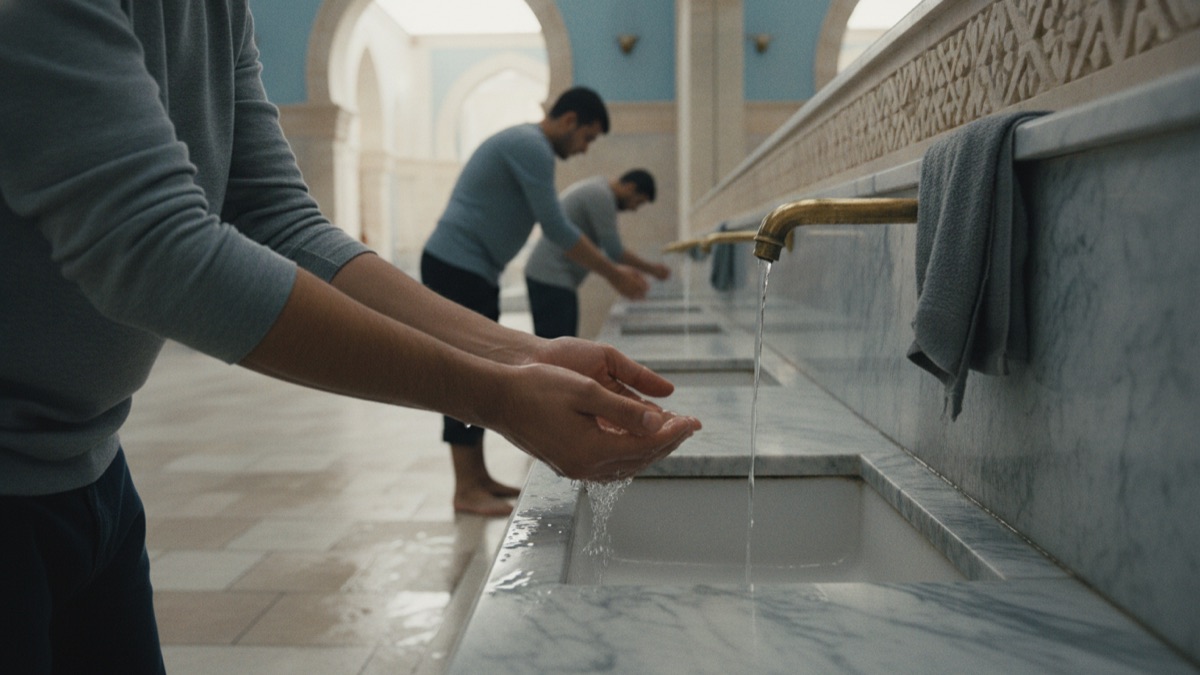
Before any of the five daily prayers, a Muslim performs a short, structured ritual washing called wudu. Far from an informal rinse, it follows a specific order covering particular body parts, carries a defined list of actions that invalidate it, and includes a recognised dry substitute for situations where water genuinely cannot be used, forming one of the most frequently repeated ritual acts in Islamic daily life.
The practice is rooted directly in Quranic instruction and elaborated extensively in hadith literature, and while the core sequence is broadly agreed upon across Islamic legal schools, a number of secondary details, particularly around what breaks wudu, remain genuinely debated points of jurisprudence that shape how millions of Muslims practise the ritual slightly differently depending on which school they follow.
Why Wudu Precedes Every Prayer
Islamic teaching holds that the five daily prayers require a state of ritual purity, and wudu is the standard means of achieving that state for ordinary conditions, distinct from the more comprehensive ritual washing, ghusl, required after specific circumstances such as major ritual impurity, which involves washing the entire body rather than the more limited set of parts covered in wudu each time.
This requirement is stated directly in the Quran, in a verse instructing believers preparing for prayer to wash their faces and hands, wipe their heads, and wash their feet, a passage that forms the textual foundation from which the detailed practical sequence followed today has been derived and elaborated by generations of Islamic scholars working across many centuries and many distinct legal traditions.
How the Exact Washing Sequence Works
The standard sequence begins with washing the hands up to the wrists, followed by rinsing the mouth and then the nose, washing the face from hairline to chin and ear to ear, washing the arms up to and including the elbows, wiping the head and ears with wet hands, and finally washing the feet up to and including the ankles.
Each step is generally performed in a fixed order and, according to widespread practice, three times for most steps, though some scholars consider a single thorough washing of each part sufficient to fulfil the minimum requirement, with the threefold repetition treated as a recommended rather than obligatory enhancement of the basic act required for validity.
Why Intention Matters Before Washing Begins
Islamic jurisprudence places significant weight on intention, niyyah, as a prerequisite for wudu to count as a valid act of worship rather than an ordinary act of hygiene, meaning a person who happens to wash their face and hands without any intention of performing ritual purification has not thereby completed wudu in the religious sense.
This intention is not typically verbalised aloud and does not require any specific wording, existing instead as a conscious mental resolve to perform the washing for the purpose of prayer or another act requiring ritual purity, a requirement scholars generally describe as easily satisfied but nonetheless essential to distinguishing the ritual from mere washing performed for hygiene alone.
What Counts as an Invalidator of Wudu
A specific, generally agreed list of actions is understood to invalidate wudu once performed, chief among them using the toilet, passing gas, deep sleep that removes awareness of one's surroundings, and loss of consciousness, all of which are treated as returning a person to a state requiring fresh ritual purification before the next scheduled prayer time.
Beyond this core list, additional potential invalidators are debated at length across different schools of Islamic jurisprudence, including questions such as whether touching a member of the opposite sex, bleeding, or vomiting breaks wudu, debates rooted in differing interpretations of specific hadith and Quranic passages rather than any disagreement over the underlying core requirement itself or its overall purpose.
Why One Wudu Can Cover Multiple Prayers
Contrary to a common misconception, wudu does not need to be repeated before every single prayer as a matter of strict obligation, remaining valid across multiple prayers as long as nothing occurs in the meantime to invalidate it, meaning a person who performs wudu in the morning and encounters no invalidator can pray several prayers using that same state of purity.
Some scholars and pious individuals nonetheless recommend performing fresh wudu before each prayer as a matter of spiritual merit rather than strict necessity, based on narrations describing this as a praiseworthy though optional practice, a distinction between the minimum obligatory requirement and a recommended additional act that recurs throughout many areas of Islamic ritual practice more broadly.
How Wiping Over Socks Is Permitted
Islamic jurisprudence permits wiping over socks or leather footwear instead of washing the bare feet during subsequent wudu performances, provided the footwear was put on while the feet were already in a state of ritual purity, an allowance rooted in specific hadith narrations and generally accepted across the major schools with some variation in the permitted duration.
This concession, known as mash ala al-khuffayn, is typically time-limited, commonly around one day for a resident and three days for a traveller under most schools, after which the socks must be removed and the feet washed normally the next time wudu is performed, reflecting a practical accommodation balanced against the underlying requirement rather than an open-ended exemption.
What Tayammum Is and When It Applies
Tayammum is a recognised dry substitute for wudu, performed using clean earth, sand, or a similar natural surface instead of water, permitted specifically when water is genuinely unavailable, when using water would cause harm such as aggravating illness or extreme cold, or when obtaining water would involve excessive hardship or danger.
The procedure is considerably simpler than wudu, generally involving striking the hands against a clean surface and then wiping the face and hands, and its explicit Quranic basis demonstrates the underlying principle that ritual purity requirements are designed to accommodate genuine hardship rather than to impose an inflexible obligation regardless of circumstance or ability.
Why Schools of Jurisprudence Disagree on Certain Invalidators
The question of whether touching a member of the opposite sex invalidates wudu illustrates how genuinely different Islamic legal schools can be on secondary matters despite sharing the same core framework, with some schools holding that any direct skin contact breaks wudu under most circumstances, and others holding that it does not unless accompanied by sexual desire or a specific additional recognised condition.
These disagreements trace back to differing interpretations of the same underlying Quranic phrase describing contact between men and women in the context of ritual purity, a term whose precise scope classical exegetes debated extensively, producing genuinely divergent but equally well-reasoned positions that continue to be taught and followed within their respective schools today across different regions of the Muslim world.
How Water Purity Is Judged
Not all water is considered suitable for wudu under Islamic jurisprudence, which distinguishes between pure water suitable for both drinking and ritual purification, water that remains technically pure but is discouraged for use, and water considered impure or already used for a previous ritual washing and therefore unsuitable for a further act of purification.
Practical questions addressed within this framework include the status of water that has changed colour, taste, or smell due to natural minerals rather than contamination, generally still considered valid, and water that has come into contact with impure substances in sufficient quantity to alter its essential properties, generally considered invalid for ritual use, a distinction scholars have applied to modern questions such as treated tap water and bottled mineral water without difficulty.
Why Wudu Is Also Recommended Outside Prayer
Beyond its role as a prerequisite for prayer, wudu carries recommended status in various other contexts within Islamic teaching, including before sleeping, before handling or reciting the Quran, and after specific acts considered spiritually or physically unclean, reflecting a broader conception of the practice as generally beneficial rather than narrowly tied to the moment of formal prayer alone or any single occasion.
Some hadith narrations describe spiritual benefits attributed to maintaining a continuous state of ritual purity throughout the day rather than only performing wudu immediately before each prayer, a practice some especially observant Muslims adopt as a matter of personal devotion beyond the strict minimum requirement of the religious law.
How Children Are Taught the Practice
Wudu is typically among the first ritual practices formally taught to Muslim children, often alongside the basic movements of prayer itself, with parents and religious educators commonly using simple step-by-step demonstration and repetition rather than relying solely on verbal instruction, given the practice's inherently physical and sequential nature.
Many mosques and Islamic schools incorporate dedicated instructional sessions on correct wudu technique into their children's education programmes, reflecting the practice's foundational status as one of the earliest formal religious obligations a young Muslim is expected to learn and perform independently as they approach the age of religious accountability, with picture books, songs, and short instructional videos increasingly used alongside traditional in-person demonstration in many communities today.
How Modern Facilities Have Adapted to Wudu
Mosques worldwide typically include dedicated ablution facilities designed specifically around the wudu sequence, featuring low seating, foot-height taps, and drainage designed for repeated use by large numbers of worshippers in a short period, particularly around the busiest congregational prayers of the week and during major religious occasions.
Contemporary innovations have included water-efficient tap designs intended to reduce the volume of water used per wudu without compromising the completeness of the wash, a response partly to environmental and cost concerns in regions where water is scarce, and partly to broader efforts within some Muslim communities to align religious practice with sustainability goals, with several mosque associations publishing guidance specifically encouraging worshippers to avoid wasteful over-use of water even though the ritual itself carries no fixed minimum volume requirement.
Why the Practice Has Remained Remarkably Stable
Despite genuine jurisprudential debate over specific secondary details, the core sequence and purpose of wudu has remained essentially unchanged across fourteen centuries and across vastly different regions and cultures, a stability scholars attribute partly to its clear textual basis in the Quran and partly to its frequent, repeated performance, which limits the drift that can affect less regularly practised rituals.
This consistency means a Muslim visiting an unfamiliar mosque anywhere in the world can generally expect the ablution facilities and the expected sequence of washing to be immediately recognisable, a small but meaningful thread of continuity running through a ritual performed multiple times daily by well over a billion people across dramatically different climates, languages, and local customs.
How Wudu Differs From Ghusl
While wudu addresses the ordinary state of minor ritual impurity that arises from everyday activities, a separate and more comprehensive ritual washing called ghusl is required following specific circumstances considered major ritual impurity, including after sexual intercourse, at the end of menstruation or postnatal bleeding, and following a formal conversion to Islam in some interpretations.
Ghusl requires washing the entire body rather than the specific limited parts covered by wudu, and a person in a state requiring ghusl cannot substitute wudu for it regardless of how thoroughly the more limited washing is performed, reflecting a categorical distinction in Islamic jurisprudence between two different levels of required ritual purification recognised across every major school.
Why Some Scholars Emphasise the Spiritual Dimension
Beyond its function as a physical prerequisite for valid prayer, wudu is frequently described in Islamic teaching as carrying a spiritual dimension of its own, with hadith narrations describing the washing of each body part as symbolically accompanied by the removal of minor sins committed by that part, a teaching many scholars present as an encouragement toward sincerity rather than a literal mechanical claim.
This spiritual framing is often used in religious instruction to encourage worshippers to perform wudu attentively and unhurriedly rather than as a purely mechanical formality to be completed as quickly as possible, reinforcing the broader Islamic principle that outward ritual acts are ideally accompanied by genuine inward awareness and intention rather than rushed, distracted repetition.
Understood in full, wudu is considerably more than a simple wash before prayer, functioning as a structured ritual with a defined sequence, a specific list of invalidating actions, a recognised dry alternative for situations of genuine hardship, and centuries of careful jurisprudential attention to its precise boundaries, all oriented around preparing a worshipper to stand in prayer in a state of ritual purity.
The genuine points of scholarly disagreement that remain, particularly around certain invalidators, illustrate that Islamic jurisprudence treats even a frequently repeated everyday ritual as worthy of careful, ongoing scholarly attention rather than settling for a single rigid answer imposed without regard for differing textual interpretation. For a practising Muslim, this combination of a fixed, learnable core sequence and a body of secondary jurisprudential nuance means wudu functions simultaneously as an accessible daily habit and as a genuine subject of religious study for those who wish to go deeper into its underlying legal reasoning.
Sources
- Wikipedia — overview of wudu and its jurisprudential details
- Encyclopaedia Britannica — background on Islamic ritual purity requirements
- Oxford Islamic Studies — scholarly reference on Islamic jurisprudence and worship
- JSTOR — academic research on comparative Islamic legal schools
FAQ
Does wudu need to be repeated for every prayer?
No, wudu remains valid until something breaks it, such as using the toilet or sleeping deeply, so one wudu can cover multiple prayers if nothing invalidates it in between.
What is tayammum?
Tayammum is a dry substitute for wudu using clean earth or dust, permitted when water is unavailable, harmful to use, or would cause excessive difficulty to obtain.
Does touching a member of the opposite sex break wudu?
Islamic legal schools disagree on this specific point, with some considering it an invalidator under certain conditions and others not considering it one at all.
Can wudu be performed with any type of water?
Clean, unused water is required; water that is visibly impure or has already been used for a previous ritual washing is generally not considered valid for wudu.
Is wearing socks or shoes allowed during wudu?
Wiping over socks or leather footwear instead of washing bare feet is permitted under specific conditions, provided they were put on in a state of ritual purity.
About the Author
We reference Wikipedia, Encyclopaedia Britannica, Oxford Islamic Studies, and JSTOR to explain the background and current understanding of this topic.
Loved This Article?
Share it on WhatsApp → Share it on WhatsApp
Get more guides in your inbox — Subscribe to our newsletter for weekly surprising stories from Egypt, Saudi Arabia, Dubai, and beyond.