Every year, millions of pilgrims performing Hajj and Umrah want to carry water from a single well in Mecca back to family and friends around the world, a demand that would overwhelm almost any natural water source if it were managed the way an ordinary municipal supply is managed. Instead, Saudi authorities have built a purpose-designed extraction, testing, bottling, and distribution system specifically to meet this demand without depleting or compromising the well itself.
Understanding how Zamzam water actually moves from the well beneath the Grand Mosque to a sealed bottle carried home by a pilgrim reveals a logistics and quality-control operation considerably more sophisticated than most people who have simply received a bottle as a gift ever consider, one that blends religious significance with genuinely rigorous modern engineering and food safety science.
It also explains why counterfeit Zamzam water remains a persistent problem in some markets, and why several countries maintain specific import restrictions on a product most travelers assume would move across borders without any regulatory friction at all.
A Well That Has Never Run Dry
The Zamzam well, located within the Grand Mosque complex in Mecca, holds deep religious significance in Islamic tradition and has remained in continuous use for well over a thousand years, a longevity that itself has generated considerable scientific curiosity about the well's underlying hydrogeology and water source.
This historical continuity, combined with the well's religious significance, means any modern management system built around it has to satisfy two simultaneous requirements: genuine scientific and engineering rigor to manage the resource sustainably, and deep respect for the well's religious and historical significance to the millions who value it.
Why This Specific Well Matters So Much
Zamzam water holds particular significance in Islamic tradition connected to the Hajj pilgrimage, and pilgrims performing Hajj or Umrah commonly drink the water on-site and seek to bring bottles home for family members unable to make the pilgrimage themselves, a practice that has continued largely unchanged in spirit across many centuries even as the practical logistics around it have transformed completely.
This dual significance, both immediate religious practice at the well itself and a desire to share the experience with those who could not travel, is precisely what created the enormous logistical demand Saudi authorities eventually had to build formal infrastructure to meet.
Where the Water Actually Comes From
The well draws from a natural underground aquifer beneath Mecca, and hydrogeological studies conducted over the decades have examined the specific rock formations and water recharge patterns that sustain the well's continuous flow, research that has helped Saudi water authorities understand and responsibly manage extraction rates.
This scientific study of the well's underlying hydrogeology is not a purely academic exercise; it directly informs how much water can be safely and sustainably extracted for both on-site drinking and the formal bottling and distribution program without risking any long-term depletion of the aquifer itself.
Why the Well Does Not Run Out Despite Millions of Daily Users
Despite supplying drinking water to enormous numbers of pilgrims daily, particularly during peak Hajj season, plus the entire formal bottling operation, the well's aquifer has continued to recharge naturally at a rate that has sustained continuous use for over a millennium, a natural resilience that long predates any modern pumping or management technology.
Modern extraction technology has, if anything, allowed for more careful and monitored management of the resource than earlier eras could achieve, with pumping rates calibrated against ongoing hydrogeological monitoring rather than simply extracting water on an as-needed basis without reference to the aquifer's actual recharge capacity.
How the Modern Pumping and Storage System Actually Works
Water drawn from the well passes through a modern pumping infrastructure into storage and initial holding facilities, with continuous monitoring of water levels and quality parameters built into the system to ensure both a stable on-site drinking supply for pilgrims and an adequate feed into the separate formal bottling and distribution pipeline.
This infrastructure represents a considerable engineering investment specifically built to serve a location with genuinely unusual demand patterns, since visitor numbers fluctuate dramatically between the intense Hajj season and quieter periods throughout the rest of the year, requiring a system flexible enough to handle both extremes reliably.
The King Abdullah Zamzam Water Project
Saudi authorities established a dedicated modern facility specifically to formalize and scale Zamzam water bottling and distribution, replacing what had previously been a considerably less centralized and less rigorously standardized process with a purpose-built industrial operation incorporating modern food safety and quality control standards throughout.
This formalization reflects a broader pattern in how Saudi Arabia has approached Hajj and Umrah infrastructure more generally over recent decades, applying substantial modern engineering and logistics investment to religious practices and traditions that had previously relied on considerably more informal, smaller-scale arrangements.
How Bottling Actually Happens at Industrial Scale
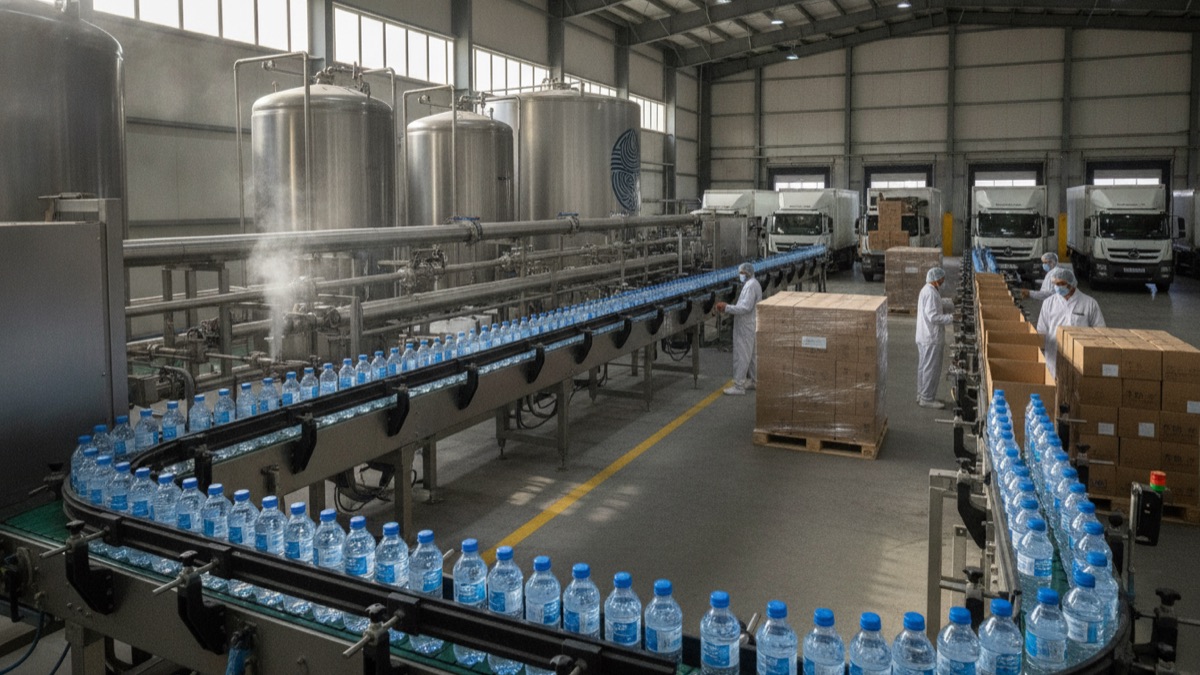
The formal bottling facility processes water through filtration, quality testing, and automated filling lines producing sealed bottles at a scale sufficient to meet demand from millions of pilgrims annually, using equipment and hygiene protocols broadly comparable to those found in any large-scale modern commercial beverage bottling operation.
This industrial-scale approach, while a considerable departure from how pilgrims historically obtained and carried the water in earlier centuries, was necessary specifically to meet consistent quality and safety standards at the volume modern pilgrim numbers require, since informal, unregulated bottling could not reliably guarantee the same consistent safety standard.
What Quality Testing Actually Checks For
Water quality testing throughout the bottling process checks for microbial contamination, mineral content, and general chemical composition, following food safety standards comparable to those applied to any commercially bottled drinking water product, ensuring the final bottled product is genuinely safe for consumption regardless of its religious significance.
This rigorous testing regime exists precisely because Zamzam water's religious significance does not exempt it from ordinary food safety science; if anything, the sheer volume of people consuming it and the trust placed in its safety by consumers worldwide makes rigorous, continuous quality testing even more important than it would be for an ordinary commercial beverage.
Why Pilgrims Historically Struggled to Bring Water Home
Before the establishment of formal bottling and distribution infrastructure, pilgrims wishing to bring Zamzam water home relied on informal containers and personal arrangements, a system that worked reasonably well at smaller pilgrim volumes but became increasingly strained and inconsistent as the number of annual pilgrims grew substantially over the twentieth century.
This growing strain on informal arrangements is precisely what drove Saudi authorities to invest in the formal infrastructure that exists today, recognizing that pilgrim volumes had reached a scale where relying purely on informal personal transport of water was no longer a practical or dignified solution.
How the Free Distribution System Works Today
Zamzam water is distributed to pilgrims free of charge through official channels, including designated distribution points within the Grand Mosque complex and at airports for departing pilgrims, a deliberate policy choice reflecting the water's religious significance and a desire to avoid commercializing what is considered a sacred resource.
This free distribution model, while logistically demanding at the volumes involved, is treated as a fundamental principle of how the water should be shared rather than a policy up for reconsideration purely on cost or convenience grounds, reflecting how deeply the non-commercial nature of the water's distribution is embedded in how Saudi authorities approach the entire program.
Why Zamzam Water Cannot Be Legally Sold in Saudi Arabia
Saudi regulations specifically prohibit the commercial sale of genuine Zamzam water within the kingdom, reinforcing the principle that access to the water should not depend on a pilgrim's ability to pay, a regulatory stance that directly shapes how the free distribution infrastructure described above actually operates in practice.
This prohibition also means that any bottle offered for sale claiming to be genuine Zamzam water within Saudi Arabia is, by definition, either counterfeit or being sold illegally, a clear legal bright line that helps authorities distinguish legitimate distribution from unauthorized commercial exploitation of the water's religious significance.
The Counterfeit Problem Authorities Actually Face
Despite the free, non-commercial distribution model within Saudi Arabia, counterfeit Zamzam water, ordinary water bottled and mislabeled to falsely claim Zamzam origin, has been documented in various international markets, exploiting the water's religious significance and the difficulty ordinary consumers face verifying a bottle's actual origin.
This counterfeiting problem is a genuine ongoing enforcement challenge rather than a solved historical issue, since counterfeit product can be difficult to distinguish from genuine bottles without laboratory testing, and demand for the water remains strong enough in markets outside Saudi Arabia to make counterfeiting a persistently attractive fraud for bad actors.
How Authorities Try to Verify Genuine Bottles
Official Zamzam water distributed through the formal Saudi program carries specific packaging, labeling, and in some cases security features intended to help distinguish genuine product from counterfeit bottles, though consumers outside the direct pilgrim distribution channel are generally advised to treat any commercially purchased "Zamzam water" with genuine skepticism.
The most reliable way to obtain verifiably genuine Zamzam water remains receiving it directly through official pilgrim distribution channels rather than purchasing it from any secondary commercial source, since the entire formal system is specifically designed to keep the water outside ordinary commercial retail channels altogether.
Why Some Countries Restrict Importing It
Several countries maintain import restrictions on bottled water generally, including Zamzam water specifically in some cases, driven by standard food safety import regulations rather than any specific objection to the water itself, meaning pilgrims traveling internationally with Zamzam water sometimes encounter restrictions similar to those applied to any other liquid or food product crossing certain borders.
These restrictions can create genuine confusion for pilgrims who assume the water's religious significance would exempt it from ordinary customs and import rules, when in practice most countries apply the same general liquid import and food safety regulations to Zamzam water that they would apply to any other bottled beverage entering the country.
What Scientific Studies Have Actually Found About the Water
Independent scientific analysis of Zamzam water's mineral composition has generally found it to be safe drinking water with a mineral profile within normal ranges for potable groundwater, though claims occasionally circulating about unusual or uniquely beneficial properties beyond standard mineral water composition are not consistently supported by rigorous peer-reviewed research.
Saudi authorities themselves have generally focused public messaging on the water's safety, religious significance, and the rigor of the formal quality control system rather than promoting more speculative health claims, a measured approach that keeps the program's credibility anchored in verifiable food safety standards rather than unsubstantiated marketing claims.
How Logistics Scale to Handle Hajj Season Specifically
Distribution infrastructure must scale dramatically during the concentrated Hajj season, when several million pilgrims arrive within a compressed timeframe, requiring distribution points, storage capacity, and bottling throughput calibrated for extreme seasonal peak demand rather than the more modest baseline demand present during quieter periods of the year.
This seasonal scaling challenge is conceptually similar to other major seasonal logistics operations worldwide, requiring significant infrastructure and staffing capacity that sits partially idle for much of the year specifically so it can handle the concentrated demand surge Hajj season reliably produces every single year.
Why This System Represents a Genuine Engineering Achievement
Bringing together hydrogeological monitoring, industrial-scale food-safe bottling, free distribution logistics at genuinely massive scale, and fraud prevention into one coordinated program represents a considerable engineering and administrative achievement, one that receives comparatively little public attention relative to its actual operational complexity and scale.
This relative lack of public attention is itself notable, since most pilgrims and recipients of gifted bottles simply experience the end result, a sealed, safe, verifiably sourced bottle of water, without much awareness of the extensive infrastructure and quality assurance system required to reliably deliver that simple end product at this scale.
What This Reveals About Managing a Sacred Resource at Scale
The Zamzam water system illustrates a genuinely distinctive challenge: applying rigorous modern engineering, food safety science, and logistics management to a resource whose value is fundamentally religious and cultural rather than purely commercial, without allowing that modernization to compromise the resource's meaning or accessibility to the people who value it most.
That balance, between scientific rigor and religious significance, between industrial-scale logistics and a deliberately non-commercial distribution philosophy, is what makes the Zamzam water program a genuinely distinctive case study in resource management, one with few close parallels anywhere else in the world.
How Airport Distribution Points Handle Departing Pilgrims
Airports serving Jeddah and Medina, the main gateways for pilgrims departing after Hajj or Umrah, host dedicated Zamzam water distribution points specifically designed to handle enormous departure-day volumes, allowing each pilgrim to collect their allotted bottles as part of the standard departure process rather than needing to arrange transport of the water separately beforehand.
This airport-based distribution model solves a genuinely practical logistics problem, since carrying large containers of water through the entire pilgrimage journey before departure would be impractical for most travelers, letting pilgrims instead collect their water at the very end of their trip when they are already packing for the flight home.
Why the Program Continues to Modernize Further
Saudi authorities have continued investing in expanding bottling capacity, improving quality monitoring technology, and refining distribution logistics as pilgrim numbers have grown over recent years, treating the current system as an evolving operation rather than a finished, static piece of infrastructure that no longer requires ongoing investment.
This continued investment reflects an expectation that pilgrim numbers will likely keep growing over coming decades, meaning the infrastructure built today has to be designed with meaningful future capacity headroom in mind rather than being sized purely for current demand levels alone.
For most pilgrims, none of this operational scale is ever visible; they simply receive a sealed bottle, sometimes handed to them personally at a distribution counter, sometimes carried home in luggage, carrying with it both a tangible physical connection to their pilgrimage and a far less visible testament to decades of accumulated engineering, hydrology, food safety science, and logistics planning working quietly together behind a genuinely simple final product.
What Family Members Receiving a Bottle Often Do Not Realize
A relative receiving a small bottle of Zamzam water as a gift from a returning pilgrim rarely thinks about the hydrogeological monitoring, industrial bottling line, or fraud-prevention system that made that specific bottle possible, experiencing instead a simple, deeply personal gesture connecting them to a pilgrimage they may never have the opportunity to make themselves.
That gap between the visible gesture and the invisible infrastructure supporting it mirrors a pattern found across many of the systems this site covers: the more reliably and safely something works at genuine scale, the less most people ever need to think about how it actually works, right up until they read an explainer that pulls back the curtain on exactly what stands behind the simple object in their hands.
Sources
- Wikipedia — overview of the Zamzam well, its history, and modern management
- Saudi General Presidency for the Affairs of the Two Holy Mosques — official information on Grand Mosque and Zamzam water management
- Saudi Food and Drug Authority — food safety and water quality regulatory standards in Saudi Arabia
- World Health Organization — general drinking water safety and quality standards for reference
FAQ
Why doesn’t the Zamzam well ever run dry despite millions of daily users?
The well draws from a natural underground aquifer that has continued recharging naturally for over a millennium, and modern extraction is carefully calibrated against ongoing hydrogeological monitoring to avoid depleting it.
Can you legally buy Zamzam water in Saudi Arabia?
No — Saudi regulations specifically prohibit commercial sale of genuine Zamzam water within the kingdom, so any bottle offered for sale there claiming to be genuine is by definition counterfeit or sold illegally.
Is counterfeit Zamzam water actually a real problem?
Yes — ordinary water mislabeled as Zamzam water has been documented in various international markets, exploiting the water’s religious significance and the difficulty ordinary consumers face verifying a bottle’s true origin without laboratory testing.
Why do some countries restrict bringing Zamzam water across their borders?
These restrictions generally come from standard food safety and liquid import regulations applied broadly to bottled beverages rather than any specific objection to Zamzam water itself.
Do scientific studies support special health claims about Zamzam water?
Independent analysis generally finds it safe drinking water with a normal mineral profile for potable groundwater, though more speculative claims about unique health benefits are not consistently supported by rigorous peer-reviewed research.
About the Author
We reference Wikipedia and other authoritative sources to explain the background and current understanding of this topic.
Loved This Article?
Share it on WhatsApp → Share it on WhatsApp
Get more guides in your inbox — Subscribe to our newsletter for weekly surprising stories from Egypt, Saudi Arabia, Dubai, and beyond.