What Is the Islamic New Year?
The Islamic New Year, also called the Hijri New Year or Ras as-Sanah al-Hijriyah, marks the beginning of a new year in the Islamic lunar calendar. It begins on the first day of Muharram, the first month of the Hijri year.
Unlike the Gregorian New Year on 1 January, the Islamic New Year moves backward through the solar year by about ten or eleven days annually. This is because the Islamic calendar follows the moon rather than the sun — our Hijri calendar guide explains this lunar system in full detail.
The current year is often written with the suffix AH (Anno Hegirae, "in the year of the Hijrah"), distinguishing it from the CE or AD used for Gregorian dates.
The Hijrah: Why the Calendar Begins Here
The Islamic calendar begins with the Hijrah, the migration of the Prophet Muhammad (peace be upon him) and the early Muslims from Mecca to Medina in 622 CE. This journey transformed a persecuted community into the foundation of a new society, with its own social structure, legal framework, and shared identity.
The caliph Umar ibn al-Khattab later fixed the calendar to start from the year of the Hijrah, roughly two decades after the event itself, once the growing Muslim administration needed a consistent way to date official records. Choosing the Hijrah rather than the Prophet's birth reflected its significance as a communal turning point rather than a personal milestone, making it a permanent reminder of faith, planning, and sacrifice rather than a celebration centred on any one individual.
The Hijrah itself unfolded over difficult circumstances. The Prophet and his companions faced years of persecution, boycott, and threats in Mecca before the invitation from the people of Yathrib (later Medina) offered a path forward. The migration required careful planning, including a decoy plan to evade pursuers and a journey through difficult desert terrain, and it is remembered in Islamic tradition as an example of patience, trust in God, and strategic wisdom under extreme pressure — themes that continue to shape how the New Year is discussed in sermons and reflections even today.
How Hijri Years Are Numbered and Why It Matters
Unlike the Gregorian calendar, which numbers years continuously from a fixed reference point regardless of local events, the Hijri calendar's year count is tied directly to a specific historical migration rather than a birth, coronation, or founding of an empire. This means every Hijri year explicitly recalls the Hijrah each time it is written or spoken, reinforcing its significance far more directly than most calendar systems reinforce their own starting points.
Because Hijri years are shorter than Gregorian years by roughly eleven days, the numerical gap between the two systems is not fixed. In practical terms, a person converting a Hijri year to an approximate Gregorian year needs to account for this drift rather than applying a single simple offset, which is one reason official converters and religious authorities remain the most reliable source for exact date confirmation rather than mental arithmetic.
This is also why references to Hijri years appear consistently across Islamic scholarship, historical documents, and legal texts spanning fourteen centuries, giving historians a continuous and internally consistent dating system to work with even when cross-referencing events across very different regions and eras of Islamic history.
Muharram: The Sacred Month
Muharram is one of the four sacred months in Islam, alongside Rajab, Dhul-Qa'dah, and Dhul-Hijjah. Fighting was traditionally forbidden during these months, and Muslims are encouraged to increase good deeds and avoid sin.
Because Muharram opens the Islamic year, many Muslims treat it as a period of heightened self-reflection, similar in spirit — though different in practice — to how some cultures treat the start of a solar new year as a time for resolutions. Increased voluntary fasting, additional prayer, and renewed attention to personal conduct are common throughout the month, especially around its early days.
The name Muharram itself, meaning "forbidden" or "sacred," reflects its status as one of the months in which warfare was prohibited among the Arab tribes even before Islam, a practice that Islam preserved and reinforced. Scholars point to this continuity as an example of how Islam retained pre-existing Arabian customs that aligned with its own values of peace and restraint, while reforming others that did not.
Ashura: The Tenth of Muharram
The tenth day of Muharram is Ashura, a day with deep and layered significance across the Muslim world. For Sunni Muslims, fasting on Ashura (often alongside the ninth or eleventh day) is a recommended Sunnah, associated with reports that earlier prophets, including Musa (Moses), fasted on this day in gratitude for deliverance from hardship.
For Shia Muslims, Ashura carries a different and central significance: it marks the anniversary of the martyrdom of Imam Hussein ibn Ali, grandson of the Prophet Muhammad, at the Battle of Karbala in 680 CE. This event is commemorated with mourning gatherings, recitations of the events of Karbala, and processions, particularly significant in Shia-majority communities and observed with solemnity rather than celebration. Both the Sunni and Shia observances of Ashura, though different in form and meaning, share the same calendar date and reflect the depth of history carried by this single day in the Islamic year.
Historically, Ashura fasting is also linked in Islamic tradition to earlier religious communities. Reports describe the Prophet Muhammad observing that the Jewish community of Medina fasted on this day to commemorate the deliverance of the Israelites from Pharaoh, and choosing to fast it himself while encouraging Muslims to do the same, later recommending an additional day of fasting (either the ninth or eleventh) to distinguish the Muslim practice. This layered history — spanning older prophetic tradition and, separately, the events of Karbala centuries later — is part of why Ashura is often described as one of the most historically dense single days in the Islamic calendar.
How the New Year Is Observed
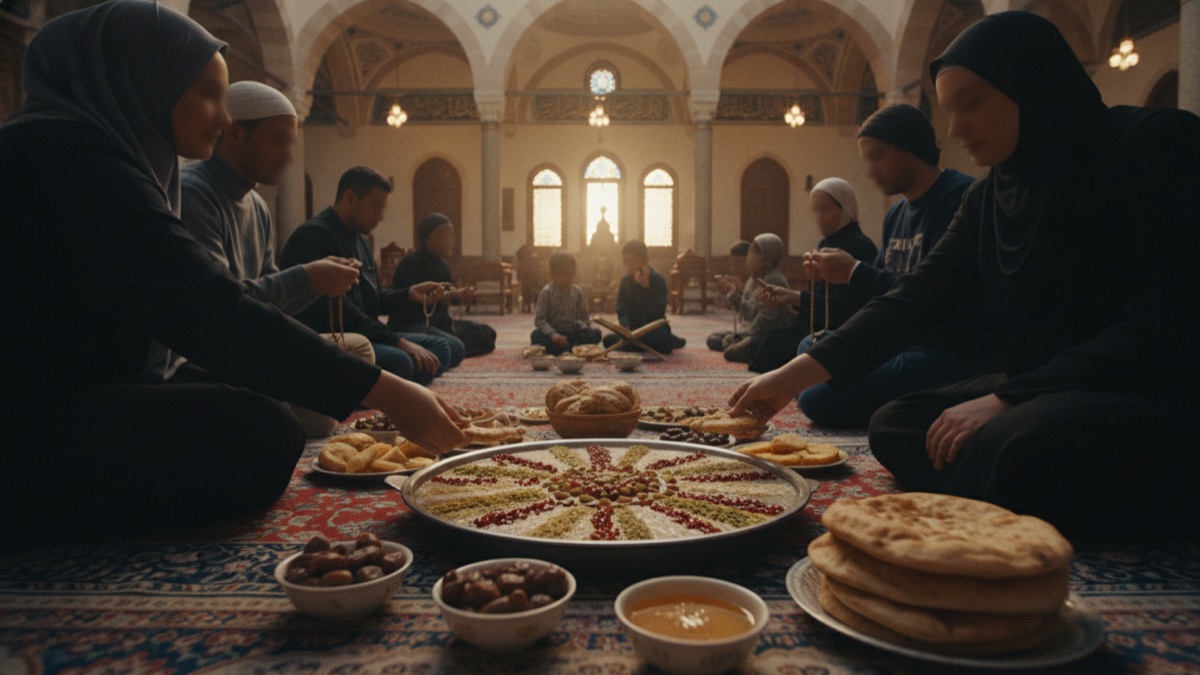
There are no prescribed communal prayers specifically for the Islamic New Year, unlike the two Eids, but many Muslims use the day for reflection, gratitude, and setting spiritual goals. Families may gather for special meals, visit relatives, and exchange greetings such as "Kul 'am wa antum bikhair" (may every year find you well).
Charity is especially encouraged at the start of Muharram. Some Muslims choose to pay Zakat or give Sadaqah as the year begins, treating the new year as a natural checkpoint for reviewing the past year's financial obligations. Learn more about charity in our guide to Sadaqah vs Zakat.
Unlike Eid al-Fitr or Eid al-Adha, there is no specific congregational prayer, festive meal, or fixed ritual attached to the Islamic New Year in mainstream Sunni practice, which means observance varies considerably by individual, family, and community. Some Muslims mark the day primarily through personal reflection and quiet worship; others use it as an occasion for community lectures on the history and meaning of the Hijrah; and many treat it as simply another day on the calendar, distinguished mainly by public holiday status in countries where it is officially recognised.
The Islamic New Year in the UAE and Saudi Arabia
In both the UAE and Saudi Arabia, the Islamic New Year is an official public holiday, and government offices, schools, and many private businesses close for the day. Unlike the elaborate public celebrations associated with Eid al-Fitr and Eid al-Adha, the Islamic New Year is typically observed quietly, with mosques sometimes offering reminders or short sermons on the significance of the Hijrah rather than festive public events.
Media outlets across the Gulf mark the occasion with retrospective coverage — reviewing the year's major regional and religious events — and with reminders about the meaning of the Hijrah as a story of patience, planning, and starting over under difficult circumstances. This tone, more reflective than celebratory, distinguishes the Islamic New Year from other calendar transitions and is broadly consistent across Muslim-majority countries.
Government communications in both countries around the New Year often emphasise national and religious continuity, connecting the Hijrah's themes of community-building and perseverance to modern national narratives. Public institutions, including mosques under the authority of national religious bodies, may coordinate messaging around the day, while private citizens are left free to mark it however feels meaningful to them personally, without any obligatory communal ritual comparable to Eid prayers.
Reflection and Renewal: A Different Kind of New Year
Because Islam does not attach fireworks, countdowns, or large public parties to the Hijri New Year, many Muslims describe it as a quieter, more introspective occasion than 1 January is in much of the world. The absence of loud celebration is not an oversight; it reflects the deeper character of the day, which commemorates sacrifice and the founding of a community under hardship rather than marking the passage of time for its own sake.
This has led many contemporary Muslim writers and preachers to frame the Islamic New Year as an opportunity for honest self-assessment: reviewing personal growth in faith and character over the past year, renewing intentions for prayer and charity, and remembering the example of patience and trust in God shown during the Hijrah itself. Some mosques and Islamic centres, including those across the UAE and Saudi Arabia, host lectures around the New Year specifically framed around these themes of renewal rather than festivity.
This contrast with globally secular New Year traditions is sometimes a point of curiosity for non-Muslims and for younger Muslims raised in multicultural societies where 1 January carries strong cultural weight. Islamic scholars generally explain the difference not as a rejection of marking time's passage, but as a deliberate choice to root the "new year" concept in a story with specific moral and spiritual content, rather than treating the changeover of a calendar as inherently significant on its own. This is consistent with a broader pattern in Islamic tradition of attaching meaning to specific historical and spiritual events rather than to abstract calendrical milestones.
The Calendar and Worship
The Hijri calendar shapes the timing of Ramadan, Hajj, and Eid. Because it is lunar, these occasions move through the seasons over a 33-year cycle, meaning the Islamic New Year itself also shifts through every season of the Gregorian year across that same cycle.
Knowing when Muharram begins helps Muslims prepare for Ashura and plan the spiritual year ahead, and connects the New Year to the wider rhythm of Islamic worship that continues through Ramadan and the two Eids later in the year. Our Hijri calendar guide explains the lunar system in detail, and our guide to Laylat al-Qadr covers the most significant night later in the Islamic year.
Because the Islamic calendar governs when Muslims fast, perform Hajj, and celebrate Eid, understanding how the year begins is more than a historical curiosity — it is the starting point for anticipating an entire cycle of worship. Muslims tracking their spiritual calendar often use the Islamic New Year as a natural moment to look ahead to when Ramadan and Hajj will fall in the coming Gregorian year, since these dates shift each year relative to the solar calendar, and mosques, employers, and event planners across the Muslim world routinely publish forward-looking Hijri-Gregorian conversions for exactly this purpose.
Frequently Asked Questions
What is the Islamic New Year called?
It is called the Hijri New Year or Ras as-Sanah al-Hijriyah.
Why does the date change every year?
The Islamic calendar is lunar, so it is about eleven days shorter than the solar year, causing the New Year to shift earlier on the Gregorian calendar each year.
Is the Islamic New Year a public holiday?
In many Muslim-majority countries, including Saudi Arabia and the UAE, it is an official public holiday, though celebrations are typically low-key compared with the two Eids.
What is Ashura?
Ashura is the 10th day of Muharram. Sunni Muslims fast it as a recommended Sunnah; Shia Muslims mark it as a solemn day of mourning for the martyrdom of Imam Hussein at Karbala.
How can I observe the Islamic New Year?
Reflect on the past year, set spiritual goals, read about the Hijrah, give charity, and spend time with family. There is no obligatory ritual, so observance is largely personal.
Why doesn't the Islamic New Year involve big public celebrations?
The day commemorates the Hijrah, a story of hardship, sacrifice, and community-building rather than festivity, so tradition treats it as a time for reflection rather than celebration.
Is the Islamic New Year the same date every year on the Gregorian calendar?
No. Because the Hijri calendar is lunar, the Islamic New Year falls roughly ten or eleven days earlier each Gregorian year, cycling through all seasons over about 33 years.
Do Sunni and Shia Muslims observe the Islamic New Year differently?
The New Year itself (1 Muharram) is generally observed similarly, but the tenth day, Ashura, differs significantly: Sunni Muslims mark it with recommended fasting, while Shia Muslims observe it as a solemn day of mourning for Imam Hussein.
What greeting do Muslims use for the Islamic New Year?
A common greeting is "Kul 'am wa antum bikhair," meaning "may every year find you well," though there is no single fixed greeting comparable to "Eid Mubarak."
Related Reading
- The Hijri Calendar Explained: How the Lunar Year Works
- Laylat al-Qadr: The Night of Decree Explained
- What Is Zakat and How to Calculate It
- Sadaqah vs Zakat: What's the Difference?
- Hajj: A Complete Guide for Pilgrims
- Umrah: A Step-by-Step Guide
- Fasting in Ramadan: A Health Guide from Medical Sources
- Islamic Finance: A Beginner's Guide
Sources
- Encyclopaedia Britannica — Islamic calendar
- Time and Date — Islamic calendar
- Arab News — Islamic New Year coverage
- IslamQA — Ashura and the significance of Muharram
- Al-Islam.org — the Hijrah and the Islamic calendar
About the author: The doyouknow.app editorial team writes clear guides that make complex topics easy. Have a topic idea? Get in touch.
📱 Tell a friend: Share on WhatsApp