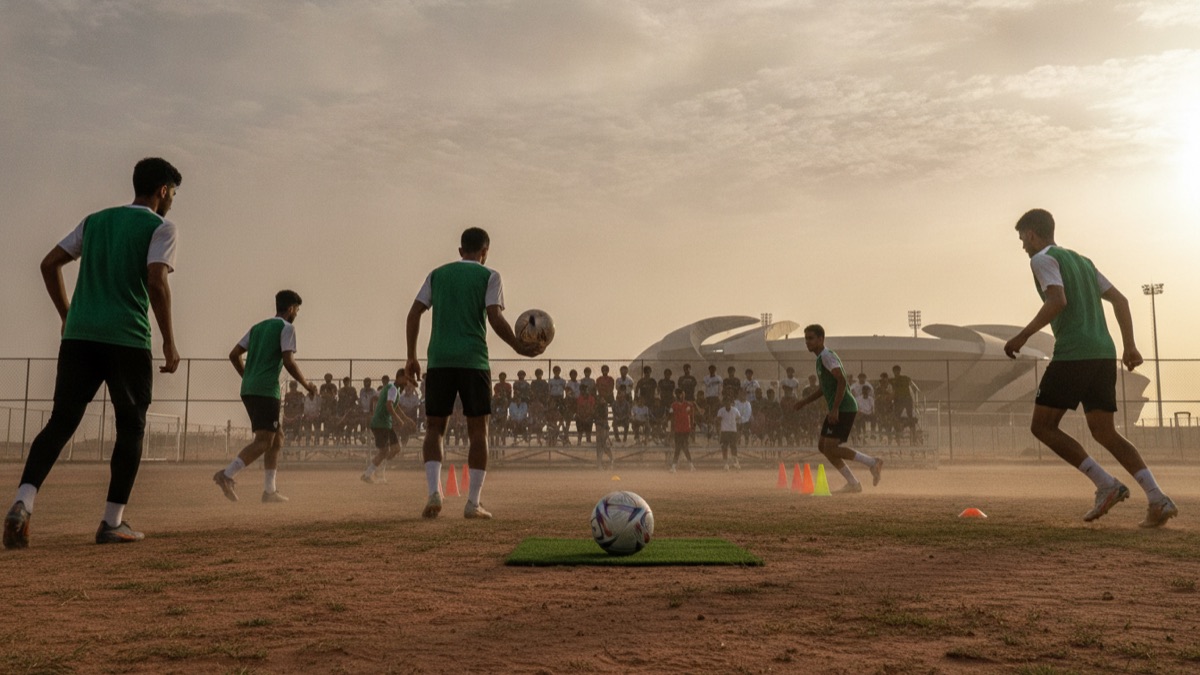
Saudi Arabia continue to evolve as one of Asia's most visible football projects. At World Cup 2026, the Green Falcons bring technical flashes, strong support, and a growing expectation that they should not simply participate, but compete with clarity and confidence. The Saudi Pro League's transformation into a global destination for elite players has raised the domestic standard, and the national team is beginning to reflect that elevated environment.
The big question is whether Saudi Arabia can translate regional progress into consistent World Cup execution. That requires compact defending, smarter ball progression, and sharper finishing in the moments that define tournament matches. Their stunning 2-1 victory over Argentina in Qatar 2022 proved they can defeat the very best, but maintaining that level across multiple matches is the challenge that defines elite tournament football.
Key Takeaways
- Saudi Arabia are now judged by competitive standards, not just effort.
- Their technical quality must be matched by defensive discipline.
- Midfield transitions are crucial to their success.
- They need composure in big moments more than possession for its own sake.
- The Green Falcons can be dangerous when they play with courage and structure together.
- The Saudi Pro League's growth has improved the player development pipeline.
Context and Overview of Saudi Arabia's 2026 Challenge
Saudi Arabia have shown that they can produce memorable performances against strong opposition. The next step is repetition. In major tournaments, isolated brilliance matters less than the ability to repeat good decisions under pressure. Coach Hervé Renard, who led the team to their famous Argentina victory, departed after the 2022 tournament, and the current coaching staff has worked to maintain the tactical identity while adding more offensive variety.
Saudi football has benefited from greater investment, visibility, and ambition. The domestic league's recruitment of global stars has raised training standards and tactical awareness among Saudi players. World Cup 2026 is an opportunity to show that progress is not only domestic, but international. The team qualified comfortably from the Asian confederation, finishing among the top teams in their group with a consistent record against regional rivals.
The 2026 tournament's North American venues will present different challenges from Qatar. Travel between venues, climate variation, and unfamiliar time zones will test Saudi Arabia's preparation. The team's ability to adapt tactically to different opponents and conditions will be as important as their technical quality. The Green Falcons must demonstrate that the Argentina victory was not a one-off miracle but evidence of genuine capability.
Historical Context: From 1994 to Qatar 2022
Saudi Arabia's World Cup history has been a rollercoaster of highs and lows. Their debut in 1994 remains their most successful campaign, with Saeed Al-Owairan's remarkable solo goal against Belgium earning a place in tournament folklore. The Green Falcons reached the Round of 16 that year, a feat they have not repeated since. The subsequent decades brought heavy defeats and group-stage exits that damaged the team's international reputation.
The Qatar 2022 tournament changed the narrative. Saudi Arabia's opening match victory over Argentina, one of the greatest upsets in World Cup history, demonstrated what the team could achieve at maximum intensity. Salem Al-Dawsari's winning goal, following a defensive error by Argentina, was celebrated across the Arab world as proof that Asian teams could compete with South American powerhouses. However, subsequent defeats to Poland and Mexico showed the difficulty of maintaining peak performance across a group stage.
Between the 1994 peak and the 2022 resurgence, Saudi Arabia experienced several humbling tournaments. The 2002 World Cup brought an 8-0 defeat to Germany, while 2018 saw a 5-0 loss to Russia. These experiences have shaped a more realistic assessment of Saudi capabilities. The 2026 squad must combine the confidence of the Argentina victory with the humility learned from past setbacks.
Breakdown of Saudi Arabia's Playing Identity
Technical Confidence
Saudi Arabia are usually comfortable receiving and circulating the ball, especially when they can establish rhythm early. The technical education provided by domestic academies and the Pro League's international players has produced a generation comfortable in possession. However, technical comfort must translate into penetration, and this remains the area where Saudi Arabia must improve.
Press Resistance
Against top teams, the question becomes whether they can play through pressure without losing shape. Saudi Arabia's midfielders have improved their ability to receive under pressure, but the backline remains vulnerable when pressed high. Building from the back against aggressive opponents is a risk that requires precise execution.
Final-Third Precision
Their campaign may depend on whether they turn promising moves into actual goals. Saudi Arabia create chances but have historically struggled with conversion. The development of clinical finishers who can perform under tournament pressure is essential. Saleh Al-Shehri's goals in Qatar 2022 showed that the capability exists, but consistency is the challenge.
Defensive Recovery
If they lose the ball in advanced zones, fast defensive recovery becomes essential. Saudi Arabia's full-backs push forward to support attacks, leaving space behind them. The defensive midfielder's ability to delay counter-attacks and the center-backs' recovery speed are critical components of their defensive system.
Key Players to Watch
Salem Al-Dawsari (Al-Hilal): The captain and most influential attacker. His goal against Argentina in Qatar 2022 demonstrated his ability to deliver in the most pressurized moments. Al-Dawsari's dribbling, vision, and finishing make him the player around whom Saudi Arabia's attack revolves. His leadership and experience will be crucial in guiding younger teammates through tournament intensity.
Saleh Al-Shehri (Al-Ittihad): The forward provides a focal point for the attack. His hold-up play and aerial ability allow Saudi Arabia to vary their approach, combining direct play with shorter passing combinations. Al-Shehri's goals in qualifying proved his reliability, and his partnership with Al-Dawsari is the team's primary attacking relationship.
Mohammed Al-Breik (Al-Hilal): The right-back offers width and crossing ability from the flank. His overlapping runs create space for the midfielders and provide an alternative attacking route when central areas are congested. Defensively, his positioning and recovery speed are essential against fast wingers.
Yasser Al-Shahrani (Al-Hilal): The experienced left-back combines defensive solidity with attacking support. His understanding with the left winger creates combinations that can overload opposing defenses. Al-Shahrani's leadership from the back helps organize the defensive line.
Abdullah Al-Mayouf (Al-Hilal): The goalkeeper provides experience and command of the penalty area. His shot-stopping and distribution from the back give Saudi Arabia a reliable foundation. In tournament football, a trustworthy goalkeeper is invaluable, and Al-Mayouf offers that assurance.
Pros & Cons of Saudi Arabia's World Cup Outlook
Pros
- Technically capable midfielders with improving Pro League experience
- Growing belief on the global stage after the Argentina victory
- Ability to create dangerous passages of play through quick combinations
- A clear sense of national momentum around football development
- Proven ability to perform against elite opposition in one-off matches
- Strong domestic league providing competitive match experience
Cons
- Can be punished quickly in transition when full-backs are advanced
- Finishing consistency is a concern across multiple matches
- The tempo of elite opponents can stretch the structure
- Defensive mistakes become costly at World Cup level
- Historical difficulty in repeating peak performances across a tournament
- Squad depth may be tested by injuries or suspensions
How To Judge Saudi Arabia Fairly
Focus on Shape Without the Ball
That usually tells you more than possession numbers. If Saudi Arabia maintain compact defensive lines and reduce space between midfield and defense, they are executing their game plan. When these lines stretch, the team becomes vulnerable.
Measure Progression Speed
Saudi Arabia are more threatening when they move the ball forward decisively. Slow, sideways possession that does not advance the attack is a warning sign. The best Saudi performances feature quick vertical passing that catches opponents before they organize.
Watch Decision-Making in Big Moments
The difference between a good display and a winning result often comes down to one or two calm decisions. Whether it's a final pass, a shot selection, or a defensive clearance, composure under pressure separates tournament winners from early departures.
Consider the Level of Opposition
Competitive performances against stronger teams can still indicate real progress. Saudi Arabia should not be judged solely by results against the tournament's elite. Improvement in structure, mentality, and consistency matters as much as the scoreline.
Evaluate Tactical Adaptability
The ability to adjust approach based on the opponent is crucial. Saudi Arabia's success in 2026 will depend on whether they can switch between defensive compactness and attacking ambition as situations demand. Rigidity in approach, regardless of circumstances, is a weakness that better opponents will exploit.
FAQs
What does Saudi Arabia need most at World Cup 2026?
Defensive discipline, efficient transitions, and composure in the final third. The team must combine the courage shown against Argentina with the structural consistency needed for a three-match group stage.
Are Saudi Arabia naturally a possession team?
They often enjoy building play, but possession only helps when it leads to quality chances. Against stronger opponents, Saudi Arabia may need to accept less possession and focus on counter-attacking efficiency.
What is their biggest risk?
Being exposed after losing the ball in ambitious attacking phases. When full-backs push forward and midfielders advance, the space behind them can be exploited by quick opponents.
Can Saudi Arabia surprise bigger teams?
Yes, especially if they stay compact and take their best chances early. The Argentina victory proved that Saudi Arabia can defeat elite opponents when they execute their game plan with maximum intensity and focus.
Which Saudi players are most important in 2026?
Salem Al-Dawsari, Saleh Al-Shehri, and Mohammed Al-Breik provide the spine of experience, while younger talents add energy and unpredictability. The blend of veteran leadership and youthful enthusiasm will shape the team's character.
Related Resources
- Arab teams to watch at World Cup 2026
- Qatar's prospects at World Cup 2026
- Iraq's route to World Cup 2026
- Saudi Arabia's tactical progress in recent years
- How Asian and Arab teams manage tournament pressure
- FIFA World Cup 2026 match schedule and fixtures
Conclusion
Saudi Arabia have enough technical quality and confidence to compete, but tournament football is ruthless. Their success depends on reducing mistakes, managing transitions, and staying emotionally steady in defining moments. If the Green Falcons combine courage with discipline, they can leave a meaningful mark on World Cup 2026. The Argentina victory proved their potential; now they must demonstrate their consistency.
Sources
This article was reviewed against current tournament context and official competition resources.