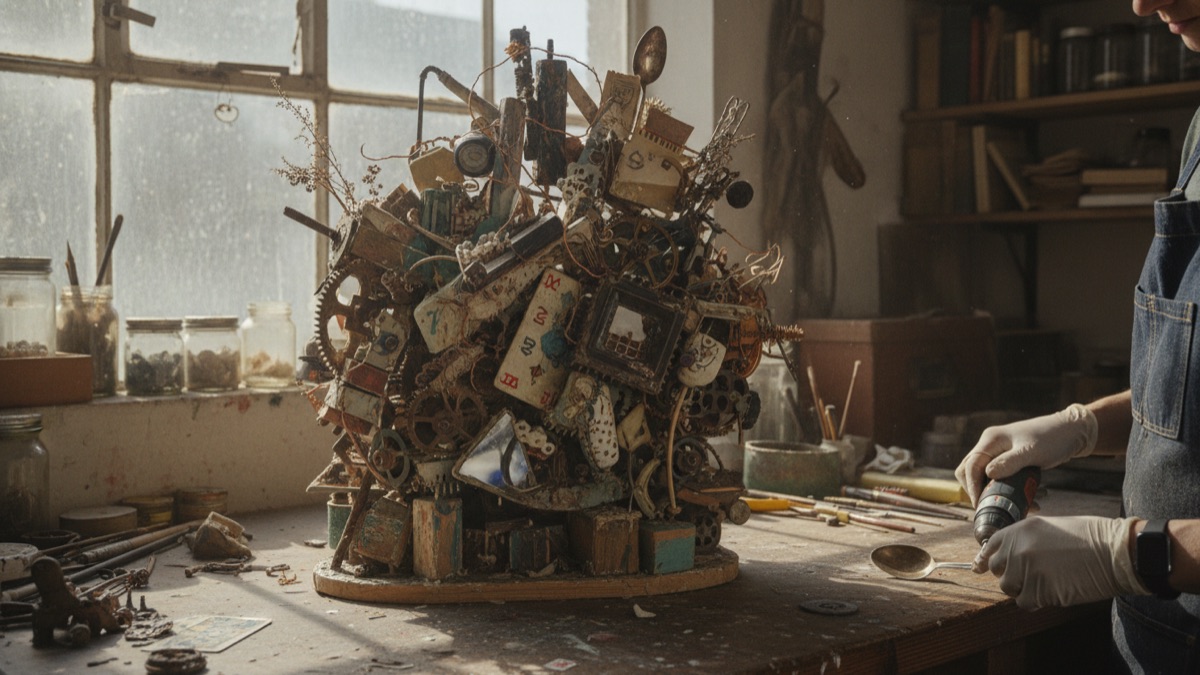
Assemblage art is a three-dimensional artistic technique built by combining found objects, everyday materials, and often discarded items into a unified sculptural composition, rather than being carved, molded, or painted from a single continuous material.
The technique grew out of early 20th-century collage experiments by artists like Pablo Picasso and Georges Braque, who began incorporating real-world materials like newspaper and fabric directly into two-dimensional works before the concept expanded into fully three-dimensional constructions.
Art Built From Found Objects
From Early Collage to a Recognized Sculptural Form
The term 'assemblage' itself became widely used following a major 1961 exhibition at the Museum of Modern Art in New York that showcased the technique's range, from small sculptural pieces to large-scale constructions built from salvaged materials.
A defining feature of assemblage art is its transformation of ordinary or discarded objects, things not originally intended as art materials, into a new context where they take on unexpected meaning, aesthetic value, or commentary through their combination and placement.
Sources
- Wikipedia — overview of assemblage art history and technique
- Museum of Modern Art (MoMA) — background on the 1961 exhibition that popularized the term assemblage
- Tate — explainer on assemblage art and its origins
FAQ
What materials are used in assemblage art?
Found objects, everyday materials, and often discarded items, combined into a unified three-dimensional sculptural composition.
Where did assemblage art originate from?
It grew out of early 20th-century collage experiments by artists like Pablo Picasso and Georges Braque before expanding into fully three-dimensional work.
When did the term 'assemblage' become widely used?
It became widely used following a major 1961 exhibition at the Museum of Modern Art in New York that showcased the technique's range.
About the Author
We reference Wikipedia, Museum of Modern Art (MoMA), and Tate to explain the background and current understanding of this topic.
Loved This Article?
Share it on WhatsApp → Share it on WhatsApp
Get more guides in your inbox — Subscribe to our newsletter for weekly surprising stories from Egypt, Saudi Arabia, Dubai, and beyond.