Introduction
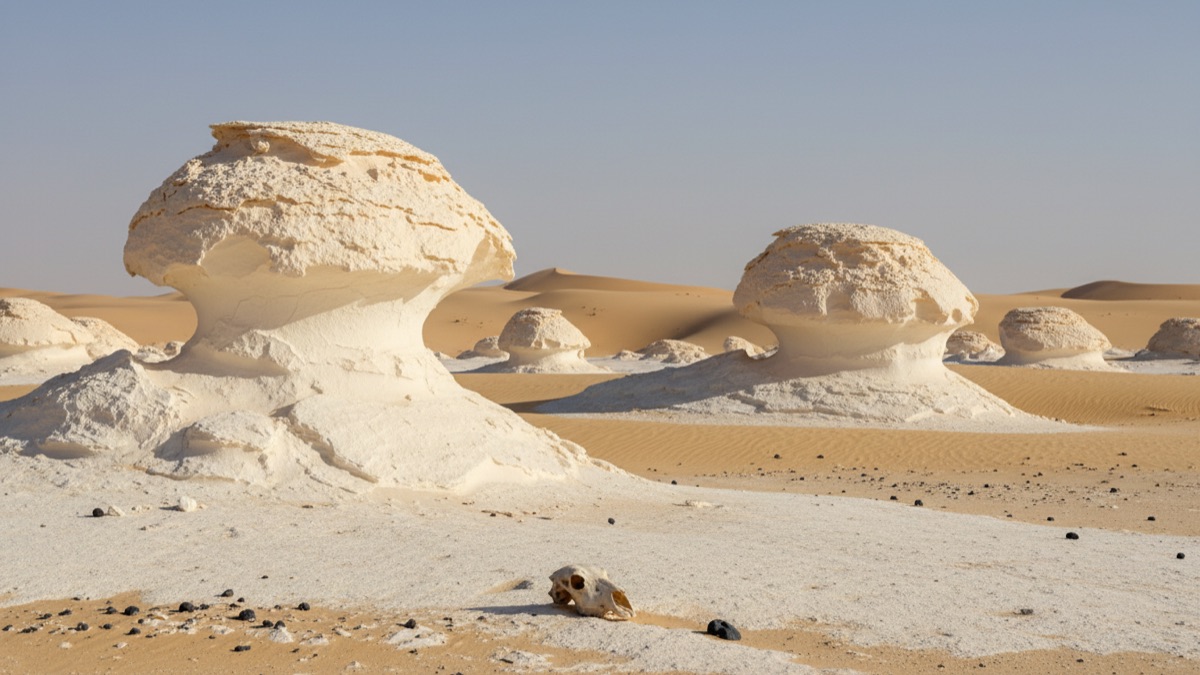
The White Desert (Sahara el-Beyda), a national park in Egypt's Western Desert roughly 45 kilometers north of the town of Farafra, is one of the most visually surreal landscapes in the country: a vast plain of white chalk rock formations sculpted by wind erosion into shapes frequently compared to mushrooms, animals, and abstract sculpture. It stands in striking visual contrast to the golden sand dunes more commonly associated with the Sahara.
The park's chalk deposits formed roughly 60 to 80 million years ago on the floor of an ancient sea that once covered the region, later exposed and shaped by millions of years of wind and occasional flash flooding after the sea retreated and the desert climate took hold.
The Chalk Rock Formations
The White Desert's most photographed formations include shapes locally nicknamed 'the Mushroom,' 'the Chicken,' and 'the Sphinx,' though visitors and guides often disagree on exact names and see different shapes in the same rocks. The white chalk contains embedded flint deposits and, in places, visible fossilized sea creatures, tangible evidence of the region's marine origins tens of millions of years ago.
The formations are most photogenic at sunrise and sunset, when low-angle light emphasizes their texture and casts long shadows across the pale desert floor, which is why most overnight camping trips are timed specifically to catch both.
Overnight Camping in the White Desert
An overnight camping trip is the standard and strongly recommended way to experience the White Desert, typically arranged through a licensed desert safari operator based in Farafra or Bahariya Oasis, using 4x4 vehicles for the unpaved desert terrain. Camps are usually simple, without facilities, set directly among the rock formations, with dinner cooked over an open fire and clear, light-pollution-free night skies that are a highlight in their own right.
Given the total absence of infrastructure, water, and mobile signal in much of the park, independent travel without an experienced guide is strongly discouraged and, in practice, rarely attempted by visitors.
Getting There: Farafra and Bahariya Oases
Most White Desert trips are organized from either Farafra Oasis, the closest and most direct base, or Bahariya Oasis, a larger and more established tourism hub roughly 175 kilometers further north that also serves as a common overnight stop for multi-day Western Desert circuits. Both oases are reached from Cairo by road, a journey of roughly 5 to 7 hours depending on the specific destination and route.
Multi-day desert circuit itineraries often combine the White Desert with the nearby Black Desert, characterized by volcanic basalt-covered hills, and Crystal Mountain, a small quartz outcrop along the route between Farafra and Bahariya.
Practical Visiting Tips
Desert nights can drop to near-freezing temperatures even when daytime heat is intense, particularly in winter months, making warm layers essential for overnight camping regardless of season. October through April generally offers the most comfortable daytime temperatures for exploring the formations on foot.
Given the park's remoteness and lack of facilities, visitors should bring more water than they expect to need, sun protection, and confirm their chosen operator carries appropriate permits and safety equipment for desert travel.
Most safari operators supply tents, sleeping bags, and meals as part of the overnight camping package, though travelers with specific dietary needs should confirm arrangements in advance. Photography enthusiasts should note that a wide-angle lens is particularly useful for capturing the scale of the formations, while a headlamp is essential for moving around camp after dark given the complete absence of artificial lighting in the park.
Sources
- Egyptian Ministry of Tourism and Antiquities — Official tourism information for Egypt's Western Desert protected areas
- Encyclopaedia Britannica — White Desert National Park reference entry
- Egyptian Environmental Affairs Agency — Protected area status and conservation information for the White Desert
- Encyclopaedia Britannica — Farafra Oasis reference entry
FAQ
How do you get to the White Desert in Egypt?
Most trips are organized from Farafra Oasis, the closest base, or Bahariya Oasis further north, both reached from Cairo by road in roughly 5 to 7 hours, followed by a 4x4 transfer into the park itself.
Do you need a guide to visit the White Desert?
Yes, in practice. Given the total absence of infrastructure, water, and mobile signal in much of the park, independent travel without an experienced, licensed guide is strongly discouraged and rarely attempted.
How old are the White Desert's chalk formations?
The chalk deposits formed roughly 60 to 80 million years ago on the floor of an ancient sea that once covered the region, later exposed and shaped by millions of years of wind erosion after the sea retreated.
Is overnight camping in the White Desert cold?
Yes, often. Desert nights can drop to near-freezing temperatures even when daytime heat is intense, particularly in winter months, so warm layers are essential for overnight camping regardless of season.
Can the White Desert be combined with other sites?
Yes. Multi-day desert circuit itineraries commonly combine the White Desert with the nearby Black Desert, known for volcanic basalt-covered hills, and Crystal Mountain, a small quartz outcrop along the Farafra–Bahariya route.
About the Author
doyouknow.app Editorial Team — We rely on official protected-area documentation and established desert safari operators' guidance to keep our White Desert visiting information accurate and safety-focused.
Loved This Article?
Share it on WhatsApp → Share on WhatsApp
Get more guides in your inbox — Subscribe to our newsletter for weekly surprising stories from Egypt, Saudi Arabia, Dubai, and beyond.