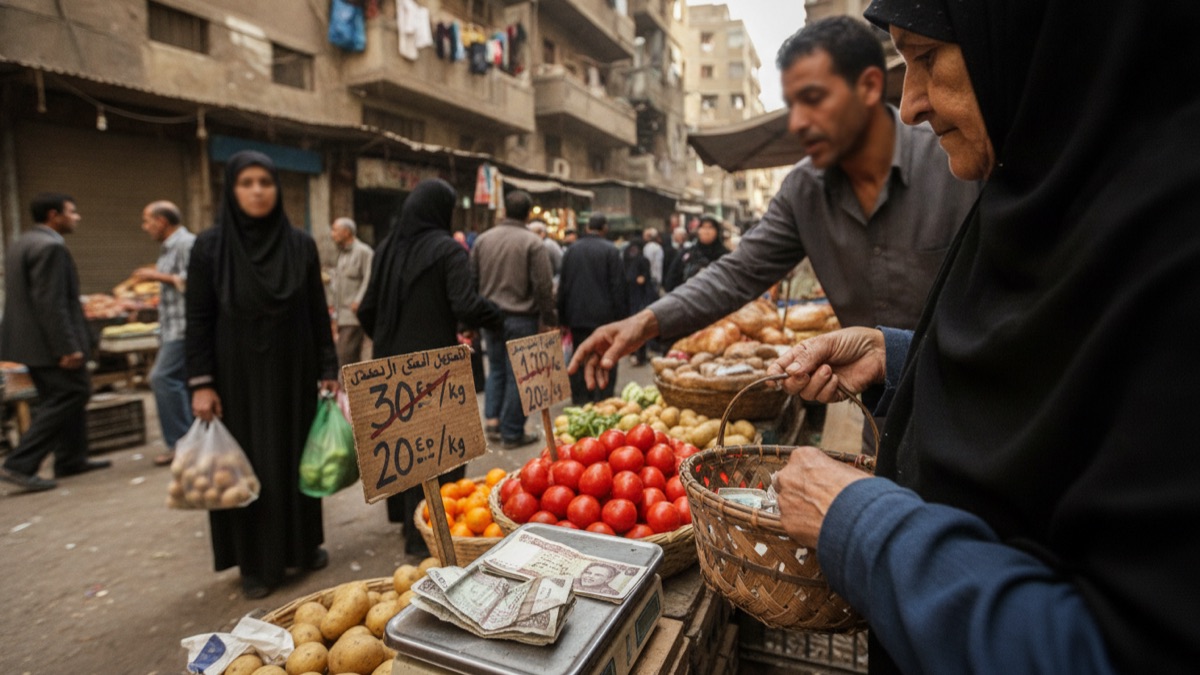
When the Egyptian pound loses value against the US dollar, the news usually breaks with a headline about exchange rates, yet for most Egyptian households the real story shows up days or weeks later at the grocery counter, the pharmacy, and the car dealership. Currency fluctuations feel abstract until they translate into a higher bill for the same basket of goods a family bought last month, and understanding why that happens requires connecting a chain of cause and effect that starts on a trading screen and ends in someone's kitchen.
The Headline Versus the Grocery Bill
For years, discussions of the Egyptian pound's exchange rate were largely the domain of economists, bankers, and business owners tracking import costs. That changed as successive rounds of currency adjustment made exchange-rate news a regular topic of everyday conversation, because the gap between the official rate and daily lived experience narrowed dramatically each time the pound moved.
The core reason ordinary Egyptians feel currency swings so directly is straightforward: Egypt imports a large share of what it consumes, from fuel and wheat to medicine and manufacturing components, so the price of foreign currency effectively becomes an input cost baked into an enormous range of everyday goods.
What the Egyptian Pound's Value Actually Means
The exchange rate between the Egyptian pound and the US dollar reflects, in simple terms, how much foreign currency it takes to buy one pound, or conversely, how many pounds it takes to buy one dollar. When the pound weakens, each dollar buys more pounds, meaning anything priced in dollars — imported goods, foreign travel, dollar-denominated debt — becomes more expensive in pound terms.
This relationship matters enormously for an economy like Egypt's, which imports substantial volumes of essential goods and relies on tourism, remittances, Suez Canal revenue, and foreign investment as major sources of foreign currency inflow.
From Managed Peg to Managed Float
For long stretches, Egypt maintained a fixed or tightly managed exchange rate, with the Central Bank of Egypt intervening actively to hold the pound near a target level against the dollar. This approach offered predictability but required the central bank to maintain substantial foreign currency reserves to defend the rate, and became increasingly difficult to sustain when reserves came under pressure.
In more recent years, Egypt has moved toward a more flexible, market-driven exchange rate framework, allowing the pound's value to adjust more freely in response to supply and demand for foreign currency, a shift generally supported by international financial institutions as a way to reduce the buildup of unsustainable currency pressure over time.
Why Egypt Relies So Heavily on Imports
Egypt imports a significant share of its wheat, a staple central to subsidized bread that forms a core part of the national diet, along with much of its refined fuel products, pharmaceutical ingredients, and industrial inputs used in local manufacturing. This import dependence means the country's economy is structurally exposed to currency movements in a way that a more self-sufficient economy would not be.
Because so many essential goods pass through this import channel before reaching consumers, currency depreciation does not stay contained to luxury or discretionary spending — it touches staple foods, basic medicine, and transportation costs that virtually every household depends on.
How a Weaker Pound Raises Import Costs
When the pound weakens against the dollar, an Egyptian importer buying goods priced in dollars needs more pounds to complete the same purchase, immediately raising the local cost of that shipment before it even reaches a shelf or a factory floor. This cost increase then flows through the supply chain, affecting wholesalers, manufacturers using imported components, and eventually retail prices paid by consumers.
The scale of this effect depends heavily on how much of a given product's cost structure is import-dependent; a locally grown vegetable feels currency depreciation far less directly than an imported medication or an appliance built from imported parts.
The Pass-Through Effect on Retail Prices
Economists refer to the process by which currency depreciation shows up in consumer prices as exchange-rate pass-through, and in Egypt this pass-through has historically been fairly fast and fairly complete, meaning retail prices tend to rise relatively quickly and substantially after a significant devaluation rather than absorbing the shock gradually.
Businesses facing higher import costs generally cannot absorb them indefinitely without damaging their own margins, so price increases at the retail level tend to follow currency moves within weeks or a few months rather than being spread out over years.
Fuel, Wheat, and Medicine: The Sensitive Categories
Certain categories of goods act as particularly sensitive transmission points between currency movements and household budgets. Fuel prices affect transportation costs across the entire economy, touching everything from public transport fares to the delivered price of goods trucked between cities. Wheat and bread pricing carries deep social and political sensitivity given bread's central role in the Egyptian diet and its history of government subsidy. Imported medicine and medical supplies, meanwhile, directly affect healthcare affordability for patients managing chronic conditions.
Because these three categories touch nearly every household regardless of income level, currency-driven price changes in fuel, staple food, and medicine tend to generate the most immediate and widely felt public reaction compared with changes in more discretionary spending categories.
Why Devaluation Fuels Inflation
Currency depreciation is one of the primary channels through which inflation accelerates in import-dependent economies like Egypt's, because a weaker currency simultaneously raises the cost of imported final goods and the cost of imported inputs used in domestic production, compounding the inflationary pressure across multiple points in the economy at once.
This combination — imported goods costing more directly, and domestically produced goods costing more because their inputs became more expensive — is why periods of significant currency depreciation in Egypt have historically coincided with periods of markedly higher consumer price inflation.
The Role of the Central Bank of Egypt
The Central Bank of Egypt sets monetary policy, manages the country's foreign currency reserves, and, particularly under managed exchange rate regimes, intervenes in currency markets to influence the pound's value. Its decisions around interest rates, reserve management, and exchange rate policy sit at the center of how currency pressure builds or eases over time.
The central bank also works closely with international partners, including the International Monetary Fund, on programs aimed at stabilizing Egypt's external finances, often involving commitments around exchange rate flexibility, fiscal discipline, and structural economic reforms in exchange for financial support.
Interest Rates as a Counterweight
One of the tools central banks use to manage currency pressure is adjusting domestic interest rates; raising rates can make pound-denominated savings and investments more attractive relative to foreign currency alternatives, helping support the currency's value while also working to cool inflation by making borrowing more expensive.
Higher interest rates come with their own trade-offs, however, since they raise borrowing costs for businesses and consumers, meaning the same policy tool used to stabilize the currency can also slow economic activity and increase the cost of mortgages, business loans, and consumer credit.
How Households Try to Protect Their Savings
Facing a currency whose value can shift significantly over relatively short periods, many Egyptian households look for ways to preserve the purchasing power of their savings rather than holding cash entirely in Egyptian pounds. This behavior is a rational response to lived experience with periods of rapid currency depreciation eroding pound-denominated savings.
Common strategies include holding savings in US dollars where legally accessible, purchasing gold, or investing in assets like real estate that are perceived as more likely to retain value even if the pound weakens further.
Gold as a Traditional Hedge
Gold holds deep cultural and practical significance in Egypt, both as jewelry with sentimental value, especially in the context of weddings and dowries, and as a store of value households can convert relatively easily during periods of financial stress. Because gold is priced internationally in dollars, its Egyptian pound price tends to rise when the pound weakens, helping gold-holding households partially offset the erosion of pound-based savings.
This long tradition of gold ownership is one reason gold shops remain a fixture of Egyptian commercial streets, serving simultaneously as jewelry retailers and, in practical terms, a widely accessible informal savings vehicle for many families.
Real Estate and the Search for Stable Value
Real estate is another asset class many Egyptians turn to as a hedge against currency depreciation, based on the belief that property values, particularly in dollar-equivalent terms, tend to hold up better over time than cash savings held purely in Egyptian pounds. This dynamic has historically contributed to strong demand for property as a savings vehicle rather than purely a housing need.
This pattern is not unique to Egypt — it appears in many economies with a history of currency instability — but it has shaped Egyptian real estate markets noticeably, with property sometimes bought and priced with an eye toward preserving value against future currency depreciation rather than purely reflecting rental yield or housing demand.
Who Actually Benefits From a Weaker Pound
While currency depreciation creates widespread hardship for import-dependent consumers, it is not uniformly negative across the economy. Egyptian exporters selling goods priced in foreign currency see their pound-denominated revenue rise when the pound weakens, potentially making Egyptian goods more price-competitive internationally. Tourism businesses earning in foreign currency similarly benefit, as does the broader tourism sector when a weaker pound makes Egypt a comparatively cheaper destination for foreign visitors.
Egyptians receiving remittances from family members working abroad also see the pound value of those transfers rise when the currency weakens, which is one reason remittance inflows sometimes increase noticeably during periods of pound depreciation.
Remittances and the Parallel Market Problem
During periods when the official exchange rate diverges significantly from what people believe the pound is genuinely worth, an unofficial or parallel currency market can emerge, offering a different, often less favorable, rate for pounds outside official banking channels. This gap between official and parallel rates has periodically affected how remittances and foreign currency actually flow into Egypt's formal financial system.
Efforts to close this gap through more flexible official exchange rate policy have generally aimed at reducing the incentive to route currency through informal channels, encouraging more foreign currency to flow through the formal banking system where it can be captured in official reserves.
The Black Market Premium Explained
A parallel market premium emerges when demand for foreign currency at the official rate exceeds what banks and official channels can supply, pushing some transactions into informal channels willing to pay or charge a different rate. This premium is, in effect, a market signal that the official rate may not fully reflect underlying currency supply and demand.
Persistent, large gaps between official and parallel rates have historically been associated with periods preceding significant official currency adjustments in Egypt, as authorities eventually moved the official rate closer to what the parallel market had already been signaling.
Small Business Owners Caught in the Middle
Small business owners who import raw materials, components, or finished goods face some of the most immediate and difficult currency-related decisions, since they must decide how quickly and how fully to pass rising import costs on to customers without losing sales to price-sensitive competitors or damaging long-term customer relationships.
Many small businesses respond by holding some inventory in anticipation of currency moves, adjusting supplier relationships, or shifting toward more locally sourced inputs where feasible, all strategies aimed at reducing direct exposure to currency volatility rather than eliminating it entirely.
Why Currency Stability Matters for Ordinary Planning
Beyond the immediate price effects, currency volatility complicates something more fundamental for households and businesses alike: the ability to plan ahead with confidence. A family budgeting for the year, a business quoting a long-term contract, or a young couple saving for a wedding all depend, at least implicitly, on some degree of predictability in what money will actually be worth by the time it is spent.
This is ultimately why currency fluctuations reach so far beyond financial pages and trading terminals into ordinary Egyptian life: the exchange rate is not an abstract number but a variable embedded in the price of bread, the cost of a taxi ride, the value of a family's gold savings, and the confidence with which anyone can plan more than a few months into the future.
How Egyptians Adapted Their Saving Habits Over Time
Repeated currency devaluations have shifted household saving behavior noticeably over the past decade, with a growing share of Egyptians who can afford to do so holding savings in foreign currency, gold, or real estate rather than Egyptian pound-denominated bank deposits.
This shift reflects a rational individual response to currency risk, but economists note it can create a feedback loop at the national level, since reduced demand for pound-denominated savings can itself put additional pressure on the currency, complicating central bank efforts to stabilize the exchange rate.
Sources
- Central Bank of Egypt — Official monetary authority publishing exchange rate policy, reserves data, and monetary reports.
- International Monetary Fund — Publishes analysis and program details related to Egypt's currency and fiscal reforms.
- World Bank — Publishes economic indicators and analysis on Egypt's macroeconomic conditions and inflation.
- Central Agency for Public Mobilization and Statistics (CAPMAS) — Egypt's official statistics agency, publishing consumer price index and inflation data.
FAQ
Why does the Egyptian pound lose value against the dollar?
The pound's value reflects supply and demand for foreign currency in Egypt, driven by factors like import demand, tourism and remittance inflows, foreign investment, and the Central Bank of Egypt's exchange rate policy, including periods of managed float versus fuller liberalization.
Why do prices rise so quickly after a devaluation?
Egypt imports a large share of fuel, wheat, medicine, and manufacturing inputs, so a weaker pound immediately raises the local cost of those imported goods, and businesses typically pass much of that cost increase on to consumers fairly quickly.
How do Egyptians try to protect their savings from currency swings?
Many households and investors hold savings in gold, US dollars, or foreign-currency bank accounts where available, and some also invest in real estate, viewing these as more stable stores of value than pound-denominated cash during periods of currency uncertainty.
What is a managed float versus a free float currency?
A managed float means the central bank actively intervenes to influence the exchange rate within an informal or formal range, while a free float lets market supply and demand determine the rate with minimal direct central bank intervention.
Who benefits when the Egyptian pound weakens?
Egyptian exporters, tourism businesses earning in foreign currency, and Egyptians receiving remittances from abroad can benefit from a weaker pound, since their foreign earnings convert into more local currency, even as importers and everyday consumers face higher costs.
About the Author
We reference the Central Bank of Egypt, the International Monetary Fund, the World Bank, and Egypt's Central Agency for Public Mobilization and Statistics to explain the background and current understanding of this topic.
Loved This Article?
Share it on WhatsApp → Share it on WhatsApp
Get more guides in your inbox — Subscribe to our newsletter for weekly surprising stories from Egypt, Saudi Arabia, Dubai, and beyond.