Introduction
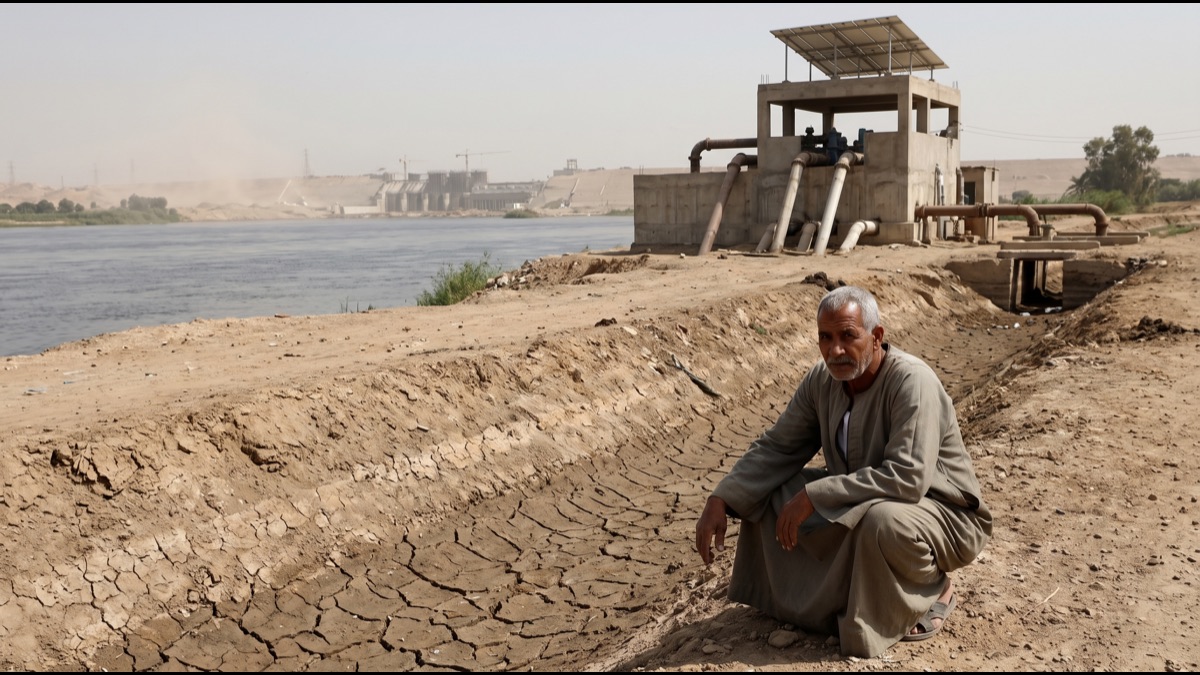
Few countries depend on a single river the way Egypt does. Egypt's water supply comes overwhelmingly from the Nile, a river whose flow Egypt shares with ten other African nations and whose waters have sustained civilization in this desert landscape for thousands of years. Today, that dependence is colliding with a hard reality: Egypt's population has grown past 100 million while its share of water has stayed fixed, pushing the country deep into what hydrologists call water scarcity.
This guide explains where Egypt's water actually comes from, how much each person effectively has, why taps sometimes run dry in certain neighborhoods, and what the government is doing through desalination and water reuse to close the gap. Figures are drawn from the Ministry of Water Resources and Irrigation, the UN's Food and Agriculture Organization, and other bodies listed in the sources, and are given as approximate values because totals shift slightly from year to year.
The Nile: Egypt's Lifeline
More than 90 percent of Egypt's renewable freshwater comes from the Nile. Under a long-standing water-sharing agreement with Sudan dating to 1959, Egypt's allocation is 55.5 billion cubic meters per year, a figure that has not changed in decades even as the population has more than doubled. Rainfall contributes very little: precipitation is modest along the Mediterranean coast and close to zero in most of the interior, which is why roughly 95 percent of Egyptians live within a narrow strip along the river and its delta.
The remaining sliver of supply comes from groundwater, some of it deep and non-renewable, from limited rainfall harvesting, and from a small but growing contribution of desalinated seawater. Officials sometimes describe the total renewable resource pool at roughly 60 to 65 billion cubic meters a year. Against that, total demand estimates range from around 90 billion to more than 110 billion cubic meters annually, depending on how agricultural needs are counted. Agriculture alone consumes over three-quarters of all water used in Egypt, which is why irrigation efficiency sits at the center of every national water plan.
A Shrinking Per-Capita Share
The clearest way to see the pressure is the per-person number. In the early 1960s, each Egyptian's notional share of renewable water was around 2,000 cubic meters per year. Today, officials put it at roughly 500 cubic meters, about half the 1,000-cubic-meter line that hydrologists use to define water scarcity, and right at the 500-cubic-meter mark classed as absolute scarcity. The Nile share did not shrink; the number of people sharing it did.
Climate change adds further stress by making rainfall in the Nile basin less predictable and by increasing evaporation from reservoirs. Upstream dam projects, above all Ethiopia's Grand Renaissance Dam, have added a diplomatic dimension to what was already a difficult arithmetic problem. Egyptian officials frame the issue as existential: with a fixed river allocation and a growing population, the only realistic paths are using each cubic meter more efficiently, recycling what has already been used, and creating new sources from the sea.
Why Do Water Cuts Happen?
When water stops flowing in a Cairo apartment block or a Delta village, the cause is usually local rather than a national shortage. The most common reason is planned maintenance: water companies schedule shutdowns to repair pumps, replace valves, or connect new pipes, and typically announce them through local media and hotlines in advance. Summer heat brings a second wave of cuts, when demand surges in the afternoon and evening and utilities reduce pressure in some districts to keep the wider network stable.
A third driver is infrastructure age. Parts of Egypt's urban water network are decades old, and pipe bursts or contamination scares can force emergency closures while crews isolate a damaged section. In fast-growing informal settlements on city edges, connections sometimes outpace the capacity of local mains, so flow weakens at peak hours even when total production is adequate. Finally, some Upper Egyptian and desert communities rely partly on wells, where falling groundwater levels can interrupt supply. In short, the national water balance explains the background stress, but a given day's outage usually traces back to maintenance, pressure management, or local network limits.
Desalination and Reuse: Closing the Gap
Egypt's strategy rests on two pillars. The first is water reuse. The country already recycles on the order of 20 billion cubic meters or more of water each year, collecting agricultural drainage and treating wastewater for irrigation instead of letting it flow wasted to the sea. Giant treatment complexes anchor this effort: the New Delta plant on the western Delta edge, designed to treat around 7.5 million cubic meters per day, ranks among the largest water treatment facilities in the world, alongside the Bahr al-Baqar and Mahsama plants in the east. The FAO notes that Egypt has pursued drainage-water reuse as national policy since the 1990s.
The second pillar is seawater desalination. Egypt operates on the order of 100 desalination plants, mainly serving coastal cities such as Marsa Matrouh and the Red Sea resorts, with a combined output reported at roughly 1.2 to 1.4 million cubic meters per day. The government has announced a target of about 10 million cubic meters per day within five to six years under a national desalination strategy that runs in phases to 2050, with an emphasis on building the industry locally. Alongside these, canal lining projects, drip and sprinkler irrigation subsidies, and digital monitoring of water distribution aim to squeeze more value from the existing Nile share.
Sources
- Ministry of Water Resources and Irrigation (Egypt) — Official water policy, Nile share, and national strategy figures
- FAO AQUASTAT — Egypt Country Profile — UN data on Egypt's water resources, irrigation, and reuse
- UNICEF Egypt — Water, Sanitation and Hygiene — Household water access and scarcity context in Egypt
- World Bank — Egypt Overview — Economic and development context including resource pressure
FAQ
How much of Egypt's water comes from the Nile?
More than 90 percent of Egypt's renewable freshwater comes from the Nile. Egypt's treaty allocation is a fixed 55.5 billion cubic meters per year, supplemented by small amounts of groundwater, rainfall, and a growing share of desalinated seawater.
Is Egypt running out of water?
Egypt is not literally running dry, but it is structurally water-scarce. The per-capita share of renewable water has fallen to roughly 500 cubic meters per year, half the international scarcity threshold, which is why reuse and desalination have become national priorities.
Why does the water get cut in my area?
Most cuts are local and temporary: scheduled maintenance by the water company, pressure reductions during peak summer demand, emergency repairs after pipe bursts, or local network limits in fast-growing districts. Utilities usually announce planned shutdowns in advance.
What is Egypt doing to fix its water shortage?
The strategy combines large-scale wastewater treatment and reuse, a major expansion of seawater desalination targeting roughly 10 million cubic meters per day, canal lining, modern irrigation systems, and digital monitoring of distribution networks.
Is tap water safe to drink in Egypt?
Municipal water in Egypt is treated and chlorinated at government plants before distribution. Many residents still prefer bottled water or home filters, mostly because of taste and the condition of building-level pipes and storage tanks rather than the treatment plants themselves.
About the Author
doyouknow.app Editorial Team — We base our Egypt explainers on official and UN sources such as the Ministry of Water Resources and Irrigation, FAO AQUASTAT, and UNICEF, and we present shifting figures like per-capita water shares as approximations rather than fixed numbers.
Loved This Article?
Share it on WhatsApp → Share on WhatsApp
Get more guides in your inbox — Subscribe to our newsletter for weekly surprising stories from Egypt, Saudi Arabia, Dubai, and beyond.