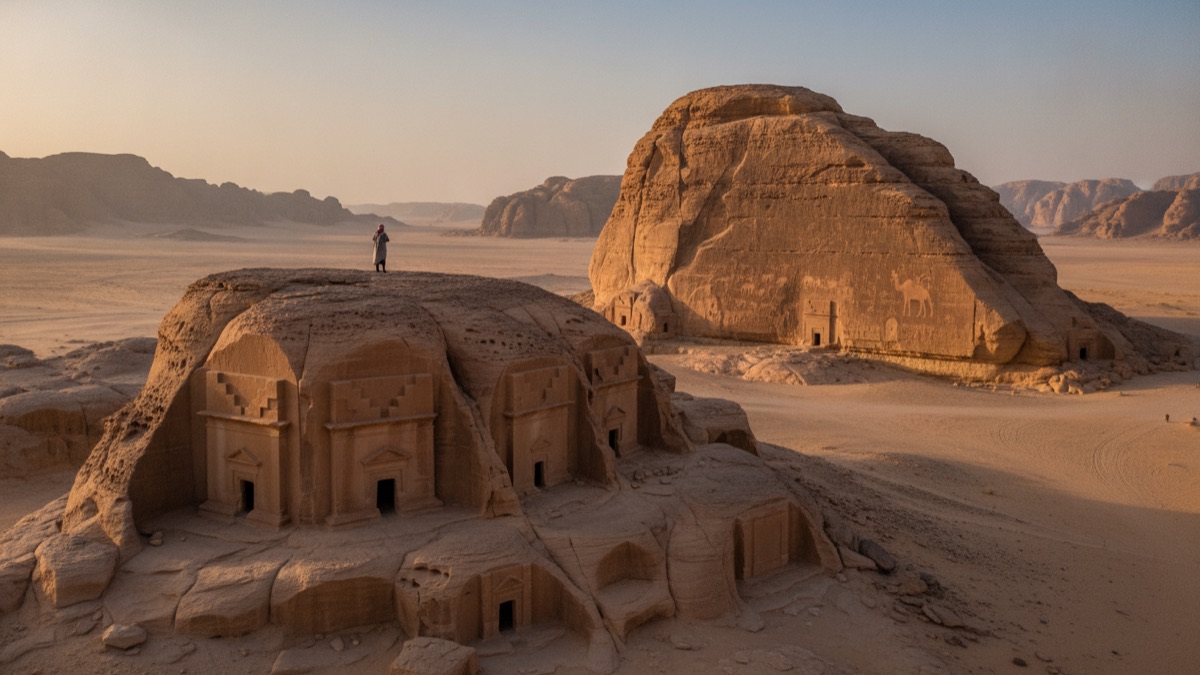
Beyond AlUla: Saudi Arabia's Layered Past
Most travellers who land in Saudi Arabia with archaeology on their minds head straight for AlUla. The Nabataean tombs of Hegra are justifiably famous, but the story of the Arabian Peninsula did not begin with the Nabataeans. Long before their carved facades rose from the sandstone, the valleys and deserts of north-west Arabia hosted kingdoms, artists and traders whose remains are only now receiving the attention they deserve.
This Saudi archaeology guide looks beyond AlUla's headline attraction to five extraordinary places: Dedan (Dadan), the capital of the Dadanite and Lihyanite kingdoms; Jabal Ikmah, the open-air library of inscriptions; the Rock Art of Jubbah and Shuwaymis, two UNESCO-listed petroglyph complexes in the Hail region; and Tayma, an oasis city with roughly 4,000 years of continuous human settlement. Together they reveal a country whose history is far deeper and more diverse than any single site can show.
Over the past decade, Saudi Arabia has invited international archaeological missions from France, Germany, Italy and beyond to work alongside the Heritage Commission and the Royal Commission for AlUla. Their excavations are rewriting the textbook on ancient Arabia, proving that the peninsula was not a silent desert between Mesopotamia and Egypt but a dynamic region with its own cities, languages and artistic traditions.
Whether you are planning an itinerary, researching Arabian civilisation, or simply curious about what else lies in the desert, this guide covers the history, significance and practical visiting information for each destination.
Dedan (Dadan): Capital of the Dadanite Kingdom
The ancient city of Dedan, known in modern archaeology as Dadan, lies in the valley that is now AlUla. It was one of the most important settlements of first-millennium BCE Arabia and served as the capital of two successive kingdoms: the Dadanites and the Lihyanites. Its location on the incense route, the caravan corridor that carried frankincense and myrrh from southern Arabia toward the Mediterranean, gave Dadan control over trade, taxation and political influence across the region.
Archaeological evidence suggests that the valley was inhabited even earlier, but Dadan reached its peak between the 9th and 1st centuries BCE. The Dadanites developed their own script, known as Dadanitic, one of the earliest north Arabian writing systems and an important ancestor in the long evolution of the Arabic script. They built a sophisticated urban centre supported by agriculture and irrigation, and their inscriptions have been found as far away as Yemen and the Levant. At the heart of the city stood a large temple dedicated to Dhu Ghaybaham, the chief deity of the kingdom.
Recent excavations by the Saudi-French archaeological mission have revealed residential quarters, defensive walls, workshops and religious precincts. Objects recovered include finely carved altars, pottery imported from the eastern Mediterranean, and jewellery that testifies to Dadan's participation in long-distance exchange networks. The city was not isolated: Minaean traders from South Arabia also lived here, leaving their own language inscribed on local stone.
Today visitors can walk through the excavated ruins with a guide and see the foundations of houses, temples and administrative buildings. The site is managed by the Royal Commission for AlUla and is accessible only through organised tours. Interpretive panels and the Dadan Visitor Centre explain the chronology of the city and its role in the wider Arabian world.
Significance: Dadan is crucial because it proves that complex urban societies existed in Arabia well before the better-known Nabataean period. Its inscriptions, sculptures and religious architecture show a culture that was connected to Egypt, Mesopotamia and South Arabia.
The Lihyanite Kingdom and the Lion Tombs
After the Dadanites, the Lihyanite Kingdom ruled from Dadan from roughly the 5th to the 1st century BCE. The Lihyanites expanded their territory northward, controlling an area that stretched from modern Medina toward the Levant. They left behind some of the most striking visual evidence of pre-Islamic Arabian art and are now recognised as one of the major political powers of ancient north Arabia.
The most photographed monuments at Dadan are the Lion Tombs, two rock-cut burial niches carved high into the red sandstone cliff of Jabal Dadan. Each niche is flanked by seated lion sculptures roughly two metres in size. The lions are believed to have served as both status symbols and protective guardians for elite, possibly royal, burials. Their placement some 50 metres above the wadi floor remains a puzzle and a testament to the skill of Lihyanite stoneworkers, who had to haul tools, scaffolding and workers up an almost vertical face.
In addition to the Lion Tombs, excavations have uncovered colossal statues up to 2.6 metres tall, thought to represent kings or priests. These figures show artistic ambition comparable to contemporary work in Egypt and Mesopotamia. The Lihyanites also produced incense burners, altars and finely carved funerary monuments, many of which are now displayed in the Dadan Visitor Centre exhibition. The permanent display, developed with the French Agency for AlUla Development, presents more than 100 objects, several of them shown to the public for the first time.
Visiting tip: The Standard and Audio Guided tours include Dadan and usually continue to Jabal Ikmah. The Premium tour allows direct parking at the Visitor Centre and access to the exhibition. Morning slots are cooler and the light is better for photography. Because the site is still under excavation, some areas may be closed on any given day, so flexibility is useful.
Jabal Ikmah: Arabia's Open Library
About ten minutes north of Dadan, Jabal Ikmah is a sandstone canyon whose walls hold the largest concentration of Dadanitic and Lihyanite inscriptions anywhere in the world. In May 2023 the site was added to UNESCO's Memory of the World Register, recognising its value as a documentary heritage site of global importance.
The canyon contains nearly 300 inscriptions written in Dadanitic, Lihyanitic, Minaic, Thamudic, Aramaic and Nabataean scripts. Together these languages illustrate the cultural traffic that passed through the valley over more than a thousand years. Some inscriptions record religious dedications and pilgrimages; others are simple names, ownership marks or messages left by travellers. The canyon also features rock drawings of animals, musical instruments and daily life, turning the mountain into a kind of ancient guestbook.
Where Dadan impresses with monumental tombs, Jabal Ikmah impresses with intimacy. Standing before a wall covered in ancient handwriting gives visitors a direct, almost personal connection to the people who lived and travelled here. The site is normally visited on a combined tour with Dadan and can be appreciated in one to two hours. Guides often point out the way different scripts overlap, showing how the valley functioned as a crossroads long before modern borders existed.
Researchers continue to document new inscriptions at Jabal Ikmah, and digital photography is helping scholars read weathered texts that were previously illegible. The site therefore offers not only a visitor experience but also a window into an active field of archaeological science.
Jubbah: 10,000 Years Carved in Stone
In the Nafud desert of the Hail region, the oasis of Jubbah sits beside Jabal Umm Sinman, a sandstone massif covered with one of the richest rock art complexes on Earth. Together with Shuwaymis, Jubbah forms the UNESCO World Heritage Site Rock Art in the Hail Region, inscribed in 2015.
The petroglyphs at Jubbah span an astonishing time range. The oldest images, dating back to the Neolithic period, depict long-horned cattle, ibex, aurochs and human figures with distinctive oval heads. Later panels show the domestication of the camel, hunting scenes with dogs, warriors on horseback, and inscriptions in Thamudic script. Some of the most famous carvings include early depictions of domesticated dogs, which are among the oldest known in Arabia.
Jubbah is not only an art gallery; it is an environmental record. The site was once beside a freshwater lake that attracted wildlife and human settlement during wetter climatic periods. Palaeolake sediments visible in the basin have been dated to around 10,000 BCE and again to about 4600 BCE, attesting to phases when the Nafud was far less arid than it is today. As the climate dried, the lake disappeared, but the carvings remained, protected by desert varnish and the remoteness of the location.
Archaeologists have recorded more than a thousand rock art panels around Jubbah, containing thousands of individual animal engravings and hundreds of human figures. The artistry ranges from quick sketches to carefully composed scenes, and the content shifts from wild animals to herded cattle, horses and camels, mirroring the changing economy of the region.
How to visit: Jubbah lies about 90 kilometres north-west of Hail city, roughly a 75-minute drive. There is no public transport, so a private car or organised tour is necessary. Entry is generally free, but visitors should register at the Visitor Centre. Boardwalks and viewing platforms protect the rock faces while allowing close-up views. Winter, from November to March, offers the most comfortable temperatures. Many visitors combine Jubbah with A'arif Fort and the city of Hail in a single day.
Shuwaymis: Desert Galleries and Hunting Dogs
Shuwaymis, the southern component of the Hail rock art World Heritage listing, lies roughly 250 kilometres south of Hail. It was discovered by archaeologists only in 2001 and inscribed by UNESCO shortly afterwards, a measure of its extraordinary importance.
The site is spread across Jabal al-Manjor and Jabal Raat, two sandstone outcrops that tower above a dry wadi. The panels at Shuwaymis contain thousands of petroglyphs, many of them large, deeply pecked images of animals and humans. Among the most significant are scenes of hunters with dogs, images of leopards, ostriches, ibex and cattle, and processions of camels. The quality of preservation is exceptional, and the density of images is higher than at almost any other site in the region.
Shuwaymis provides some of the earliest evidence for dog-assisted hunting in Arabia and documents the transition from wild-animal hunting to pastoralism and then to camel-based caravan travel. One of the reasons the site was listed so quickly is that its artwork is not merely decorative but a detailed visual archive of how human societies adapted to the Arabian environment over millennia.
Like Jubbah, Shuwaymis is best visited with a four-wheel-drive vehicle and a local guide, because the site is remote and signposting is limited. A sealed access road has improved reach in recent years, but the final approach still crosses desert terrain. A full day should be allowed if you plan to combine the drive from Hail with time on site. Bring water, sun protection and a sense of adventure.
Tayma: A 4,000-Year Oasis City
While Dadan and the Hail rock art dominate the north-west, the oasis of Tayma adds another layer to Saudi Arabia's archaeological story. Located in Tabuk Province, Tayma has been inhabited almost continuously since at least the Bronze Age and is mentioned in Assyrian records and the Hebrew Bible. For a decade in the 6th century BCE, it even served as the residence of Nabonidus, the last king of Babylon, who famously preferred the oasis to his capital.
Tayma's importance came from water and location. A massive outer wall, built between the 4th and 3rd millennia BCE, enclosed the oasis and protected its agriculture. Within the walls stood temples, palaces and residential quarters. The most impressive surviving monument is Bir Haddaj, an ancient well roughly 18 metres in diameter and 13 metres deep, which remained the lifeblood of the oasis for more than two millennia. An Aramaic stele depicting the god Salm, discovered at Tayma and now in the Louvre, is one of the most important documents of pre-Islamic Arabian religion.
Other key sites include Qasr al-Hamra, a stone palace probably used during Nabonidus's stay; Qasr al-Radm, a massive rectangular fortress; the Temple of Salm, dedicated to the chief deity of ancient Tayma; and Qasr al-Bajidi, an Abbasid-era palace. About 50 kilometres south of the oasis, the famous Al Naslaa rock formation attracts photographers with its naturally split sandstone boulder and ancient petroglyphs.
The Tayma Museum provides context for the whole region, displaying artefacts from the Palaeolithic through the Islamic period, including pottery, inscriptions, coins and fossils. The museum was renovated as part of the government's plan for regional museums and is a useful first stop before heading into the oasis.
Visiting Tayma: Tayma is roughly 260 kilometres south-east of AlUla and can be reached by car or through day-trip packages. The Heritage Commission has developed a heritage circuit that includes Bir Haddaj, the palaces and the museum. A weekly live demonstration at the well recreates traditional water drawing. Allow a full day, especially if you want to visit Al Naslaa.
Planning Your Archaeological Trip
Visiting these sites requires more preparation than a city break, but the rewards are immense. Here are the practical points to keep in mind.
Best season: October to April is ideal for all of these destinations. Daytime temperatures are mild, desert light is beautiful, and sites are easier to walk. May to September can exceed 45°C in Jubbah, Shuwaymis and Tayma, making outdoor exploration uncomfortable and sometimes unsafe.
Getting around: A rental car or private driver is essential for Jubbah, Shuwaymis and Tayma. Dadan and Jabal Ikmah are accessed through Experience AlUla's organised tours, which include transport from Winter Park. Domestic flights connect Riyadh and Jeddah to AlUla and Hail, so a logical loop is to fly into AlUla, visit Dadan, Jabal Ikmah and Tayma, then drive or fly to Hail for Jubbah and Shuwaymis.
Tickets and permits: Dadan and Jabal Ikmah require advance booking through the official Experience AlUla platform. Standard tours start around SAR 60 per person. Jubbah and Shuwaymis generally do not charge entry fees, but registration at the Visitor Centre may be required. Tayma's heritage circuit has a small fee and fixed opening hours.
What to bring: Sunscreen, a wide-brimmed hat, sturdy walking shoes, at least two litres of water per person, and a camera with a zoom lens for rock art. Mobile coverage is patchy in remote areas, so download offline maps.
Photography: Early morning and late afternoon light bring out the colour of the sandstone and make rock art easier to photograph. A polarising filter can reduce glare on polished stone surfaces. Tripods and drones usually require advance permission.
Respect the sites: These are fragile, irreplaceable heritage places. Stay on marked paths, do not touch carvings, do not remove stones or inscriptions, and avoid climbing on archaeological walls. Report any damage or suspicious activity to site staff.
Sources
- Experience AlUla — Dadan — Official visitor information for Dadan and Jabal Ikmah tours.
- UNESCO World Heritage Centre — Rock Art in the Hail Region — Official listing for Jubbah and Shuwaymis.
- UNESCO World Heritage Centre — Ancient Walled Oases of Northern Arabia — Tentative listing including Tayma.
- House of Saud — Tayma Oasis Guide — Practical guide to Tayma's archaeological sites.
- House of Saud — Jubbah Rock Art Guide — Visiting information for Jubbah and the Hail region.
- Encyclopaedia Britannica — Tayma — Historical overview of Tayma oasis.
- Experience AlUla — Jabal Ikmah — Official information on the open-air library of inscriptions.
FAQ
What is Dedan, also known as Dadan?
Dedan, or Dadan, was an ancient city in the AlUla valley and the capital of the Dadanite and later Lihyanite kingdoms. It flourished from around the 9th century BCE as a major centre on the incense trade route.
Who were the Lihyanites?
The Lihyanites were a north Arabian kingdom that ruled from Dadan between roughly the 5th and 1st centuries BCE. They are known for their Lion Tombs, colossal statues and inscriptions.
Where is the best rock art in Saudi Arabia?
The most significant rock art is in the Hail region, particularly at Jubbah and Shuwaymis, which together form a UNESCO World Heritage Site with carvings up to 10,000 years old.
Can you visit Jubbah and Shuwaymis independently?
Jubbah can be reached by private car from Hail, but Shuwaymis is much more remote and requires a four-wheel-drive vehicle and ideally a local guide. There is no public transport to either site.
What is Tayma famous for?
Tayma is a roughly 4,000-year-old oasis city known for Bir Haddaj well, ancient palaces, the Temple of Salm, its massive outer wall, and the nearby Al Naslaa rock formation.
Do I need a guide for Dadan?
Yes. Dadan and Jabal Ikmah are only accessible through organised tours managed by Experience AlUla. Booking in advance is strongly recommended.
When is the best time to visit these archaeological sites?
October to April is ideal. Summer temperatures can exceed 45°C and make walking in open desert sites difficult.
Are these sites suitable for children?
Older children who enjoy history and walking can enjoy Dadan and Tayma. Jubbah and Shuwaymis involve longer drives and uneven ground, so they are better suited to families with active teenagers.
About the Author
The doyouknow.app Editorial Team researches and writes about travel, history and culture across the Middle East. Our guides combine official sources, academic research and practical on-the-ground advice to help readers explore with confidence.
Loved This Article?
Share it on WhatsApp → Share on WhatsApp
Get more Saudi travel tips in your inbox — Subscribe to our newsletter for weekly surprising stories from Saudi Arabia and beyond.