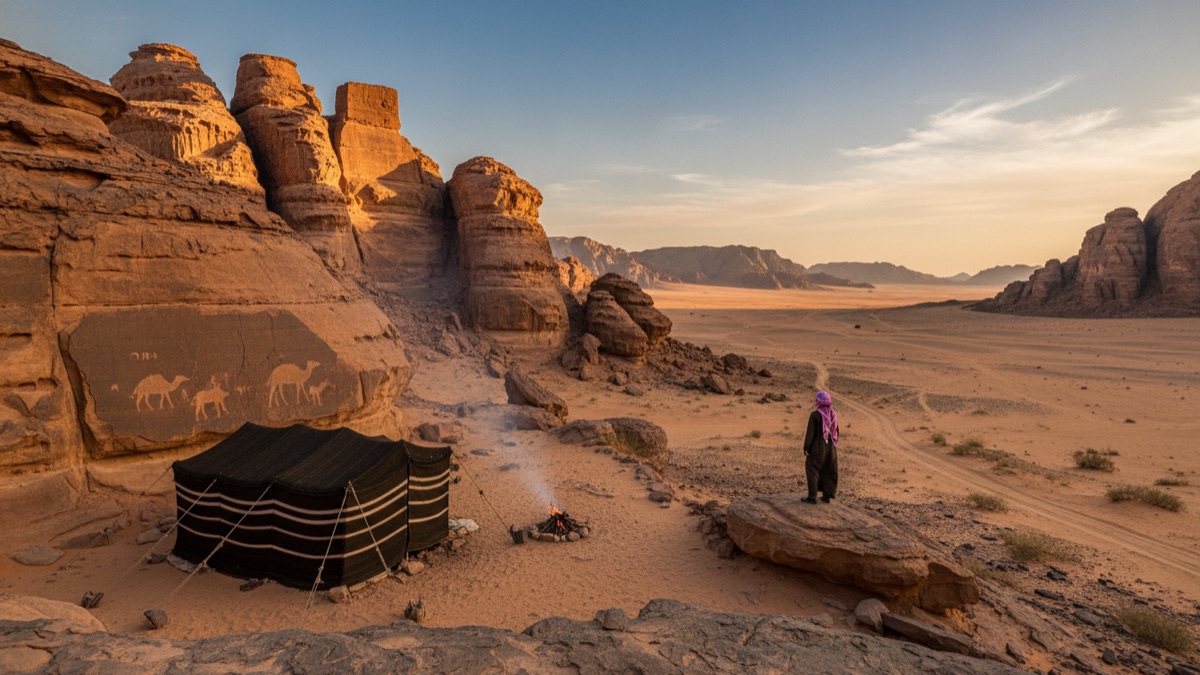
Hail: The Key to the North
Hail is one of Saudi Arabia's most historically significant yet under-visited cities. Located in the northern Najd region, it sits at the crossroads of ancient caravan routes that connected Arabia with Mesopotamia, the Levant, and the Mediterranean. For centuries, Hail was the capital of the powerful Al Rashid emirate and a rival to Riyadh for control of central Arabia. Today, it is a relaxed provincial city surrounded by some of the most remarkable desert landscapes and prehistoric art in the entire kingdom.
The Northern Region, which includes Hail Province and extends toward the borders with Jordan and Iraq, is characterized by vast gravel plains, black volcanic fields, sandstone outcrops, and hidden oases. Unlike the commercial cities of the east or the Red Sea coast, this region offers a slower, more contemplative kind of travel. Visitors come here for archaeology, stargazing, desert hospitality, and a sense of Arabia as it existed before the oil era.
This guide covers the city of Hail, the surrounding archaeological treasures, the practicalities of travel in the north, and the cultural traditions that make this region distinct from the rest of Saudi Arabia.
Hail City & Its Forts
Hail City is the capital of Hail Province and home to around 400,000 people. The city has a dry, continental climate with hot summers, cool winters, and low humidity year-round. Its relaxed pace, tree-lined streets, and strong tradition of desert hospitality make it one of the most pleasant Saudi cities to explore on foot.
The most visible landmarks in Hail are its two mud-brick forts, which dominate the city center. Qishlah Fortress is a massive rectangular structure built in the 1940s during the reign of King Abdulaziz. Unlike the older forts of central Arabia, Qishlah was constructed using modern techniques of its time and served as a military barracks and palace. Today it houses a museum and is one of the best-preserved examples of Najdi military architecture.
A'arif Fort, also known as Aarif Castle, sits on a hill overlooking the city from the west. It is much older than Qishlah, with origins stretching back several centuries, and it offers panoramic views of Hail and the surrounding desert. The fort was used as a watchtower to spot approaching caravans and, in times of conflict, enemy forces. The climb to the top is short but rewarding, especially at sunset.
Between the two forts lies the old commercial district, where traditional markets once thrived. The area has been partially restored, and visitors can still find shops selling dates, spices, traditional clothing, and handicrafts. The Hail Regional Museum, located near Qishlah, provides context for the city's history with exhibits on the Al Rashid emirate, the unification of Saudi Arabia, and the archaeology of the surrounding region.
Ancient Rock Art of Hail
The landscapes around Hail contain one of the most important concentrations of prehistoric rock art in the world. The Rock Art in the Hail Region was inscribed as a UNESCO World Heritage Site in 2015, recognizing the exceptional quality and density of carvings found at Jabal Umm Sinman, Jabal Al-Manjor, and Jabal Raat.
These carvings span thousands of years and include images of wild cattle, ostriches, lions, camels, horses, hunters, and warriors. Some panels show scenes of daily life; others appear to have ceremonial or symbolic meaning. The art was created by successive cultures that inhabited the region, from prehistoric hunter-gatherers to Bronze Age pastoralists and later Arab tribes.
Jabal Umm Sinman, near the town of Jubbah, is the most accessible site. The sandstone outcrop rises from a flat desert plain and contains thousands of carvings, some of which are remarkably well preserved because the hard desert varnish protected them from erosion. A visit here is best done with a local guide who can point out the most significant panels and explain their context.
What makes the Hail rock art so important is not just its age but its variety. You can see the transition from images of extinct wild animals to depictions of domesticated camels and horses, charting the ecological and cultural transformation of Arabia over millennia. The sites are open to visitors, but photography rules may apply, and touching the carvings is strictly prohibited.
Desert Oases & Landscapes
Beyond the rock art, the Hail region is famous for its oases. For centuries, these green pockets in the desert sustained agriculture, trade, and settlement. The most famous is Al-Qassim to the south, but Hail itself has several beautiful oasis areas worth visiting.
Al-Shamli and the surrounding date palm groves produce some of the finest dates in Saudi Arabia. The region is known particularly for Sukkari and Khalas dates, which are prized across the Gulf for their sweetness and texture. During the harvest season in late summer, the oases are busy with activity, and visitors can see dates being picked, sorted, and packed using both traditional and modern methods.
The desert itself is a major attraction. The Nafud Desert, a vast sand sea that stretches across northern Saudi Arabia, begins near Hail. Its dunes can reach heights of over 100 meters and display a striking range of colors from pale cream to deep orange. The Nafud is particularly beautiful at sunrise and sunset, when long shadows accentuate the curves of the dunes.
| Site | Distance from Hail | Highlight |
|---|---|---|
| Jabal Umm Sinman | 90 km north | UNESCO-listed rock art |
| Jubbah Oasis | 95 km north | Palm groves and archaeology |
| Nafud Desert | 30-80 km east | Sand dunes and camping |
| Al-Shamli Oasis | 70 km south | Date palm cultivation |
| Ha'il Volcanic Field | 100 km west | Lava flows and black basalt plains |
The Harrat, or volcanic fields, west of Hail add another layer of geological interest. These black basalt plains were formed by ancient lava flows and create a stark, otherworldly landscape. Scattered across the harrat are volcanic cones, lava tubes, and archaeological sites that testify to human adaptation to even the harshest environments.
Culture & Traditions
Hail has a strong identity rooted in bedouin heritage and northern Najdi culture. The city is famous for several traditional arts and customs that distinguish it from other parts of Saudi Arabia.
Hail coffee is renowned throughout the kingdom. The local preparation tends to be lighter and more cardamom-forward than Hijazi coffee, and serving coffee remains a central ritual of hospitality. Visitors to Hail homes, markets, and even government offices are likely to be offered small cups of qahwa accompanied by dates.
The region also has a strong tradition of poetry and oral history. Hail produced some of the most famous poets of the Arabian Peninsula, and the city hosts cultural festivals that celebrate this heritage. The Hail International Rally, one of the oldest desert rallies in the Middle East, draws competitors and spectators from across the region every year. The rally route crosses some of the most dramatic desert terrain in northern Arabia, reinforcing the city's identity as a place where modern motorsport meets ancient landscapes.
Al-Jawf, the province north of Hail, is often included in northern itineraries. Its capital, Sakaka, sits amid a fertile agricultural region famous for olives, wheat, and dates. The area contains important archaeological sites including Qasr Marid, a mud-brick fortress that dominates the old town of Dumat al-Jandal, and the nearby Omar ibn al-Khattab Mosque, one of the oldest surviving mosques in Saudi Arabia. Al-Jawf's ancient trade connections with Mesopotamia give it a cultural flavor slightly distinct from central Najd.
Traditional crafts include sadu weaving, a form of geometric embroidery used to decorate tents and camel bags, and date palm crafts, in which dried palm fronds are woven into baskets, mats, and decorative items. These crafts are still practiced by older women in rural communities, and some products are available in Hail's markets.
Outdoor Adventure
The Hail region is ideal for travelers who want outdoor experiences without the crowds of more famous destinations. The landscapes are dramatic, the air is clear, and the lack of light pollution makes for exceptional stargazing.
- Desert camping in the Nafud, either independently or with a guide
- Dune bashing and off-road driving across sand seas and gravel plains
- Rock art tours to Jubbah and the UNESCO World Heritage sites
- Hiking in the sandstone hills around the rock art sites
- Camel riding and bedouin-style experiences with local operators
- Photography of dunes, forts, and historic old towns
Spring is the best season for wildflowers. After winter rains, the desert around Hail can burst into color with blooming herbs and shrubs. This phenomenon, known locally as the rawd, transforms the gravel plains and draws local families on picnics.
Winter camping in the Nafud is a highlight. Nighttime temperatures can drop close to freezing, so proper gear is essential, but the silence and clarity of the desert sky are unforgettable. Many visitors report seeing shooting stars on almost any clear night.
Practical Travel Tips
Hail Regional Airport has domestic flights from Riyadh and Jeddah, making it accessible for a long weekend. The city is also connected to the rest of Saudi Arabia by excellent highways, and it is a manageable drive from Riyadh, Buraidah, or Al-Jawf.
Accommodation options in Hail include business hotels, local guesthouses, and a growing number of international chain properties. For the full experience, consider combining a hotel stay in the city with one or two nights of desert camping.
Renting a four-wheel-drive vehicle is strongly recommended if you plan to visit the rock art sites, the Nafud, or the volcanic fields. Many sites are far from paved roads, and mobile phone coverage can be unreliable. Always carry extra water, snacks, and a first-aid kit when traveling into remote areas. Fuel up before leaving the city, as petrol stations become scarce in the deep desert.
The best time to visit Hail is from October to April. Summers are extremely hot and dry, with temperatures regularly exceeding 40°C. Winters are cool and pleasant, though nights can be cold. Spring offers the bonus of desert wildflowers if winter rains have been adequate. During the date harvest in late summer, the oases around Hail and Al-Jawf are particularly lively, though daytime heat can be intense.
Respect for local customs enhances any visit to the north. Dress modestly, greet people warmly, and accept offers of coffee and dates when possible. Photography of people, especially women, should always be done with permission. The people of Hail and the north are known for their pride in bedouin hospitality, and visitors who show genuine interest in the region's culture are usually welcomed warmly.
Sources
- Visit Saudi Official Tourism Portal — Official destination information and regional travel guidance
- UNESCO World Heritage Centre — Rock Art in the Hail Region inscription and documentation
- Saudi Tourism Authority — Regional tourism resources and cultural information
- Lonely Planet — Saudi Arabia — Travel guidance for Hail and northern regions
- Rough Guides — Saudi Arabia — Historical and cultural context for Hail
- Encyclopaedia Britannica — Hail — Historical and geographical reference
FAQ
Where is Hail located?
Hail is located in northern Saudi Arabia, approximately 570 kilometers north of Riyadh. It lies on the edge of the Nafud Desert and has historically been a key crossroads for trade and pilgrimage routes.
What is Hail famous for?
Hail is famous for its historic mud-brick forts, its UNESCO-listed rock art, its date palm oases, and its strong bedouin cultural heritage. It is also known for the Hail International Rally and its distinctive style of hospitality.
Can you see rock art near Hail?
Yes. The Rock Art in the Hail Region is a UNESCO World Heritage Site located near the town of Jubbah, about 90 kilometers north of Hail City. The carvings depict animals, humans, and scenes from thousands of years of Arabian history.
Is Hail safe for tourists?
Yes, Hail is generally safe for visitors. As with any remote travel, take standard precautions, especially when driving into the desert. Inform someone of your plans and carry adequate water and supplies.
When is the best time to visit Hail?
The best time to visit is from October to April. Winter days are mild and sunny, while nights can be cold. Spring may bring desert wildflowers, and summer is extremely hot and best avoided for outdoor activities.
What should I wear in Hail?
Modest dress is recommended. Women are not required to wear an abaya but should wear loose clothing covering shoulders and knees. Men should wear long trousers in town centers. Sturdy shoes, a hat, and sunscreen are essential for desert excursions.
How do I get to Hail?
Hail Regional Airport has domestic flights from Riyadh and Jeddah. The city is also reachable by car or bus from major Saudi cities. Driving from Riyadh takes approximately five to six hours on modern highways.
About the Author
doyouknow.app AI-assisted Editorial Workflow — This article was prepared with AI-assisted research and editing, using the sources listed on the page. It is not based on firsthand testing, on-the-ground reporting, or a claim of personal experience or professional credentials. Please check official sources for current details.
Loved This Article?
Share it on WhatsApp → Share on WhatsApp
Get more Saudi Arabia travel tips in your inbox — Subscribe to our newsletter for weekly surprising stories from Dubai, Saudi Arabia, and beyond.