Tabuk & NEOM: Saudi Arabia's Northwestern Frontier
Most travelers to Saudi Arabia focus on Riyadh, Jeddah, and AlUla. But the northwestern corner of the kingdom — anchored by the province of Tabuk and the emerging region of NEOM — offers a different kind of journey. This is a land of sharp contrasts: turquoise Red Sea waters, ancient incense routes, rugged desert canyons, and some of the most ambitious development projects on Earth.
Tabuk has long been the gateway between the Arabian Peninsula and the Levant. Its fertile valleys supported civilizations for thousands of years, and its forts guarded caravans carrying frankincense north toward Egypt and the Mediterranean. Today, the same geography that made Tabuk strategically important has turned it into one of Saudi Arabia's most exciting tourism frontiers.
This guide is a destination companion, not a construction update. It focuses on what you can actually experience now — the coast, the history, the landscapes, and the culture of the Tabuk and NEOM region — while acknowledging the dramatic changes reshaping the area. Whether you are planning a road trip, a diving holiday, or a cultural escape, here is everything you need to know.
Tabuk City & Heritage
Tabuk City is the provincial capital and the natural starting point for exploring the region. With a population of around 700,000, it is large enough to have good hotels, restaurants, and services, but small enough to feel relaxed and distinctly Saudi. The city sits in a wide basin surrounded by mountains, and its climate is noticeably milder than the rest of the kingdom in winter.
The most important historic site in the city is Tabuk Castle, also known as Ain Sukkar Fort. This stone fortress dates back to around 1559 and was built by the Ottoman Sultan Suleiman the Magnificent to protect the pilgrimage route between Damascus and Medina. The castle has been carefully restored and now houses a small museum with displays on the city's Islamic history, the famous Battle of Tabuk in 630 CE, and the region's role in the early Arab Revolt during World War I.
Nearby, the Tabuk Museum provides a broader overview of the province. Its exhibits include prehistoric tools from the Paleolithic period, Nabataean inscriptions, Ottoman coins, and photographs of the old Hejaz Railway. The museum helps visitors understand that Tabuk is not merely a transit point — it is one of the longest continuously inhabited regions in Arabia.
The Hejaz Railway Station in Tabuk is another highlight. This was once a key stop on the Ottoman railway that connected Damascus to Medina, and the original locomotives and rolling stock are still on display. The station is historically significant because it was targeted by T.E. Lawrence and the Arab forces during the 1916-1918 revolt against Ottoman rule.
Beyond the city, the region is dotted with archaeological sites. Al-Bid', an ancient oasis town, contains rock art and inscriptions that date back thousands of years. Magha'er Shuaib, or the Caves of Shuaib, features Nabataean tombs carved into rose-colored sandstone — a smaller, quieter cousin to the more famous tombs at Mada'in Saleh. These sites are usually free to visit and rarely crowded.
The Red Sea Coast
The Tabuk coastline is one of the most beautiful and least developed in the Red Sea. For most of the year, the water is clear, calm, and warm enough to swim in. The shoreline alternates between long sandy beaches, rocky headlands, and sheltered coves, with the dramatic mountains of the Sarawat range rising directly behind them.
Sharma Beach and the surrounding coastline have become increasingly popular with Saudi families and adventure travelers. The area offers camping, snorkeling, and some of the best stargazing on the western coast because light pollution is minimal. On a clear night, the Milky Way stretches across the sky in a way that is increasingly rare in the modern Middle East.
The waters off Tabuk are exceptionally rich in marine life. The coral reefs here are healthier than those closer to major population centers, and divers regularly encounter sea turtles, dolphins, reef sharks, and hundreds of species of fish. Visibility often exceeds 20 meters, and the water temperature stays between 24°C and 30°C throughout the year.
| Activity | Best Location | Experience Level |
|---|---|---|
| Snorkeling | Sharma Beach | Beginner |
| Scuba diving | NEOM coastline | Intermediate to advanced |
| Beach camping | Al-Hasmi Bay | Beginner |
| Kayaking | Duba coastline | Beginner |
| Deep-sea fishing | Tabuk Marina | All levels |
Duba, historically known as Leuke Kome by Greek geographers, is the region's main Red Sea port. The town has a working harbor, a small commercial center, and a growing number of cafes and fish restaurants. Fresh seafood is the highlight here — the local hammour, shrimp, and parrotfish are usually caught the same morning they are served. Duba is also the embarkation point for the ferry to Egypt, making it a useful transit hub for overland travelers.
Further south, the coastline becomes more rugged. Al-Wajh is a historic port with a well-preserved old town of coral-stone buildings. The old district is smaller than Al-Balad in Jeddah but similarly atmospheric, and it has not yet been heavily restored or commercialized. Walking through its narrow lanes feels like stepping back into the era of pearl merchants and Red Sea traders.
Desert Canyons & Adventure
Inland from the coast, the Tabuk region is dominated by desert and mountain landscapes that feel worlds away from the cities. The Saudi desert here is not just sand — it is a varied terrain of black volcanic fields, red sandstone cliffs, granite peaks, and deep wadis carved by seasonal floods.
Wadi Al-Disah is the crown jewel of the region's interior landscapes. This dramatic valley, located about 250 kilometers south of Tabuk City, features towering sandstone columns, natural springs, palm groves, and narrow slot canyons. The name "Disah" means "palm grove," and the valley lives up to it with hundreds of date palms growing along seasonal watercourses. The rock formations are reminiscent of Wadi Rum in Jordan but on a larger scale and with far fewer visitors.
The area is ideal for hiking, photography, and overnight camping. Local guides can lead visitors through the canyon on foot or by 4x4. Birdwatchers also visit Wadi Al-Disah to spot species such as the griffon vulture, desert lark, and various raptors that nest in the cliffs.
Jabal Al-Lawz, which translates to the "Mountain of Almonds," is the highest peak in Tabuk Province at approximately 2,549 meters above sea level. In winter, the mountain occasionally receives snowfall, a phenomenon that draws Saudi visitors from across the kingdom. The upper slopes are covered in juniper forests and offer cooler temperatures, hiking trails, and panoramic views across the Gulf of Aqaba toward Jordan and Egypt.
For adventure seekers, the region offers:
- Rock climbing on the granite and sandstone cliffs near Tabuk and Wadi Al-Disah
- Sandboarding on the dunes of the Nafud Desert to the east
- Off-road driving through ancient lava fields and wadi systems
- Wild camping in designated desert and coastal areas
- Stargazing in areas with zero light pollution
NEOM: The Future Region
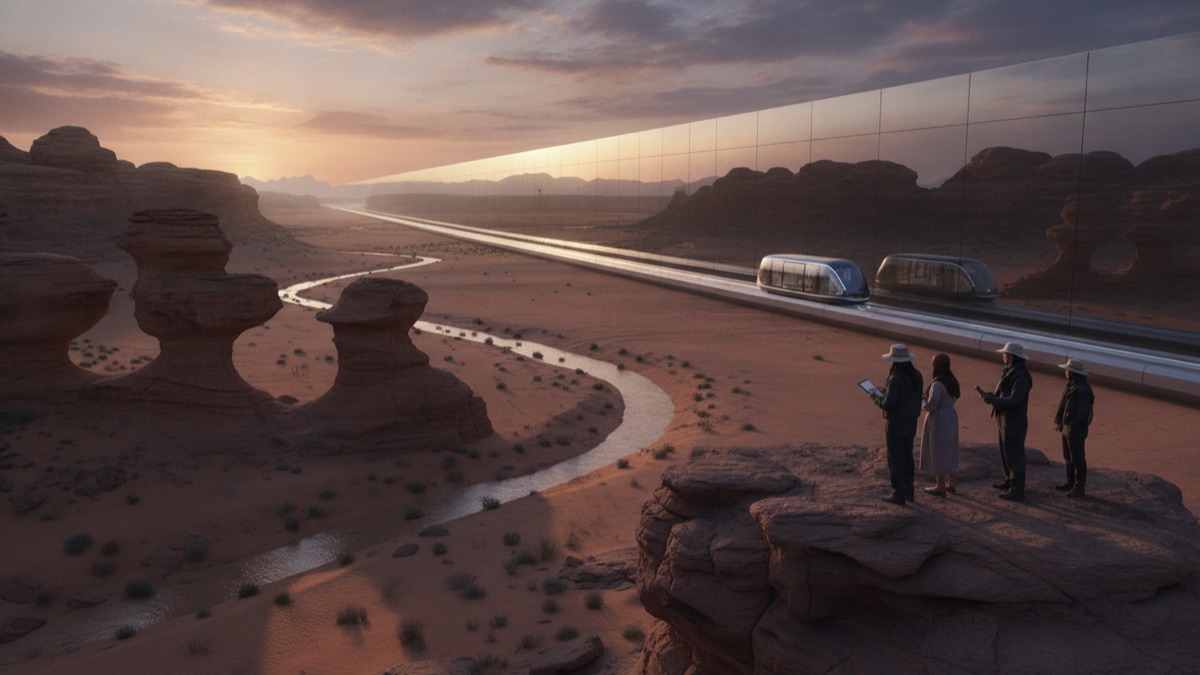
NEOM is Saudi Arabia's most ambitious giga-project, a planned region spanning approximately 10,200 square kilometers in the northwestern corner of the kingdom. The project includes several sub-developments, of which The Line, Oxagon, Trojena, and Sindalah are the most prominent. This article is not a technical explainer of those projects, but any travel guide to the Tabuk region must address what NEOM means for visitors.
Crucially, much of the NEOM coastline is currently closed to casual public access while infrastructure is under construction. However, the broader Tabuk region remains open, and travelers can already see the dramatic changes taking place — new roads, airports, resorts, and renewable energy installations. The NEOM Bay Airport has opened to limited commercial traffic, and some tourism offerings are beginning to operate on a controlled basis.
What makes NEOM relevant to travelers is its setting. The project has been designed around some of the most spectacular landscapes in Saudi Arabia: the Red Sea coast, the mountains of Trojena, and the coastline near the Gulf of Aqaba. When visitor access expands, the region will likely become one of the most talked-about destinations in the Middle East. For now, it remains a place to watch from the edges — and to explore the surrounding areas that have been quietly spectacular for millennia.
Visitors interested in NEOM should check the latest access rules directly with official channels, as regulations change frequently. Do not attempt to enter restricted construction zones, and respect all signage and security checkpoints.
Best Time to Visit
The Tabuk region has a desert climate with significant seasonal variation, especially in the mountains. The best time to visit is from November to March, when daytime temperatures are pleasant and nights can be cool, particularly at higher elevations.
| Season | Temperature | Best For |
|---|---|---|
| Winter (Nov-Feb) | 10-25°C | Hiking, sightseeing, camping |
| Spring (Mar-Apr) | 18-32°C | Wildflowers, diving, coastal drives |
| Summer (May-Sep) | 30-42°C | Coastal water activities only |
| Autumn (Oct) | 22-35°C | Desert trips, fewer crowds |
Winter is also the best time to see snow on Jabal Al-Lawz, though snowfall is not guaranteed every year. If you plan to camp in the desert, be prepared for cold nights even when days are warm. Summer visits are best limited to early mornings and late afternoons, with indoor or water-based activities during midday.
Where to Stay
Accommodation options in the Tabuk region are developing but still limited compared to Jeddah or Riyadh. Tabuk City has the widest selection, including international chain hotels, business hotels, and local guesthouses.
For a more immersive experience, many visitors choose to camp. Both coastal and desert camping are popular, and several local operators offer fully equipped glamping setups with tents, meals, and guides. These experiences are particularly memorable in Wadi Al-Disah and along the Sharma coastline.
Near the NEOM area, access-controlled stays may become available through the project's own hospitality channels. As of now, most travelers base themselves in Tabuk City or Duba and make day trips to the coast and interior.
Getting Around
The easiest way to explore the Tabuk region is by rental car or private 4x4. Public transport is limited, and many of the most interesting sites are far from main roads. Tabuk Regional Airport has direct flights from Riyadh, Jeddah, Dammam, and some international destinations including Egypt and Jordan.
Major highways connect Tabuk City to Duba, Al-Wajh, and the Jordanian border at Halat Ammar. The roads are generally in good condition, but always carry extra water, fuel, and a charged phone when traveling into remote areas. Mobile coverage can be patchy in wadis and desert areas.
For sites like Wadi Al-Disah and the remote Red Sea coves, a guide is strongly recommended. Local knowledge matters for navigation, safety, and understanding the cultural significance of the landscape.
Sources
- Visit Saudi Official Tourism Portal — Official destination information and travel guidance
- Saudi Tourism Authority — Regional tourism development and visitor resources
- NEOM Official Website — Official information about the NEOM region and access updates
- UNESCO World Heritage Centre — Heritage context for Hejaz Railway and archaeological sites
- Lonely Planet — Saudi Arabia — Practical travel advice and regional overviews
- Rough Guides — Saudi Arabia — Cultural and historical context for Tabuk and the northwest
- Encyclopaedia Britannica — Tabuk — Historical and geographical reference
FAQ
Where is Tabuk located?
Tabuk is in the northwestern corner of Saudi Arabia, near the borders with Jordan and Egypt across the Gulf of Aqaba. It lies along the historic trade and pilgrimage route between the Levant and the Hejaz region.
Can tourists visit NEOM?
Parts of the NEOM region are currently restricted while development continues. Some controlled visitor access exists through official channels, but casual public access to construction zones is not permitted. Check the latest rules before traveling.
What is Wadi Al-Disah?
Wadi Al-Disah is a dramatic valley in Tabuk Province known for its towering sandstone formations, palm groves, natural springs, and narrow canyons. It is one of the most beautiful natural landscapes in Saudi Arabia.
Does it snow in Tabuk?
Snow is rare but possible on Jabal Al-Lawz, the highest peak in Tabuk Province, during winter cold snaps. Lower elevations rarely see snow, but winter nights can be cold.
Is Tabuk safe for visitors?
Yes, Tabuk is generally safe for tourists. Standard travel precautions apply, especially when visiting remote desert or coastal areas. Travel with adequate supplies and inform someone of your itinerary.
What should I wear in Tabuk?
Modest dress is recommended. Women are not required to wear an abaya but should wear loose clothing covering shoulders and knees. Men should avoid shorts in town centers. Comfortable walking shoes and sun protection are essential for outdoor activities.
How do I get to Tabuk?
Tabuk Regional Airport has domestic flights from major Saudi cities and some international connections. The city is also reachable by road from Jeddah, Riyadh, and Jordan. Long-distance buses operate but are less convenient than flying or driving.
About the Author
doyouknow.app AI-assisted Editorial Workflow — This article was prepared with AI-assisted research and editing, using the sources listed on the page. It is not based on firsthand testing, on-the-ground reporting, or a claim of personal experience or professional credentials. Please check official sources for current details.
Loved This Article?
Share it on WhatsApp → Share on WhatsApp
Get more Saudi Arabia travel tips in your inbox — Subscribe to our newsletter for weekly surprising stories from Dubai, Saudi Arabia, and beyond.