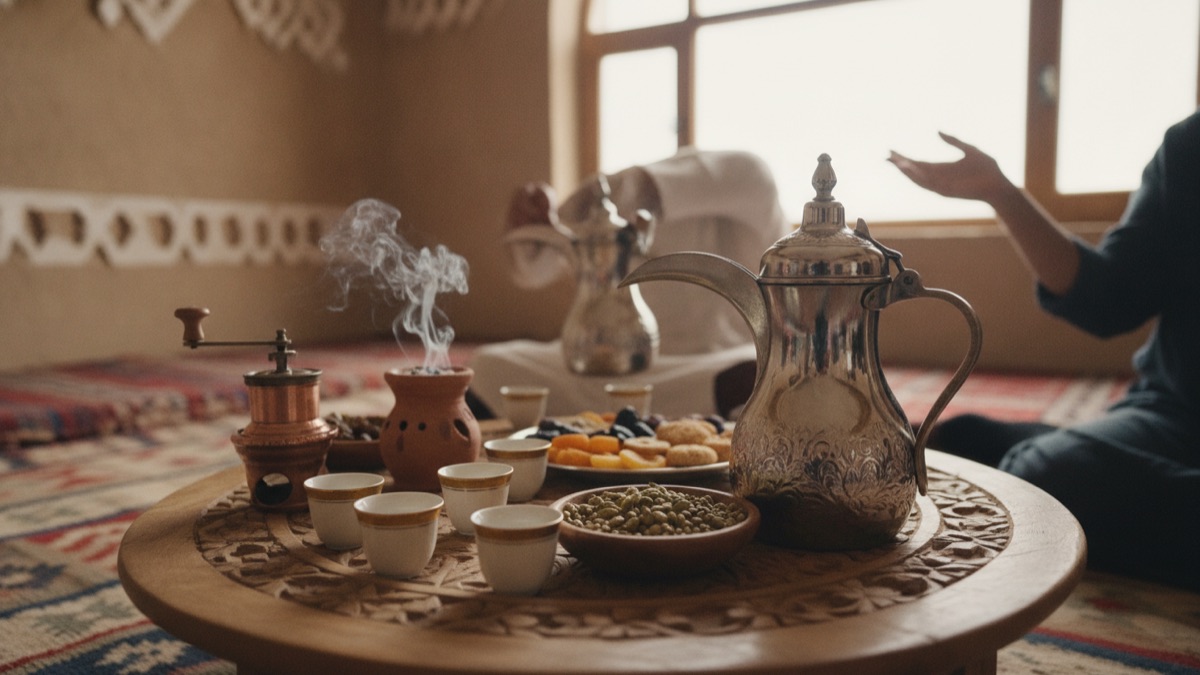
Qahwa: More Than a Drink in Saudi Arabia
In Saudi Arabia, offering coffee is not simply a matter of hospitality — it is a ritual, a social contract, and a symbol of welcome that has shaped Arabian culture for centuries. The Arabic word qahwa refers to the lightly roasted, cardamom-scented coffee that is served in small cups throughout the Gulf. But qahwa is far more than a beverage. It marks births, weddings, business meetings, funerals, and ordinary visits. To refuse it abruptly is considered rude; to accept it is to acknowledge the bond between host and guest.
Saudi coffee culture differs significantly from the espresso-based traditions of Italy or the filter-coffee culture of the United States. The coffee itself is pale gold rather than dark brown, lightly caffeinated, and heavily spiced. It is served in tiny handleless cups called finjan, usually accompanied by dates or sweets. A single serving is just a few sips, and the cup is refilled continuously until the guest signals they have had enough.
This guide explores the history, preparation, etiquette, and regional varieties of Saudi qahwa. It is a cultural explainer, not a health guide. Our focus is on understanding why coffee matters so deeply in Saudi society and how to appreciate it when you are invited to share a cup.
History of Qahwa in Arabia
Coffee's origins lie in the highlands of Ethiopia, where the coffee plant grew wild long before humans cultivated it. According to popular legend, a Sufi goatherd named Kaldi noticed that his goats became energetic after eating the red berries of a particular shrub. Whether or not Kaldi existed, the story points to a real historical shift: by the 15th century, coffee was being cultivated and consumed across the Red Sea in Yemen.
From Yemen, coffee spread north along trade routes into the Hejaz, the Najd, and eventually the Ottoman Empire. The port city of Mocha in Yemen became the center of the coffee trade, and Yemeni beans were prized across the Islamic world. Pilgrims traveling to Mecca and Medina carried coffee with them, helping it spread throughout Arabia and beyond.
Saudi Arabia adopted coffee with particular enthusiasm. In the arid interior of the peninsula, where alcoholic drinks were forbidden by Islamic law, coffee became the default social beverage. It accompanied religious study, poetry recitals, business negotiations, and tribal councils. By the 18th century, coffee houses had appeared in Mecca, Medina, and Jeddah, where scholars, merchants, and travelers gathered to discuss politics, theology, and literature.
The drink also acquired political significance. Coffee was taxed, debated by religious scholars, and occasionally banned by rulers who feared its stimulating effects might encourage dissent. Despite these controversies, coffee became deeply embedded in Arabian life. Today, Saudi Arabia is one of the largest consumers of coffee in the Middle East, and the tradition of qahwa remains central to national identity.
The Coffee Beans & Roast
Saudi qahwa is traditionally made from lightly roasted Arabica beans. The roast is much lighter than what most Western coffee drinkers are used to — often a pale cinnamon or tan color rather than the dark brown of espresso or French roast. This light roasting preserves the bean's natural acidity and allows the spices, particularly cardamom, to dominate the flavor profile.
The quality of the beans matters enormously. Historically, Saudi merchants imported Yemeni coffee through Jeddah and other Red Sea ports. Today, beans may come from Ethiopia, Colombia, Brazil, or other coffee-growing regions, but the preparation method remains distinctly Arabian. Some families still prefer beans from specific origins and will pay a premium for them.
Roasting is often done at home or in small shops just before brewing. Freshness is key: coffee that was roasted weeks ago is considered inferior. The roasting process is usually brief and uses low heat, with the roaster constantly stirring the beans to prevent burning. The sound of beans cracking and the aroma that fills the house are part of the sensory experience of qahwa preparation.
| Element | Saudi Qahwa | Typical Western Coffee |
|---|---|---|
| Roast level | Very light to light | Medium to dark |
| Serving size | Small cups, 60-90 ml | Mugs, 240-350 ml |
| Flavor profile | Cardamom, saffron, light bitterness | Chocolate, caramel, strong bitterness |
| Milk | Not used | Often added |
| Sugar | Rarely used | Often added |
How Saudi Qahwa Is Made
The traditional method of making qahwa is simple in ingredients but precise in technique. The basic tools include a long-handled pan for roasting, a mortar and pestle or small grinder, a brass or copper coffee pot called a dallah, and small cups called finjan.
The process begins with green coffee beans, which are lightly roasted in a flat pan over low heat. The beans are stirred constantly until they reach a light tan color and release a dry, grassy aroma. Some families add a tiny amount of oil or butter to the pan to help the spices adhere later, though this is not universal.
After roasting, the beans are cooled and then ground. In traditional households, the grinding is done by hand in a mortar with a pestle, which gives the host control over the texture. The grind is relatively coarse, similar to what might be used for filter coffee. The ground coffee is then placed in the dallah with water and brought to a gentle boil.
Cardamom is the defining spice. Whole green cardamom pods are lightly crushed and added to the pot. Some recipes also include a few strands of saffron, a pinch of cloves, or a small piece of dried ginger. The mixture is simmered for several minutes, then removed from the heat and allowed to settle so the grounds sink to the bottom.
The qahwa is poured slowly from the dallah into the finjan, leaving the sediment behind. The pour is almost a performance: a skilled host can produce a thin, steady stream that fills the cup without disturbing the grounds. The first cup is often the strongest, and subsequent cups become progressively lighter as more water is added to the pot.
Spices & Flavor
Cardamom is the soul of Saudi qahwa. Its bright, resinous flavor cuts through the natural bitterness of the coffee and gives the drink its refreshing quality. In some regions, the cardamom is ground with the coffee beans; in others, it is added whole to the pot. The amount varies by family and occasion — a generous host may use enough cardamom to make the coffee almost green in color.
Saffron is the second most common addition, especially in the Hejaz region along the Red Sea coast. It adds a subtle earthiness and a golden hue that makes the coffee visually striking. Cloves, cinnamon, and dried ginger appear in some regional recipes, though they are less common in mainstream Saudi preparation.
Importantly, Saudi qahwa is usually served without sugar. The natural sweetness of the dates served alongside the coffee provides balance. Some modern cafes offer sweetened versions, but traditionalists consider this a departure from the authentic taste.
Serving Etiquette
The ritual of serving qahwa follows a clear etiquette that visitors should understand. The host or the youngest person present typically holds the dallah and pours for everyone. Cups are filled only about one-third full, not because the host is stingy but because the coffee is meant to be consumed while hot and fresh.
The cup is taken with the right hand. It is acceptable to shake the empty cup slightly from side to side when you do not want a refill. If you simply place the cup down, the host will refill it. To signal that you are finished, you can wiggle the cup gently or tap it with your fingers.
Dates are the traditional accompaniment. The combination of bitter coffee and sweet date is considered ideal. In more formal settings, the qahwa may be served with maamoul date cookies, candied fruits, or other sweets. The order of service usually honors age and social status, with elders served first.
In bedouin and rural traditions, qahwa is the first thing offered to any guest, even before water. Refusing outright is considered insulting unless there is a strong reason. If you do not drink coffee, it is polite to accept the cup and hold it briefly before setting it down, or to explain your reason respectfully.
Regional Variations
Although qahwa is broadly similar across Saudi Arabia, subtle regional differences exist. These variations reflect local tastes, available ingredients, and historical trading connections.
Hijazi qahwa, from the western region around Jeddah, Mecca, and Medina, tends to be lighter and more fragrant. Saffron is more commonly used here, reflecting the region's Red Sea trade connections. The coffee is often served with distinctive Hijazi sweets such as aseeda or mamool.
Najdi qahwa, from the central region around Riyadh, is often stronger and more cardamom-forward. The harsh desert climate of the interior favored a more robust drink, and Najdi hospitality traditions emphasize frequent refills and generous use of spices.
Southern Saudi qahwa, from regions such as Jazan and Asir, sometimes incorporates local flavors including ginger and is influenced by Yemeni coffee traditions just across the border. The mountainous south has a cooler climate and a longer history of coffee cultivation.
Hail qahwa is known for being particularly light and elegant, served with local dates from the region's famous palm groves. The city's bedouin heritage places great emphasis on the ceremony of serving.
Modern Coffee Culture
In recent years, Saudi Arabia has experienced a specialty coffee boom. Cities like Riyadh, Jeddah, and Khobar now have vibrant cafe scenes serving pour-over, cold brew, and espresso-based drinks. International chains and independent roasters compete for customers, and young Saudis have embraced coffee as both a social activity and a form of personal expression.
Yet traditional qahwa has not disappeared. On the contrary, it has gained renewed prestige as a marker of Saudi heritage. Luxury hotels, government receptions, and national celebrations routinely serve qahwa from ornate dallahs. The Saudi government has promoted Arabic coffee as part of the country's cultural diplomacy, and UNESCO has recognized Arabic coffee as an element of intangible cultural heritage.
Many modern cafes now offer both traditional qahwa and contemporary coffee styles. This coexistence reflects a broader theme in Saudi culture: the preservation of heritage alongside rapid modernization. For visitors, this means you can experience qahwa in a Bedouin tent, a family home, or a sleek urban cafe — and each setting offers a different perspective on the same tradition.
Buying qahwa to take home is also popular. Souks and modern shops sell pre-ground qahwa blends, whole cardamom pods, and decorative dallahs and finjans. These make meaningful souvenirs, though nothing quite matches the experience of drinking qahwa as a guest in a Saudi home.
Sources
- UNESCO Intangible Cultural Heritage — Arabic coffee tradition recognition
- Saudi Tourism Authority — Cultural heritage and hospitality information
- Visit Saudi Official Tourism Portal — Saudi customs and cultural practices
- Encyclopaedia Britannica — Coffee — Historical background on coffee origins and spread
- Khan Academy — Coffee and the Islamic World — Educational context on coffee's role in the Middle East
- National Geographic — Cultural reporting on coffee traditions
- Al Jazeera — Coverage of Saudi coffee culture and heritage
FAQ
What is qahwa?
Qahwa is traditional Arabic coffee, especially the lightly roasted, cardamom-scented coffee served in Saudi Arabia and the Gulf. It is usually served in small cups without milk or sugar and accompanied by dates.
How is Saudi coffee different from Turkish or Italian coffee?
Saudi qahwa uses a much lighter roast than Turkish or Italian coffee and is heavily flavored with cardamom. It is not boiled to a foam like Turkish coffee and is not espresso-based like Italian coffee. It is also served unsweetened, with dates providing sweetness.
Why is coffee important in Saudi Arabia?
Coffee is central to Saudi hospitality and social life. Offering qahwa is a sign of respect and welcome, and the serving ritual plays a role in gatherings ranging from family visits to business meetings and weddings.
What are a dallah and finjan?
A dallah is the traditional long-spouted coffee pot used to brew and serve qahwa. A finjan is the small handleless cup in which qahwa is served. Both are often decorated and can be highly ornate.
Do Saudis drink coffee all day?
Qahwa is commonly served throughout the day, especially when receiving guests. Morning and evening are particularly common times. Specialty espresso-based coffee is also popular, especially in urban cafes.
Can tourists drink qahwa?
Yes. Visitors to Saudi Arabia are often offered qahwa in hotels, homes, offices, and traditional markets. It is polite to accept and to hold the cup in your right hand.
What food is served with qahwa?
Dates are the classic accompaniment. Other common pairings include maamoul cookies, candied ginger, chocolates, and regional sweets. The combination of bitter coffee and sweet food is considered ideal.
Where can I buy Saudi coffee?
Qahwa blends, cardamom, and traditional coffee sets are sold in souks, supermarkets, airports, and specialty coffee shops across Saudi Arabia. They are popular gifts and souvenirs.
About the Author
doyouknow.app AI-assisted Editorial Workflow — This article was prepared with AI-assisted research and editing, using the sources listed on the page. It is not based on firsthand testing, on-the-ground reporting, or a claim of personal experience or professional credentials. Please check official sources for current details.
Loved This Article?
Share it on WhatsApp → Share on WhatsApp
Get more Saudi Arabia travel tips in your inbox — Subscribe to our newsletter for weekly surprising stories from Dubai, Saudi Arabia, and beyond.